This youtube video by "Stated Clearly" introduces the basic mechanisms of evolution.
Friday, January 25, 2013


Tuesday, January 15, 2013
Gallup poll indicates students' loss of interest in school over time
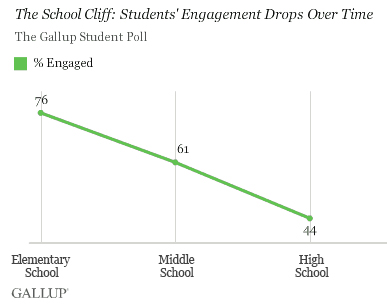
Albert Einstein said that "Education is what remains after one has forgotten what one has learned in school.“ Sadly, a recent Gallup survey of nearly 500,000 students from grades five through 12 from more than 1,700 public schools in 37 US states in 2012 suggests that students increasingly loose their interest in going to school in the first place. By the time students get to high school only about 4 in 10 qualify as engaged.
Larry Ferlazzo rightly points out that this is not a statistically valid survey as there was no random sampling involved; schools and students participated on a volunteer basis. However, the large sample size still provides an interesting dataset.
Another critique point is the measure for the construct "engagement". Here are some sample questions:
8. I have a best friend at school.
9. I feel safe in this school.
10. My teachers make me feel my schoolwork is important.
11. At this school, I have the opportunity to do what I do best every day.
12. In the last seven days, I have received recognition or praise for doing good schoolwork.
13. My school is committed to building the strengths of each student.
14. In the last month, I volunteered my time to help others.
9. I feel safe in this school.
10. My teachers make me feel my schoolwork is important.
11. At this school, I have the opportunity to do what I do best every day.
12. In the last seven days, I have received recognition or praise for doing good schoolwork.
13. My school is committed to building the strengths of each student.
14. In the last month, I volunteered my time to help others.
The data however fits well with other surveys who indicated waining interest in STEM education (See http://proto-knowledge.blogspot.com.au/2012/05/usa-fails-to-make-progress-in-stem.html)
Mark Twain suggested: Don't let school interfere with your education.
Source: A Bad Start to Lifelong Learning? - Mission to Learn - Lifelong Learning Blog
Thursday, December 6, 2012
Test your web searching skills
 |
| Connected information [Picture source: http://www.scientificamerican.com/media/inline/semantics-searching-intuitive-internet_1.jpg] |
The internet offers vast amounts of information. The challenge is to find desired information quickly.
These two fun online applications will test your abilities to locate information fast:
"A google a day": Using the google search engine, how quickly do find the answer to question to a given question?
"The Wiki Game": This game asks you to locate information within Wikipedia. The answer can only be found by clicking through related information within Wikipedia pages. The fewer jumps the better.
Want to improve your search skills? Click on the infograph below for helpful Google search tips. [See original infograph here]

Wednesday, December 5, 2012
The future of digital [Slideshow]
This extensive slideshow presents an interesting overview of the history, present, and future of digital spaces. [Click on "Slide Deck" below]
Friday, November 30, 2012
Knowledge Integration Maps (KIM)
.tiff/lossless-page1-800px-Knowledge_Integration_Map_(KIM).tiff.png) |
| Knowledge Integration Map (KIM) |
Knowledge Integration Maps (KIMs) have been developed at the University of California, Berkeley by Beat A. Schwendimann in the research group of Marcia Linn.
You can learn more about Knowledge Integration Maps in this Wikipedia article.
More about the research on Knowledge Integration Maps in my dissertation (available for free here).
Wednesday, November 28, 2012
Causes for the persistent denial of evolution
 |
| Source: https://blogger.googleusercontent.com/img/b/R29vZ2xl/AVvXsEiWFZbj8Rb3st3cV-wf4VGimgU0IpBZJVnDng91tAoTsL33oegAdf9igjR9kFZn-pvgEqyn97NIT7QOPW_yZhfx98NMrkw4M68pkN1c7I5qiJeQNkXvts7_s6w4PMs6wvpScoZ4g1IHrcg/s1600/denialism.jpg |
Read more here: http://nothinginbiology.org/2012/11/27/science-denial-is-rationa/
Unfortunately, the article doesn't have any concrete suggestions how to better promote scientific understanding and acceptance among religious people.
Building "A Young Lady's Illustrated Primer"

Neil Stephenson's book "The Diamond Age" presents a fascinating piece of educational technology called "A Young Lady's Illustrated Primer" (See diagram below).
The primer is an interactive book that can answer a learner's questions (spoken in natural language), teach through allegories that incorporate elements of the learner's environment, and presents contextual just-in-time information.
The primer includes sensors that monitor the learner's actions and provide feedback. The learner is in a cognitive apprenticeship with the book: The primer models a certain skill (through allegorical fairy tale characters) which the learner then imitates in real life.
The primer follows a learning progression with increasingly more complex tasks. The educational goals of the primer are humanist: To support the learner to become a strong and independently thinking person.
 |
| A Young Lady's Illustrated Primer Diagram [Click to Enlarge] |
For example, the IBM Watson computer can understand natural spoken language and give simple answers. Educational toy company LeapFrog developed the LeapPad - a tablet computer for children that resembles the "Young Lady's Illustrated Primer" - except for the goal of subversive critical thinking.
Another example, the teaching software for the One-Laptop-Per-Child (OLPC) wis directly inspired by the "Young Lady's Illustrated Primer". It is even named "Nell" (after the main protagonist in the novel).
Dvice.com posted an example of how children in a remote Ethiopian village use Nell. Nell uses an evolving, personalized narrative to help kids learn to learn without beating them over the head with standardized lessons and traditional teaching methods:
Miles from the nearest school, a young Ethiopian girl named Rahel turns on her new tablet computer. The solar powered machine speaks to her: "Hello! Would you like to hear a story?"
She nods and listens to a story about a princess. Later, when the girl has learned a little more, she will tell the machine that the princess is named "Rahel" like she is and that she likes to wear blue--but for now the green book draws pictures of the unnamed Princess for her and asks her to trace shapes on the screen. "R is for Run. Can you trace the R?" As she traces the R, it comes to life and gallops across the screen. "Run starts with R. Roger the R runs across the Red Rug. Roger has a dog named Rover." Rover barks: "Ruff! Ruff!" The Princess asks, "Can you find something Red?" and Rahel uses the camera to photograph a berry on a nearby bush. "Good work! I see a little red here. Can you find something big and red?"
As Rahel grows, the book asks her to trace not just letters, but whole words. The book's responses are written on the screen as it speaks them, and eventually she doesn't need to leave the sound on all the time. Soon Rahel can write complete sentences in her special book, and sometimes the Princess will respond to them. New stories teach her about music (she unlocks a dungeon door by playing certain tunes) and programming with blocks (Princess Rahel helps a not very-bright turtle to draw different shapes).
Rahel writes her own stories about the Princess, which she shares with her friends. The book tells her that she is very good at music, and her lessons begin to encourage her to invent silly songs about what she's learning. An older Rahel learns that the block language she used to talk with the turtle is also used to write all the software running inside her special book. Rahel uses the blocks to write a new sort of rhythm game. Her younger brother has just received his own green book, and Rahel writes him a story which uses her rhythm game to help him learn to count.
[Source: http://dvice.com/archives/2012/10/ethiopian-kids.php] Read more in this paper.
The video by CGP Grey outlines a vision for a individualized learning tool called "Digital Aristotle":
Subscribe to:
Posts (Atom)