Friday, March 30, 2012
Bloom’s Taxonomy and iPad apps
Labels:
Education,
Learning,
Learning Technology
Wednesday, March 28, 2012
Internet and global inequality
The internet promises the provide equal access to information independent of location. However, according to research by the Oxford Internet Institute (published in the book, Geographies of the World's Knowledge), user-generated content is not equally contributed: Especially the U.S. dominates the production of user content. The authors suggest that the causes for this could be a) that people in less developed countries have less leisure time to produce content for free, and b) that people without money can't afford education necessary to produce quality content.
Unfortunately, the internet is not a magic wand that makes the world more equal.Source: The Internet Does Not Solve Global Inequality - The Atlantic
Labels:
Education,
Information visualization,
Internet,
knowledge,
Publication,
Technology
Tuesday, March 27, 2012
Arguments against "Teaching the Controversy" in science education
![]() |
| Source: http://controversy.wearscience.com/ |
In a remarkable display of twisted thinking, the legislators stated that the bills aims to protect teachers from being "punished" for covering the "scientific strengths and scientific weaknesses of existing scientific theories" (I find it hard to believe that teachers in bible belt states have to fear punishment for criticising the theory of evolution). Despite the authors' affirmation that the bills "shall not be construed to promote any religious or nonreligious doctrine", they are quite obviously thinly veiled creationist agenda.
The goals of the bills sound noble: To "help students develop critical thinking skills they need in order to become intelligent, productive, and scientifically informed citizens." While "teaching the controversy" could indeed be used to improve science education, there are three (or more) arguments against implementing such a curriculum:
![]() |
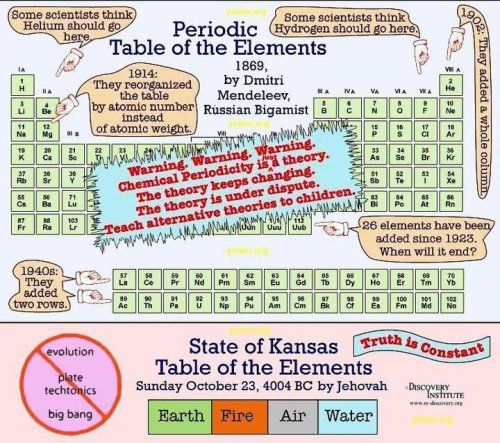
| The Periodic Table of the Elements is also just a theory! |
2) Time in science classroom is both limited and valuable. U.S. high school science teachers spend only an average of 13.7 hours on evolution (Berkman, et. al. (2008)). Building a deep understanding of complex scientific theories is hard cognitive work and takes time (even without spending time on non-scientific alternatives). Spending valuable time on alternative theories will take away valuable time that could be spend on helping students grasp accepted scientific theories. U.S. students are already lacking in scientific understanding (see PISA test results) and around 50% of U.S. citizens reject the theory of evolution (see survey results here).
![]() |
| Teach the Controversy |
- Geocentrism (rejected since the introduction of the theory of heliocentrism)
- Phrenology (abandoned due to lack of evidence)
- Aether theory (abandoned since introduction of theory of relativity and quantum theory)
- Impetus theory (abandoned since the introduction of the theory of gravity)
- Illness caused by bad odours (abandoned since the introduction of the theory of bacteria and viruses)
- Flat earth theory (abandoned since the introduction of the spherical earth theory)
- Four humors of the human body theory (abandoned since the advancement of physiology and modern medicine)
- Unchanging nature of organisms over generations (abandoned since the introduction of the theory of evolution)
- Four elements theory (abandoned since introduction of theory of chemical elements)
An integrated understanding of major scientific theories and the nature of science is important in a science-based democratic society to 1) make informed evidence-based decisions, 2) understand the complexity and inter-connectedness of the underlaying mechanisms behind natural phenomena (see Richard Dawkins' book "The magic of reality"), and 3) appreciate scientific theories as major human accomplishments (See more detailed discussion in essay "Why science education").
Sources:
- "Teach the controversy" science education bills advance in Tennessee, Oklahoma
- http://wpln.org/?p=35472
- Berkman, M. B., Pacheco, J. S., & Plutzer, E. (2008). Evolution and creationism in america's classrooms: A national portrait. PLoS Biology, 6(5), 920-924
Labels:
Biology,
Education,
Evolution,
School,
School Reform,
Science,
Science Education,
Teaching
Monday, March 26, 2012
Carl Sagan's "Cosmos" show reboot in 2013
![]() |
| Carl Sagan in "Cosmos" |
Fox has given the greenlight for a reboot of Carl Sagan’s iconic TV series Cosmos, to be hosted by well-known astrophysicist Neil deGrasse Tyson.
The original Cosmos: A Personal Voyage series ran on PBS in 1980 and was one of the most successful American public television series of all time, watched by an estimated 700 million viewers around the world. The reboot is expected to air in 2013.
I can highly recommend Carl Sagan's book "The Demon-Haunted World: Science as a candle in the dark" in which Sagan elaborates the difference between science and pseudo-science (for example astrology and UFO "research"). It also includes the helpful "Baloney detection kit" for detecting fallacious or fraudulent arguments.
Source: Seth MacFarlane to Produce Sequel To Carl Sagan's Cosmos | Geekosystem
Labels:
Astronomy,
Science,
Science Education,
Television
Thursday, March 22, 2012
Teachers as 21st century knowledge workers
![]() |
| 21st century teachers as knowledge workers |
A 2012 OECD study, headed by Andreas Schleicher, concludes that if schools systems want to be competitive in the 21st century they need to recruit and reward top teachers. The study suggests that teachers should be recruited from the top tier of university graduates (not the bottom third) and the teaching profession should be made more attractive to knowledge-age workers who are able to support children's learning in the digital age.
However, many high achieving knowledge workers are currently not attracted to work in schools settings that still operate on an industrial age model: Organised like an assembly line with strictly regulated hours, students grouped by age, and strictly artificial divisions between disciplines. Teachers are seen as interchangeable and replaceable. If technology is used, it is used in a very restricted way: Many schools limit free internet access and ban the use of social tools such as Facebook, Youtube, Wikipedia, and Twitter in the classrooms - tools which are essential for many knowledge age workers.
An knowledge age teacher must be able to model knowledge age work to students. For example, how to build and maintain a network of contacts through social media to exchange ideas with other
Knowledge-age workers want to be seen as professionals who continuously learn, adapt to new situations, creatively design instructional material, work on cross-discipline projects, and implement a wide range of technologies.
Becoming a teacher should not be a "last alternative" or a "higher calling without proper reward". Teacher education programs in Finland and Singapore are highly competitive (comparable to medical schools) and only accept 10% of applying top students. In return, graduates from teaching programs receive salaries competitive to other knowledge workers and have a high social status. Imagine a world in which you ask somebody for his/her profession and your response to him/her being a teacher is "Wow! You are a teacher!"
Two great examples for schools who see teachers as 21st century knowledge workers are High Tech High (in San Diego) and Northern Beaches Christian Schools (in Sydney). Read more here Reforming-schools-for-knowledge-age
![]() |
| UFM furniture for education |
Reforming schools for 21st century learning needs to happen on multiple levels (guided by a shared vision):
![]() |
| Reforming schools for 21st century teaching |
- Each NBCS student has a laptop (either a personal one or a school's one).
- The school uses a blended learning approach that combines online and offline learning environments. Teachers post activities and resources online which students access as starting points for their assignments. Students use different online learning environments in different grades (based on Moodle):"Primary uses PETE (Primary Education Through e-Learning) to manage research projects, submit and document work, assessments and day-to-day tasks, as well as a way of communicating with parents. Secondary’s LEARN environment is a tightly integrated portal for students and teachers to manage assessments, work and to provide course material. Class forums, wikis and other online tools enhance collaboration and allow students to work more effectively and efficiently - even when at home. Senior students from schools around NSW use HSC Online for online course delivery." Despite (and because) students' accessto a wide range of online material, NBCS understands that students need clear boundaries and structures (for example posting indecent pictures or cyber-bullying). The school employs web-designers to create and support the online learning environment and teaches its teachers how to create online activities.
- NBCS does not use bells (as "there are no bells in real life"). Instead, teachers (and students) decide when it is time for a break ("periods" are called "learning sessions") or to change topics.
- In middle school, students of different ages work together in mixed groups which are facilitated by multiple teachers. This gives students the opportunity to work with different teachers and students of different ages. Students are encouraged to be independent learners who know best with whom, where, and how they learn best: Some prefer working alone, in pairs, or in groups; some like sitting on a table, laying on a couch or on the carpet; some prefer quiet, talking, or music.
- NBCS teachers hardly lecture. Their work consists of designing learning activities and facilitate students in class. Teachers model knowledge-age skills by having their own professional blogs, youtube channels, and twitter feeds; by connecting with experts outside of schools for projects; by organising online and in-school exhibits open to the public; by publishing innovative instructional material in teacher forums and presenting at conferences.
- The school understands that innovative pedagogy also needs innovative physical spaces: Inspired by creative design spaces (such as architecture bureaus and design studios), NBCS replaced small classrooms with open-floor multi-purpose "learning spaces" with versatile furniture that fosters collaboration and re-arrangement (created by UFM solutions).
![]() |
| NBCS middle school learning space |
- Teachers attend a "skill workshop"every Friday afternoon where they explore new technologies or activities. Taking innovation to all levels, teachers try out new forms for meetings in their own meetings.
- Teachers frequently integrate current technology such as iPod/iPad apps, SecondLife, moodle, or google maps.
- Teachers record their sessions through hover cams (document cameras) and digital pens to make them available online. After hours, students can contact their teachers by email or text message. For example, a student might send the teacher a screenshot of a math problem he/she is struggling with. The teacher uses screen recording software to record his response to the student. The teacher then uploads the screen recording for other students who might have a similar issue.
- Traditional classrooms have rows of benches with students facing the teacher standing at the whiteboard. At NBCS, most walls have been turned into whiteboard walls (using idea paint). This allows teachers and students to use a shared drawing area wherever they are in the room. The design of the physical space follows the socio-cultural perspective of learning that centers on students learning from each other (with the teacher as a facilitator): Instead of facing the teacher (as the center of attention), students sit around smaller tables facing one another.
For inspiration, see A vision of the classroom of the future.
![]() |
| Northern Beaches Christian School (NBCS) learning space |
Consider this:
"In 1900, 8 out of 10 jobs involved building things with your hands. In 2010, 8 out of 10 jobs will involve working with ideas. In large part, the bricks and mortar of the industrial age have been replaced. Concepts and connections now lay the foundation for the 21st Century. A recent survey of over 400 employers in the US shows thinking skills are among the most important skills found in new hires. Whether the goal is professional success, personal self-fulfillment, national competitiveness in science and technology, or solving complex global problems, new skills are needed to thrive. The 21st century knowledge age requires people: to be adept thinkers and learners; to use and build knowledge; to differentiate and combine, compare and contrast, and construct and deconstruct ideas. In short, in the knowledge age people will need to be knowledge-able." (Source: Edgewood College, Madison, Wisconsin)
It is time to bring schools from the industrial age to the 21st century knowledge age. This can only be achieved through visionary leadership (by policy makers and principals) and attracting high-achieving knowledge-age teachers.
A more radical step would be to reconsider the public education system from the ground up. If the public education system would be designed from scratch to meet the needs of the knowledge age, the outcome would not be our current school system. Innovative schools like NBCS or High Tech High lead the way, but they only reach a relatively small number of students. The question remains how innovation can be scaled up to improve the entire school system.
"In 1900, 8 out of 10 jobs involved building things with your hands. In 2010, 8 out of 10 jobs will involve working with ideas. In large part, the bricks and mortar of the industrial age have been replaced. Concepts and connections now lay the foundation for the 21st Century. A recent survey of over 400 employers in the US shows thinking skills are among the most important skills found in new hires. Whether the goal is professional success, personal self-fulfillment, national competitiveness in science and technology, or solving complex global problems, new skills are needed to thrive. The 21st century knowledge age requires people: to be adept thinkers and learners; to use and build knowledge; to differentiate and combine, compare and contrast, and construct and deconstruct ideas. In short, in the knowledge age people will need to be knowledge-able." (Source: Edgewood College, Madison, Wisconsin)
It is time to bring schools from the industrial age to the 21st century knowledge age. This can only be achieved through visionary leadership (by policy makers and principals) and attracting high-achieving knowledge-age teachers.
A more radical step would be to reconsider the public education system from the ground up. If the public education system would be designed from scratch to meet the needs of the knowledge age, the outcome would not be our current school system. Innovative schools like NBCS or High Tech High lead the way, but they only reach a relatively small number of students. The question remains how innovation can be scaled up to improve the entire school system.
Labels:
knowledge,
Learning,
Learning Technology,
School,
School Reform,
Teaching,
Technology
TED launched TED for Education (TED-Ed)
TED (Technology, Entertainment, Design) launched a new section focused on education issues: TED-Ed.
For a start, TED-Ed added 15 videos to their YouTube channel. Some of them enhance the talk through animations, for example see "How Simple Ideas Lead to Scientific Discoveries" by MythBusters' Adam Savage below.
Celebrating over 80,000 visits to Proto-Knowledge!
Labels:
proto-knowledge,
Statistics
Wednesday, March 21, 2012
Chronozoom: A dynamic view of history, the universe, and everything
Chronozoom is an innovative dynamic animation of the history of the universe.
In their own words:
"ChronoZoom is an open source community project dedicated to visualizing the history of everything to bridge the gap between the humanities and sciences using the story of Big History to easily understand all this information. This project has been funded and supported by Microsoft Research Connections in collaboration with University California at Berkeley and Moscow State University.
You can browse through history on ChronoZoom to find data in the form of articles, images, video, sound, and other multimedia. ChronoZoom links a wealth of information from five major regimes that unifies all historical knowledge collectively known as Big History."
Try out ChronoZoom here.
Labels:
Animation,
Astronomy,
History,
Information visualization,
knowledge visualization,
Science,
Science Education
Tuesday, March 20, 2012
Open access to research journals
![]() |
| (Source: http://www.tdl.org/2010/02/open-journal-systems-and-academic-freedom/) |
A current boycott of over 8,000 researchers of one of the largest academic publishers, Elsevier, aims to expose and change their agressive business practices (See The Cost of Knowledge).
It is in the very nature of academic knowledge that it should be widely accessible. More and more researchers are looking into alternatives, for example by making their articles available for free on their own websites, or by publishing in Open Access journals (see Directory of Open Access Journals or Public Library of Science (PLoS) journals).
Read more about Open Access of academic journals here.
Labels:
knowledge,
Publication,
research
Thursday, March 15, 2012
Daily data flow on the Internet
Labels:
Info,
Infograph,
Information visualization,
Internet,
Technology
Monday, March 12, 2012
Science and math education in the U.S.
Labels:
Education,
Mathematics,
Science Education,
STEM
The Gamification of Education
Labels:
Computer,
Education,
Game,
Infograph,
Learning Technology
Thursday, March 8, 2012
The Jedi Career Path
| The Jedi Path (Source: Wookieepedia) |
I created the diagram below to illustrate the different career paths of a Jedi (in the time of the Galactic Republic) [Click to Enlarge]:
![]() |
| The Jedi Career Path |
If a Jedi Padawan passed the Jedi trials and became a Jedi Knight, he/she could join one of three branches: Jedi Guardian (typically blue lightsabers), Jedi Consular (typically green lightsabers), or Jedi Sentinel (typically yellow lightsabers).
From an educational perspective, the Jedi career path is a good example of apprenticeship learning: An initiate becomes part of a community of practice, mentored by a practicing master who assigns increasingly more challenging tasks, and learns from observing the master in action. Such situated learning is often used in trades, music, martial arts and other sports.
Labels:
Concept Map,
Geek,
Information visualization,
Learning,
Science Fiction
Subscribe to:
Posts (Atom)