Showing posts with label Religion. Show all posts

Wednesday, December 2, 2015

A short history of Santa Claus - from saint to secular

Santa Claus (Coca Cola version)
Santa Claus is a complex social-cultural phenomenon that developed over centuries.

  • Historically, Santa Claus is based on Bishop Nicholas of Myra who lived from 280-343 a.D. in Greece. He was made a Saint in 900 a.D. His Saints Day is December 6, which is the traditional 'Santa Claus' day in many European countries. St. Nicholas gave money and gifts to children but he did not like to be seen when he gave away presents. Therefore, he left his presents during the night. This turned into the modern day practice of telling children that Santa Claus will not arrive unless the children go to sleep early.
  • Leaving food: The catholic saint was merged with non-christian figures, such as Father Christmas and the Norse god Odin. During Yule time, Odin would visit every house on his horse Sleipnir. Children  would place their boots near the chimney (or outside of the door) with food for Sleipnir. During the night, Odin would enter the house through the chimney and reward them for their kindness with food, candy or gifts. The tradition still continues in Belgium, Germany and the Netherlands. The food for Sleipnir became milk and cookies for Santa; the boots become stockings hung on the chimney. Other norse influences are the Yule log and the mistletoe (Read more about the mistletoe tradition here). 
  • Influences: The modern Santa Claus was most strongly defined by Dutch and American influences. In the Netherlands, the figure is called 'Sinterklaas'. Dutch settlers brought the 'Sinterklaas' tradition to the US where the name changed into 'Santa Claus'. After arriving in the US, several poems, songs, and stories extended and changed the figure of Santa Claus. Instead of a horse, he now used reindeer. His workshop was placed at the North Pole, he was given an army of elves, and a wife (Mrs Claus was added by a 1956 popular song by George Melachrino, "Mrs. Santa Claus", and the 1963 children's book How Mrs. Santa Claus Saved Christmas, by Phyllis McGinley). 
  • Animals: In Europe, Santa Claus uses either horse, a donkey, or reindeer. In the US, his animals changed, most importantly due to the 1823 story "A Vist From St. Nicholas", better known today as "The Night Before Christmas". In this poem eight reindeer were introduced as Dasher, Dancer, Prancer, Vixen, Comet, Cupid, Dunder and Blixem (Dunder and Blixem came from the old Dutch words for thunder and lightning, which were later changed to the more German sounding Donner and Blitzen). The ninth, and most famous reindeer, was not added until 1939 by a poem about Rudolf the Red Nose Reindeer by Robert L. May of the Montgomery Ward Company; followed by the popular 1949 song by Johnny Marks about "Rudolph the Red-Nosed Reindeer".
  • Helpers: The European 'Sinterklaas' or 'Samichlaus' has often a helper called 'Black Peter/ Père Fouettard'. While Santa is the friendly gift-giver, Black Peter's job is to punish children who did not behave well. Similar to Black Peter, several European Alpine regions know a devil-like creature called Krampus who punishes naughty children. In Germany, Santa is linked to angel-like baby Jesus ('Christ Child') who brings gifts. The German word 'Kristkind' became Santa Claus' name 'Kris Kringle'. In the US tradition, Santa has a workshop full of elves who make all the gifts. However, in several Scandiavian countries, Santa is an elf himself (called Nisse or Tomte).
  • Outfit: In many European countries, Santa Claus wears a Bishop's attire. In the US, his religious looks were changed to a more secular apparel (a fur-lined red suit and a soft hat). Santa's outfit became standardized through the 1920s and firmly established through the work of Coca-Cola Company commissioned illustrator Haddon Sundblom who developed advertising images using Santa Claus in 1930.
Santa Claus can therefore be considered a product of cultural globalization and a merger of many traditions.

The Origin and Evolution of Santa Claus
by herrimanjoe. From Visually.


Thursday, September 26, 2013

Can Scientists be Atheists?


Prominent scientists, for example Richard Dawkins and Sam Harris, promote the idea that atheism and science are inherently linked and in support of one another (Wikipedia list of atheist scientists). However, this essay questions the validity of using science to support atheist viewpoints.

There are three different questions that need to be answered. First, do you believe that a higher being (deity, God) exists? Second, if yes, what is the nature of that higher being? Third, do you believe that you can gain knowledge (revelation) about the nature of a higher being? See figure 1.


Figure 1: Nature of God decision diagram
The first question (nature of a higher being) can be answered in three different ways:

  • Theism: Belief in the existence of a higher being who is responsible for the initial formation of the universe and continues to causally interact (personal God). As a theist deity continues to interfere with the world, the actions of a theist deity can be experienced (Religion with revelation).
  • Deism: Belief in the existence of a higher being who is responsible for the initial formation of the universe only, but does no longer interfere (impersonal God). As a deist deity no longer interacts with the world, the deity itself cannot be experienced (Religion without revelation).
  • Atheist: An atheist is a person who is certain that no deities exist (strong/hard atheist). An atheist rejects the existence of deities and holds the position that there are no deities.

The second question can be answered in two different ways:

  • Gnostic: Belief that one can gain knowledge of the nature and existence of a higher being.
  • Agnostic: Thomas Henry Huxley, who coined the word “agnostic” in 1869, defined it as: “Agnosticism is not a creed but a method, the essence of which lies in the vigorous application of a single principle... Positively the principle may be expressed as in matters of intellect, do not pretend conclusions are certain that are not demonstrated or demonstrable.“ An agnostic believes that nothing can be known of the existence or nature of deities (or of anything beyond material phenomena). An agnostic is a person who claims neither faith nor disbelief in God.

Answering the two basic questions allows for several combinations (See diagram). For example, Christians are (typically) gnostic-theists (belief that there exists a personal higher being that interacts with the world and that one can learn about the nature of this deity).

Many prominent scientists label themselves as atheists, but does science provide a basis to for atheism? Can a person, in his or her role as a scientist, know about the nature of deities (that are transcended = above natural principles) based on scientific evidence?

The answer must clearly be no. From a (simplified) epistemological point of view, science constructs falsifiable models that aim to explain repeated observations of phenomena in the natural world. 
By definition, science does not and cannot make statements about “super”-natural phenomena (phenomena that are outside of the laws of nature). The method of science only deals with the natural world. Statements about the existence and nature of deities lay outside the realm of science and scientists. Science does not provide the tools for gnosis (revelation). A theistic view would be in conflict with scientists' understanding of natural processes, as a theist deity could causally interfere and therefore alter natural processes at will, which could be empirically observed and tested. As science cannot make statement about supernatural deities, it does not support atheist viewpoints. I think the only possible position for a scientist is agnostic. Only agnostics hold the view that we cannot know about deities - because it is a question outside of the realm of science.
The Dutch philosopher Baruch Spinoza asked an important fourth question: What do we mean by “God”? Spinoza disagreed with Descartes about the duality between mind and body and concluded that everything that exists in Nature (=everything in the universe) is one and the same reality. Therefore, as everything is subject to the same set of rules,  “God” is no longer an entity outside of the system. “God” and “Nature” become synonymous terms. Spinoza viewed “God” not as an entity outside of nature (super-natural) but as an emergent property of the complex system of nature itself. Spinoza’s God is the embodiment of all intricately connected laws of nature. From this viewpoint, scientists could be considered religious knowledge seekers as they study the patterns of nature (aka “God”) (See figure 2). Not surprisingly, many scientists since the enlightenment shared Spinoza’s views of God, including Albert Einstein. Einstein said “I believe in Spinoza's God who reveals himself in the orderly harmony of what exists, not in a God who concerns himself with fates and actions of human beings.” (New York Times, April 25, 1929).


Figure 2: Spinoza's God
Spinoza’s view of God even aligns with hard-core atheists like Richard Dawkins. Richard Dawkins argued that he is an “atheist” because in his work as a scientist he (so far) never needed to add “God” as a variable to explain a natural phenomenon. In Spinoza’s view, “God” is not an external variable but all variables combined. It can be assumed that most self-proclaimed atheists would not have an issue with Spinoza’s view of God but only with the idea of a personal God (theism) (who can meddle with humans and natural laws at will). Most “atheists” would therefore be more accurately described as “anti-theists”.

This essay concludes with two statements. First, whenever you make a statement about “God” you should disclose in which role you are making this statement: As an individual you are (and always should be) free to believe whatever you like. However, if you make a statement in your role as a scientist, then you are bound to falsifiable statements and evidence. Science, by its very definition, does not provide the tools to prove or disprove the existence or non-existence of supernatural deities. Astrophysicist Neil DeGrasse Tyson describes himself as an “agnostic”. E.O. Wilson stated "I would even say I’m agnostic because I’m a scientist. Being an agnostic means saying, dogmatically, that we will never be able to know, so give it up." (Source). Even Richard Dawkins doesn't describe himself as a strong atheist but as a "de-facto atheist" (which refers to the belief that while god(s) cannot be absolutely proven not to exist, their existence could be provisionally described as extremely improbable) [which aligns with the view of science]. When talking about supernatural deities, the only position a scientist can take is agnostic. An agnostic answers the question “Is there a God?” with “I don’t know because I cannot know”. Second, when talking about God you should always clarify what you mean by “God”: Do you consider God a personal or impersonal entity? Do you consider God to be outside of nature or an emergent property of nature itself? Applying some philosophical rigor (and tolerance) to religious discussions could avoid many misunderstandings and unproductive arguments.


Also, see this video on the discussion an atheism.


Astrophysicist Neil deGrasse Tyson describes himself as "agnostic":


Pablo Stanley's comic sums up the four different position on the gnostic/agnostic vs theist/deist axis:

Wednesday, November 28, 2012

Causes for the persistent denial of evolution

Source: https://blogger.googleusercontent.com/img/b/R29vZ2xl/AVvXsEiWFZbj8Rb3st3cV-wf4VGimgU0IpBZJVnDng91tAoTsL33oegAdf9igjR9kFZn-pvgEqyn97NIT7QOPW_yZhfx98NMrkw4M68pkN1c7I5qiJeQNkXvts7_s6w4PMs6wvpScoZ4g1IHrcg/s1600/denialism.jpg
Why are many people resistant to accept the theory of evolution despite the overwhelming evidence? The blog post below from NothingInBiology discusses three studies that explore why some people reject science over religious views.

Read more here: http://nothinginbiology.org/2012/11/27/science-denial-is-rationa/

Unfortunately, the article doesn't have any concrete suggestions how to better promote scientific understanding and acceptance among religious people.

Saturday, August 20, 2011

Strategies for how to live forever

Every human is mortal. Our time on earth is limited. This ultimate truth motivates us to find ways to overcome our mortality.

For example, 
A) by extending your lifespan [body immortality], 
B) by preserving your unique self [mind and soul immortality], or 
C) by creating a legacy that reminds people of you [social immortality].

[Click to enlarge]
There are different strategies to delay or beat the inevitable [See concept map above].

Social immortality: You can try leaving a legacy that reminds people of your unique self, for example by creating artwork (writing books, composing songs, paint a picture, etc.) or donating money (aka to have something named after you).

Mind immortality: You can try preserving your unique mind, either actively by uploading your mind (see technological singularity), or passively by passing on your ideas (for example through educating your children or through your artwork).

Body immortality: You can try preserving your body as long as possible through a healthy diet, sports, and medicine. Beyond that, you can enhance your body through robotic replacement parts, freeze your body (cryogenics), or use cloning (to get new body parts). The most common way to achieve body immortality is passing on your genes to your children. This comes with the additional benefit that you can also pass on some of your values and ideas to your children [See mind immortality].

Soul immortality: The concept of an immortal part of ourselves - the soul - is promoted by numerous religions. 

People are often heavily invested in a particular belief system that promises eternal life. Many wars have been fought over different immortality systems [For example, see the interesting and humorous book on death and afterlife "Heidegger and a Hippo walk through those Pearly Gates"].

No matter what immortality strategy you pursue, ultimately we are all on the same level - we are all mortal and should try to make the best out of the limited time we have.

Some more ideas for how to extend your life [see infograph below]:

Tuesday, March 8, 2011

Ongoing debate between evolution and creationism


More than 150 years after Charles Darwin published his seminal work On the Origin of Species by Means of Natural Selection, people are still divided over accepting and understanding evolution. While the theory of evolution is firmly established in the scientific community, large parts of the general population across the world, from young children to college-educated adults, continue to reject evolution ideas. Understanding and accepting evolution ideas is seen as central to building an integrated knowledge of biology by many scientists and science educators.

Scientific American has a great collection of articles on the ongoing debate between evolution and creationism: Creationism Vs. Evolution: In-Depth Reports

Thursday, February 17, 2011

Vatican endorses possibility of alien lifeforms


[Excerpt from Huffington Post article] Believing that the universe may contain alien life does not contradict a faith in God, the Vatican's chief astronomer, Rev. Jose Gabriel Funes, said in an interview published Tuesday. Funes said that the possibility of extra-terrestrial life "doesn't contradict our faith" because aliens would still be God's creatures.
The Bible "is not a science book," Funes said, adding that he believes the Big Bang theory is the most "reasonable" explanation for the creation of the universe. But he said he continues to believe that "God is the creator of the universe and that we are not the result of chance." Read full article here: Vatican: It's OK To Believe In Aliens


This latest statement of the Catholic church follows a recent trend to try bringing church and modern science closer together. Pope John Paul II was reported as saying that evolution is "more than just a theory", while Benedikt XVI accepted the Big Bang theory as an explanation how the universe was created. Read more about the new conciliatory approach of the Vatican to bring science and religion closer together.

Wednesday, February 9, 2011

Bringing Religion and Science together on Evolution Weekend


This weekend, Feb 11-13 2011 is the sixth annual Evolution Weekend. The event is sponsored by The Clergy Letter Project, an organization of more than 14,000 clergy members and evolution scientists that aims to find common ground between science and religion. 


Participants span a wide range of different christian denominations, Jews and Muslims; different ethnicities; Males and females; old and young; conservatives and liberals.

Being celebrated on the weekend closest to the birth of Charles Darwin (Feb. 12, 1809), Evolution Weekend participants aim to demonstrate that the modern theory of evolution and modern religious faith are fully compatible.

Sunday, February 6, 2011

Indian Supreme Court declares Astrology a Science


According to The Times of India, an Indian NGO called Janhit Manch filed the public interest litigation. But as the Supreme Court of India has already ruled that astrology is a science, the Mumbai High Court dismissed the case on February 3rd 2011. So far as prayer related to astrology is concerned, the Supreme Court has already considered the issue and ruled that astrology is a science. The Court had in 2004 also directed the universities to consider if astrology science can be added to the syllabus. The decision of the apex court is binding on this court.

This incidence reflects the struggle India finds itself in: Establishing India as an urban technology and science power, while large parts of the population are strongly religious and believe in astrology (including Supreme Court judges).

Read more here: Short Sharp Science: Indian court considers astrology a science

Wednesday, January 12, 2011

On the Catholic Church and Science

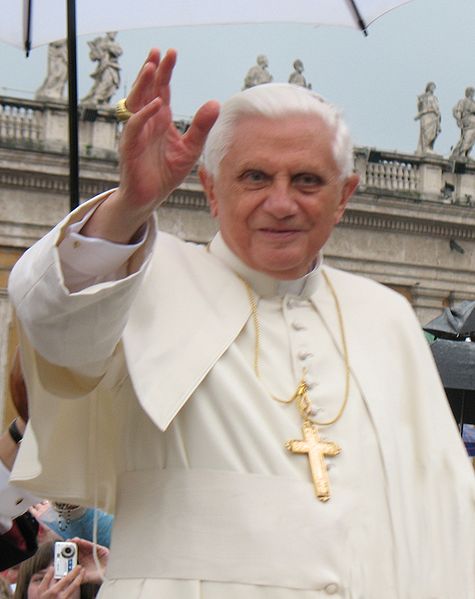
Pope Benedikt XVI
According to a news release by the Vatican Information Service on October 23, 1996, Pope John Paul II was reported as saying that evolution is "more than just a theory." This seems to mean that the Catholic church now considers evolution a scientific fact. (See Pope accepts Evolution).


Before that, Pius XII, in his famous 1950 encyclical "Humani Ceneris" made a point of allowing Catholics to study and accept evolution as a scientific theory of origins, again with the limitation that God created the soul, and that all men are descendants of Adam, along with the doctrine of original sin as inherited from Adam.


Now the current pope, Benedikt XVI, accepts the Big Bang theory as an explanation how the universe was created - as long as Catholics see the Big Bang as God's work. Benedikt XVI said that "God's mind was behind complex scientific theories such as the Big Bang, and Christians should reject the idea that the universe came into being by accident". (Read more here: NewsDaily: God was behind Big Bang, universe no accident: Pope)


Given how the Catholic church treated scientists like Galileo in the past, I guess this is step in the right direction.

Friday, December 17, 2010

Discussion on Evolution and Religion (Video)

Eugenie C. Scott, Francisco Ayala, and Denis Lamoureux in an interesting discussion on the intersection of faith and evolution (Hosted by NPR's Neal Conan) [Watch other informative videos on evolution, religion, and education on the youtube channel of the National Center for Science Education]

Monday, December 13, 2010

Why do people kiss under the mistletoe?


By Beat Schwendimann


Most types of mistletoe are classified as hemiparasitical (i.e., partial parasites), as they are capable of photosynthesis. Mistletoe lives on trees. Being evergreen, mistletoe stays green in the winter, even after the host tree lost all its leaves. This made mistletoes a symbol of life. Celtic druids considered mistletoe a sacred plant. The word "mistletoe" originated from the misconception that mistletoes would grow on branches from bird excrements. 'Mistel' is the Anglo-Saxon word for 'dung,' and 'tan' is the word for 'twig'. So, mistletoe means 'dung-on-a-twig'."

The romantic tradition of kissing under a mistletoe originates from Norse mythology. In a Norse myth, Mistletoe was said to be the sacred plant of Frigga (also called Freya; "Friday" (Freya's Day) is named after her), the goddess of family and love. Frigga has the power of prophecy and dreamed of her son Balder's death. When Balder (or Baldur) was born, Frigga made each and every plant, animal and inanimate object promise not to harm Baldur. But Frigga overlooked the mistletoe plant. Balder’s enemy, the trickster god Loki, fashioned an arrow from mistletoe and gave it to Balder's brother Hoder, the blind god of winter, who tragically killed the otherwise invulnerable Balder with it. The demise of Baldur, a vegetation deity in the Norse myths, brought winter into the world. He was brought back to life by his mother when she shed tears that turned into Mistletoe berries, so Frigga kissed everyone who passed under the tree on which it grew. Frigga declared the mistletoe sacred, ordering that from now on it should bring love rather than death into the world. From that time on, anyone who stood under the mistletoe would receive a kiss and no harm could come to him. Happily complying with Frigga's wishes, any two people passing under the plant from now on would celebrate Baldur's resurrection by kissing under the mistletoe.
Baldur's Death (Woodcarving at Oslo City Hall)
Originally, the custom was that young men have the privilege of kissing the girls under it, plucking each time a berry from the mistletoe. When the berries were all plucked the privilege ceased. Today, we have conveniently forgotten the part about plucking the berries (which, incidentally, are poisonous).


References:
More info in this extensive essay about the biology and traditions of the mistletoe: Kissing Under the Mistletoe. A description of different mistletoe traditions can be found here.

Thursday, December 9, 2010

Kentucky plans Creationist Theme Park "Ark Encounter"

Ark Encounter Theme Park in Kentucky
A planned creationist theme park in Kentucky, "Ark Encounter", which will feature a 500-foot-long wooden replica of Noah’s Ark containing live animals such as juvenile giraffes, is projected to cost $150 million. The park, to be located on 800 acres in Grant County off Interstate 75, also will include a Walled City, live animal shows, a replica of the Tower of Babel, a 500-seat special-effects theater, an aviary and a first-century Middle Eastern village.


The main forces behind the theme park are Ark Encounters LLC, the young-earth creationist ministry Answers in Genesis, which already operates a Creation "Museum" in northern Kentucky, and the governor of Kentucky, Steve Beshear. The theme park will receive state tourism development incentives.


The Kentucky governor Beshear touted the benefits of the park to the state's economy by creating an expected 900 full- and part-time jobs after its completion and attract 1.6 million visitors in the first year. Nevertheless, I think it is very questionable if a governor endorses a religious project (aka separation of church and state) - not to speak of the highly questionable message of young-earth-creationists. The Ark Encounter park and the Creationist museum aim to present creationism as scientifically valid alternative to evolution.


Understanding evolution is central to understanding modern biology. 50% of US americans already reject the idea of evolution. National and international studies (see PISA study 2010) report that the US keeps falling further behind in science education. Projects like this creationist theme park and the creationist museum are certainly not helping to increase scientific literacy in the US.


Controversy over proposed creationist theme park | NCSE

Tuesday, December 7, 2010

Mysticism vs Science: The tragic case of the eruption of Mount Merapi


Mount Merapi volcano
A massive eruption of Mount Merapi in Indonesia occured in October 2010. Seismologists detected the upcoming eruption early enough and asked people in the surrounding villages to evacuate.


Most people complied, but one group of people decided to stay - and died in the following volcanic eruption. Why did they refuse to evacuate? (See PBS video below)


A respected local man, named Marijan, who is considered the "gatekeeper" of the volcano, insisted that there was no danger and refused to leave. His words carried weight because he was the so-called gatekeeper of the volcano. In the world of Javanese mysticism, the gatekeeper protects the people of Yogyakarta by communicating with the spirit of the volcano, Grandfather Merapi. More than 300 people, including Marijan himself, died in the following eruption of the volcano.


Listening to the scientists' warning could have saved these people's lives, but science had a hard stand against the deeply rooted mystic beliefs. Some of the survivors now consider the chief seismologist the new gatekeeper of the volcano. Maybe that could save their lives when the next eruption warning arrives.


PBS report: Science, Mysticism Meld in Predicting Mount Merapi's Deadly Eruptions


Monday, November 29, 2010

Science and the Loss of Certainty


By Beat Schwendimann

The world we live in is a complex environment. Humans are seeking to find order in chaos and longing for certainty.  Humans are driven to understand how the world works and what keeps the world together. This knowledge allows humans to predict and control the world. 
Early cultures aimed to explain natural phenomena by conceptualizing them as the doing of gods. The ancient Greeks distinguished between the gods (rational control) and the Titans (elementary forces), with the gods dominating over the titans. The concept of gods served as a higher order principle that allowed explaining a wide range of phenomena. Understanding the characteristics of gods, combined with devotion and sacrifices, gave people the comforting illusion of having some control over the chaos. (See blog entries on Representations of knowledge in mythology and Trees of Knowledge)
Humans created other mental concepts to see order in the world, for example structuring the world into a system of opposing elements. Seeing the world through the lens of basic elements made the world appear orderly, manageable, and controllable, for example the ancient Greeks distinguished four elements and the Chinese used five elements.

Aristotle distinguished two different forces that influence the world:
  • Episteme: The purpose of the universe ‘pulls’ objects towards the grand goal. The transcendental structure of the universe gives everything purpose and direction. This structure and purpose of the universe is meta-physical (non-physical). Aristotle understood this grand idea of the universe as ‘God’. However, this philosopher’s view of God as being a single impersonal ordering principle of the universe differed from the colorful pantheon of the common people. God was understood as being the order and the purpose of the universe. This allowed reasoning about why things happen (reasoning about the intentionality of phenomena).
  • Techne: This refers to the forces between material objects. The world of objects works through causal relationships. Causal connections ‘push’ objects without the need for intentionality on the side of the object.


According to Aristotle, reasoning about the world can happen on the level of Episteme (ideas, intentionality) or Techne (objects). However, Episteme was regarded as of higher order as Techne (God higher than natural elements). Over the centuries, organized religion promoted God as the controlling force. Belief in God was a comforting certainty for many people. The Christian Church actively silenced any critical voices who dared to question God’s existence or the Church’s authority (which was based on the belief of God’s existence). Christian philosophers attempted to prove God’s existence through a series of logic proofs. However, skeptics showed that none of the proposed ‘proofs’ of God’s existence finally held true. Descartes showed that everything could be doubted - except one’s own realization of existence. Even one’s own existence could still be an illusion, but at the least there must be some form of consciousness that creates that illusion. Rationalism brought an end to Episteme reasoning (belief in God) as no logic proof for the existence of God could be found. Nietzsche provocatively declared the death of God. He reasoned that God only exists as long as there are followers who believe in him. Since the Enlightenment period, the Christian Church lost significant influence and people started looking for alternative ways to find certain true knowledge.

People turned from Episteme to Techne as the way to find Truth. Since the Enlightenment, empiricist science became increasingly popular. At first, science was mostly considered a hobby of aristocrats displayed in for entertainment in social clubs. However, science found its way into the school curriculum and became a major enterprise. Science focuses exclusively on the natural world, which is composed of objects that behave according the certain causal natural laws. Empirical natural science began to replace religion as the source of trustworthy knowledge [1] . Scientific laws appear to be certain and reliable, based on repeatedly cross-checked evidence.


Scientists shattered many previously held false beliefs. Humankind, especially in the Western world, was certain that earth is the center of the universe. This geocentric view was challenged by Copernicus and Gallilei. Considering their observations of star movements, they concluded that only a heliocentric model of the solar system could explain their observations. Humankind lost its place in the center of the universe. Modern astronomy moved earth even further away from being central in the universe: Earth is not the only planet but only one of many. Our sun is only one of many and not even in the center of the galaxy but far out in one of the branches. Our galaxy is not the only one but only one of many.
Humankind may have lost its place in the center of the universe, but people could still be certain about the space around them and the flow of time. Einstein took this certainty away. He discovered that time and space are connected to each other, making both of them relative to each other. Space and time are not absolute but change with the influence of mass, for example the curvature of space around a black hole, or speed, for example the difference in the speed of time as seen from objects that move at different speeds.

Humankind lost the certainty of being in the center of the universe, space and time. However, people could still hold on to the belief that humankind holds a unique place in nature. Darwin took the belief that the existence of humankind and every individual human has a higher purpose away. He presented evidence that there is no divine plan in nature, but that life changes according to the undirected mechanism of natural selection. Since Darwin, his ideas of evolution got extended and confirmed by many different branches of science. Humans are no longer God’s special creation, but cousins of apes. 
The scientific view does not offer the comfort of a benevolent divine plan and an afterlife. However, science offered humankind the comforting belief in the certainty of causal natural laws. Hume shattered this certainty. His skepticism destroyed the very foundations of science. Hume pointed out that natural “laws” are not necessarily true, but only contingent. Natural “laws” and principles are based on repeated observation, for example the rising of the sun. However, repeated observation of a phenomenon is no sufficient and necessary guarantee that it will happen again. Hume changed our understanding of science as resulting in necessary Truth to statistical ‘truth’. Science does not and cannot result in Truth [2]. There are several reasons for this: First, as Hume pointed out, causal relationships are only contingent not necessary. Statistical methods were developed to estimate how far we are from the Truth, without ever reaching it. Second, measurements with scientific instruments always include certain measurement errors. We can never measure the world with finite precision. Third, scientific measurements need interpretation. They do not tell us truth in their raw data form. For example, a probe delivers a string of numbers. The scientist needs to decide how to group those numbers to find patterns, defines certain values as desirable, and decides which outliers to exclude.

Hume’s critique ended Aristotle’s Techne reasoning the way Descartes critique ended Aristotle’s Episteme reasoning. This left the world in an epistemological void. Scientific findings are by definition always tentative and do not give us the comfort of certainty. 

Since Hume, many philosophers responded to his critique of science in an attempt to open up another path towards Truth. Kant argued that while we cannot find causal connections in nature itself, our brain is hardwired (a priori) to construct causal understanding. Kant proposed that all humans are born with the same hardwired capacity to construct such causal views of the world. In Kant’s view, there was one Truth out there (‘the thing in itself’) but we cannot ever perceive the true world directly. We can only perceive phenomena and construct causal mental models of them. As all humans are born with the same senses and basic mental processing capabilities, we all perceive the world in a similar but not identical way. As all humans have the same rational capacities, we can detect and eliminate false ideas.
Hegel responded to Kant by criticizing his view that all humans have the same hardwired (a priori) rational capacities. The existence of rationality cannot be justified without already presuming rationality. If Truth is not to be found out there in the world but only in our heads, then our minds will be fundamentally influenced by the society we live in. Hegel reasoned that the human mind is not hardwired (a priori) but formed through experience (a posteriori). Depending on which society we grow up and live in, we will acquire different mental concepts (some of them false and some of the true). Hegel believed that societies need to go through a dialectic process in which each next generation eliminates the false ideas of the previous one until one generation reaches the ultimate Truth.
Marx critiqued Hegel’s dialectic process by pointing out that as long as the power relations remain the same from generation to generation false ideas cannot be eliminated. Marx suggested that society should not be ruled by the wealthy, but by a group of intellectuals who would know best how to create an egalitarian society. Neo-Marxists, for example the Frankfurt School, criticized Marx’s view by pointing out that a ruling class of intellectuals would not eliminate power structures but only shift them. To ultimately eliminate false ideas, humankind would need to become truly egalitarian by overcoming all hierarchies of power and becoming a multicultural and class-free society. Hegel, Marx, and the Neo-Marxists were all positive that their utopian society could indeed be created and Truth be found (liberation from all false consciousness).

Post-modernism criticized this positive view that power structures can ever be truly overcome. Power is pervasive. There can never be a society without hegemony and therefore interest-free Truth can never be reached (if it exists at all). Dewey responded in a pragmatic way: If we cannot ever overcome power structures, then we should abandon the illusion to ever find that one Truth altogether and focus instead on finding pragmatic “truths” that allow us solving practical problems. Dewey viewed scientific inquiry not as a way to find Truth, but as a way to find practical solutions to solve problems. Through systematic inquiry, society can determine which ideas work and which do not. Dewey’s vision is a society, which is open to scientifically try out new ideas, learns from its experiences, and continually grows in whatever direction it functions best (similar to natural evolution).  Pragmatism seems to work well to advance technology and solve problems, but it gave up on ever finding Truth.

As we cannot find Truth independent of cultural influences, Dilthey suggested approaching Truth by going to opposite way - by further deepening our understanding of cultural influences in our mental frameworks. Studying another human means to communicate from one mental framework to another. There is no “view from nowhere”. Projecting one’s own framework onto another person’s framework does not lead to true understanding. Noddings suggests to perceive the other person’s view instead of projecting one’s own views onto the other. 

Truth is no longer seen as being external and to be discovered, but as a construct through negotiation. This is a different definition of truth than the transcendental absolute Truth that exists outside of language in humans’ heads. This is the practice in communities of scholars: The scientific community aims to create a shared understanding by creating shared definitions and agreeing on certain methods.  If truth is defined as a mental construct, then truth is no longer an external fix point, but is only “relatively true”. Instead of looking for Truth-out-there, we can try to understand how truth inside our heads is constructed. This is a loop back to Aristotle’s Episteme. This line of (qualitative) research aims to understand the factors that influence human thought and how human thought is structured. Humans are no longer seen as objects that behave according to causal “laws” but as subjects who have intentions (will). As a researcher cannot step outside his or her own conceptual framework, it is important to make underlying factors of conceptual frameworks explicit, for example our conventions, definitions, and social visions. To understand another person’s intentions, one needs to understand one’s own intentions. However, Freud destroyed our belief that we understand our own intentions. Our intentions (our will) are not primarily controlled by our conscious verbal rational mind (ego), but by the nonverbal subconscious (Id and super-ego). Only through indirect methods (symbols, dreams, self-reflective psychoanalysis) can we try to access the subconscious (which contains also cultural and social experience). Understanding of the human mind (its conscious or subconscious parts) is ultimately an interpretative activity with no ultimate answer. Our trust in knowledge (certainty) cannot be found in an external ultimate foundation, but can only be grounded in our capacity to interpret what is there. 
This review of the search for certain Truth showed that the current approaches fail to find absolute Truth. I believe that there is only one reality (Truth) out there that existed long before humans came along. Being human however, we cannot ever perceive this true reality unbiased. Through our limited senses, we do not see the world as it is, but perceive only a filtered and interpreted representation of it. Depending on our existing mental framework, we interpret what we see differently. This perception varies from person to person to some degree. We do not passively perceive the world, but rather actively construct our view of the world. I agree with Kant that all humans have certain inherited mental processing capabilities. However, the interpretations of those perceptions are dependent on our concepts, which are culturally acquired. We cannot step outside of those cultural bonds.

While I consider it desirable to find ultimate Truth that could give us the comfort of certainty, philosophy showed that our current epistemological approaches couldn’t lead us there. Science aims to find culture-neutral truth, but it can only lead to pragmatic approximations. Science made the development of modern technology possible, but it cannot discover or construct Truth. Constructs of truth are always influenced by culture. This can lead to the view that there are many truths and that no judgment can ever be made (no certainty; anything goes) over another viewpoint (hard relativism). However, while I agree that we cannot know which idea is absolutely right or ultimately best, we can at least say which ideas are wrong (soft relativism). Based on Popper’s falsification concept, evidence shows which ideas did not work in the past. This pragmatist view represent a middle ground between only one Truth (ONE Truth) and everything goes (MANY truths). Evidence-based judgment of false ideas is justified and necessary while still allowing for alternative ideas (SOME truths).

Living in a world dominated by science means living in a world without the comfort of (albeit illusionary) certainty of pre-scientific times. Science took our false trust in the certainty of knowledge away (See blog entry Knowledge comes at a high price). However, science does not provide us with ultimate Truth either, it can only show us in a piecemeal fashion what is not true. I find it disappointing that there seems to be no way to ever reach Truth. Living in a science world comes with the price tag of living in a world without the comfort of certainty of what is true.  Our next best approach is to pragmatically construct relative truths that aim to approximate Truth, without ever reaching it. I agree with Popper who said “I believe in absolute Truth, but I don’t believe anybody has it in his pocket.” Despite all our scientific and technological advances, finding ultimate certain Truth still seems to be as far away as it ever was. As all our knowledge is influenced by culture, we need to critically self-reflect on our own and our culture's concepts, definitions, conventions, methods, and goals. This allows us to define a social vision and ethics, but they will always remain relative and only one of many possible ideas.


_______
[1] Knowledge is traditionally defined as “justified true belief”. Therefore “trustworthy knowledge” is a pleonasm. In vernacular language, “belief” is often used in a religious or moral context. In philosophy, “belief” refers to all the content in a human’s mind. In vernacular use, “knowledge” refers to justified/trustworthy beliefs, while philosophy considers only “true” beliefs as knowledge. (This implies that there is one Truth out there against which beliefs can be compared to (absolute truth). Otherwise, “true” could also mean “internally consistent”, “no contradicting evidence found yet”, or “true according to a self-defined value” (relative truth).
[2] Truth (capital t) refers to the one absolute Truth (independent from humans, language, or cultural influences), while truth (minor case t) refers to multiple possible human constructed truth.

Sunday, November 28, 2010

Knowledge comes at a high price: A look at ancient mythology

By Beat Schwendimann


Humans are driven to gain more knowledge, but knowledge comes at a price. The price of knowledge is found in many ancient myth. Humans and even powerful gods and goddesses had to endure much hardship to gain great knowledge.


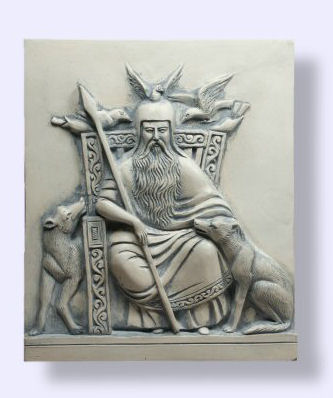
Odin with his two ravens Huginn and Muninn
The norse god Odin was the god of battle and also of wisdom, magic, and poetry. His name means "fury" or "frenzy," the quality of fierce inspiration that guided warriors and poets alike. Despite his warrior appearance, Odin was an intellectual god. Odin was credited with great wisdom, including knowledge of magic and divination. Odin's knowledge came at a high price: He had to self-sacrifice one eye (by stabbing himself with his magical speer Gungnir) and hang upside down for nine days from the tree Yggdrasil (the tree of life) to get the knowledge of the runes, the Norse symbols used for writing and fortune-telling. Odin's ordeal of hanging on the tree until his enlightenment reminds one of the stories of both the Buddha and Jesus. Odin's ordeal is also resounds in the tarot card "The Hanging Man"). Odin also gained knowledge of the world (Midgard) through his two ravens Huginn ("thought"), and Muninn ("Memory" or "Mind"). These circled the Earth each day, seeing all, and then at night reported to Odin what they had learnt. [Odin was also called Wodan: In English, Wednesday is named after him, "Wodan's day. "Friday" is named after Odin's wife Frya, "Frya's day"]


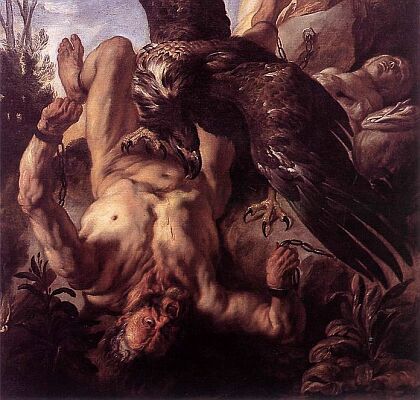
Prometheus's torment by an eagle
Prometheus, was the wisest Titan. His name means "forethought" and he was able to foretell the future. He was the god of fire. A master craftsman considered the wisest of his race, he was credited with the creation of humans and with giving them fire and various types of skills and knowledge. His name means "forethought". Prometheus was a wise craftsman who taught humans many useful skills, including navigation, writing, and architecture, and he brought the knowledge of fire to man. Zeus punished both Prometheus and mankind for gaining the knowledge of fire. Zeus punished Prometheus by chaining him to a mountain peak. Every day an eagle tore at Prometheus's body and ate his liver, and every night the liver grew back. Because Prometheus was immortal, he could not die, but suffered for thousands of years (until Zeus showed mercy). Zeus punished mankind by creating Pandora and her box containing all evil. Pandora's curiosity (to gain knowledge what is inside the box) released all evil unto mankind, only "hope" remained in the box.


Athena -  Goddess of Wisdom
Athena (called Minerva by romans) is the daughter of Zeus and Metis. Metis was the Titaness of the forth day and the planet Mercury. She presided over all wisdom and knowledge. She was seduced by Zeus and became pregnant with Athena. Zeus became concerned over prophecies that her second child would replace Zeus. To avoid this, Zeus devoured Metis. Athena emerged in full armor from Zeus' forehead. Athena is fierce and brave in battle but, only fights to protect the state and home from outside enemies. She is the goddess of the city of Athens, handicrafts, and agriculture. She invented the bridle, which permitted man to tame horses, the trumpet, the flute, the pot, the rake, the plow, the yoke, the ship, and the chariot. She is the embodiment of wisdom, reason, and purity. She was Zeus's favorite child and was allowed to use his weapons including his thunderbolt. Her tree is the olive. The owl is her bird. She is a virgin goddess.


Ganesha (notice the one broken tusk)
Ganesha is also the god of wisdom and prudence. These qualities are signified through his two wives: Buddhi (wisdom) and Siddhi (prudence). Ganesha has a thorough knowledge of the scriptures and is a superb scribe. Ganesha has an elephant's head with one broken tusk. According to one legend, Ganesha was asked to scribe down the epic of Mahabharata, dictated to him by its author, sage Vyasa. Taking into note the enormity and significance of the task, Ganesha realized the inadequacy of any ordinary 'pen' to undertake the task. He thus broke one of his own tusks and made a pen out of it. The lesson offered here is that no sacrifice is big enough in the pursuit of knowledge.


Adam and Eve at the Tree of Knowledge
Adam and Eve ate a fruit (The Bible does not say "apple") from the tree of Knowledge, gaining knowledge of good and evil.  God responded, "The man has now become like one of us, knowing good and evil. He must not be allowed to reach out his hand and take also from the tree of life and eat, and live forever." (Genesis 3:22). The price for gaining knowledge was getting expelled from paradise.


These are just a few of many examples of how great knowledge comes at a great price. Humans and Gods alike paid high prices to gain knowledge of writing, fire, and morality. Knowledge and Wisdom do not come for free, myth tells us that people often pay a price for it. (or as Robert Heinlein put it "There ain't no such thing as a free lunch" (TANSTAAFL).


Many gods of wisdom and knowledge were not gods of peace but were associated with war (power). The symbolism representing the saying "knowledge is power".


It is interesting to notice that the source of knowledge in many ancient myth is a tree - symbolizing nature as the source of knowledge. See further discussion in the blog entry 'Trees of Knowledge').


Today, humans no longer hope to receive knowledge as a gift from the gods (a transmission model of learning), but consider knowledge not as received but as constructed (a constructivist model of learning). Humans developed to tools of science to gain more knowledge about the world. Does human constructed knowledge come with a catch? Yes, of course. As our knowledge is constructed is never certain and always influenced by human interpretation. Uncertainty and tentativeness is the price we pay for scientific knowledge. Science leaves us with ever more questions, increasing complexity, and tentative theories. While science cannot reach ultimate true knowledge, as a pragmatic approach it lead to great technological developments. (Read blog entry on Science and the Loss of Certainty)