
Showing posts with label Chemistry. Show all posts
Showing posts with label Chemistry. Show all posts
Tuesday, December 15, 2015
MEL science kit: Combining real and virtual science experiments
This chemistry kit combines hands on experiments with virtual ones (through Google cardboard). See more about the MEL science kit here.


Friday, September 7, 2012
Interactive periodic table of elements with QR codes
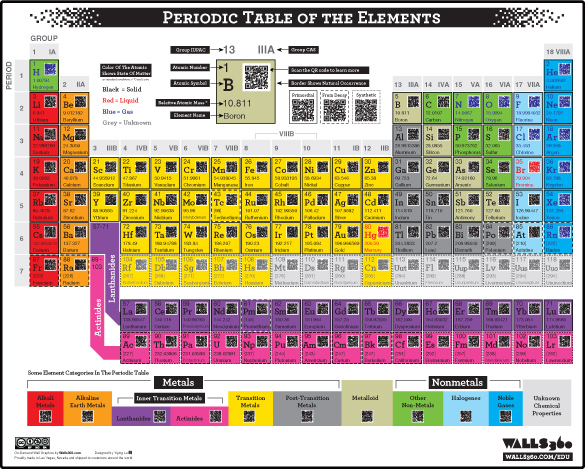
Yinging Lu from Walls 360 developed an interactive periodic table of the elements by adding QR codes (linking to Wikipedia) to each element. Students can use their smartphones to quickly access more information about each element.
The periodic table of elements can be downloaded for free or ordered as a poster for pay: http://blog.walls360.com/periodic-table-wall-graphics-from-yiying-lu-plus-free-periodic-table-design-downloads/
Friday, May 11, 2012
MIT developed a cheap artificial leaf
 |
| Source: American Chemical Society |
The artificial leaf has a sunlight collector sandwiched between two films that generate oxygen and hydrogen gas. On the other side of the leaf, a cobalt film generates oxygen gas. When dropped into a jar of water in the sunlight, it bubbles away, releasing hydrogen that can be used in fuel cells to make electricity. Instead of using an expensive platinum catalyst, Nocera used a less-expensive nickel-molybdenum-zinc compound.
Artificial photosynthesis units are attractive for making hydrogen fuel for electricity in remote places and the developing world.
Daniel G. Nocera. The Artificial Leaf. Accounts of Chemical Research, 2012; : 120404113447002 DOI:10.1021/ar2003013
Monday, April 18, 2011
Car powered by aluminum
 |
| Aleix Llovet and Xavier Salueña |
Inspired by the fusion-powered DeLorean from "Back to The Future", Aleix Llovet and Xavier Salueña from the Universitat Politecnica de Catalunya built a remote control car, called the dAlh2Orean, that captures hydrogen created by the interaction of sodium hydroxide and aluminium. The hydrogen is then used to power an on-board fuel cell, leaving no polluting waste material. Additionally, the remaining fuel material can be reprocessed. See more info in the press conference.
See a demonstration in the video below.
dAlH2Orean H2 R/C Car powered by Aluminium from Aleix Llovet on Vimeo.
Found here: Aleix Llovet - Xavier Salueña - dAlh2Orean | Geekosystem
Wednesday, February 9, 2011
2011 is the International Year of Chemistry

According to the International Union of Pure and Applied Chemistry (IUPAC), 2011 is the International Year of Chemistry. See more information here: Home - International Year of Chemistry 2011
What would our world be without chemistry?
Saturday, January 8, 2011
World largest stable synthetic molecule revealed

Read more here: Tree-like giant is largest molecule ever made - physics-math - 07 January 2011 - New Scientist
Monday, December 27, 2010
Periodic table Revised
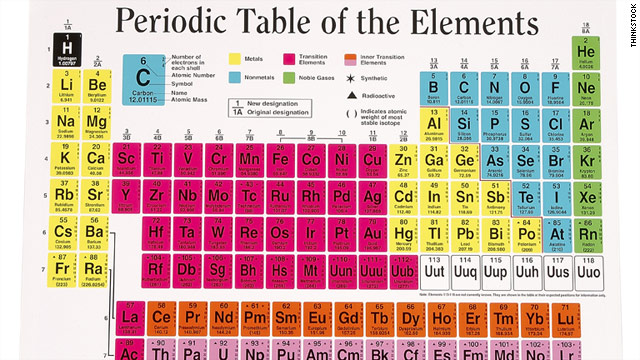
The world's top chemists and physicists have determined that the atomic weights of 10 elements need to be expressed as an interval (or range) rather than a static number, Science Daily reports.
The new atomic weights of hydrogen, lithium, boron, carbon, nitrogen, oxygen, silicon, sulfur, chlorine and thallium will more accurately reflect how those elements occur in nature.
"For example, sulfur is commonly known to have a standard atomic weight of 32.065. However, its actual atomic weight can be anywhere between 32.059 and 32.076, depending on where the element is found," the article explains.
The change will take effect in 2011, designated by the United Nations as the International Year of Chemistry, according to Science Daily.
Read original post here: Periodic table gets a makeover – This Just In - CNN.com Blogs
Subscribe to:
Posts (Atom)