Showing posts with label Medicine. Show all posts

Wednesday, July 16, 2014

Great movies for science geeks and science teachers

Mad Scientist
(Source: http://content.science20.com/)
Many movies portrait scientists (see a list here), but only few try to give realistic depiction of science and scientists (sometimes in a historical context). Scientists are often either portrayed as mad loners (see image above) or a wizard-technicians (e.g. forensic scientists or computer hackers in almost every crime TV show).

Here is a short list of movies that do a better job at representing science (and show the scientist as a positive hero):


Name of the movie
Focus
Longitude (2000)
Technology: A clockmaker needs to collect convincing evidence to support the reliability of his method to measure the position of ships out in the ocean.
Astronomy. An astronomer strives to collect convincing evidence that the royal calendar is inaccurate.
Scientists run experiments to explore an alien virus.
Architecture. The challenges of building a Japanese castle.
Agora (2009)
Astronomy. Conflict between religion and science.

Tuesday, April 26, 2011

Future Human Evolution

In this TED talk, medical ethicist Harvey Fineberg shows us three paths forward for the ever-evolving human species: to stop evolving completely, to evolve naturally -- or to control the next steps of human evolution, using genetic modification, to make ourselves smarter, faster, better.

Alternative explanations for the Common Cold

Alternative explanations for the common cold (Click on picture to enlarge).


Found here: Causes Of The Common Cold | Ape, not monkey

Tuesday, December 7, 2010

What is the difference between the common cold and the flu?

By Beat Schwendimann


Some interesting knowledge about the common cold:
  • The common cold is not the same as the flu (influenza). Both are viral infections and their symptoms are quite similar (coughing, sneezing, sore throat, runny or stuffy nose, headaches). However, there are differences:
    • The common cold symptoms can be caused by 100-200 different viruses. Rhinoviruses are the most important and cause at least one-half of colds. Cold viruses live only in the noses of humans and other higher primates, but not other animals. Contrary to common belief, you do not catch the common cold more often in the winter time because it is cold outside. The reason why people get viral infections more often in the winter is because they spend more time indoors in close proximity to other people, which makes it easier for the viruses to spread through aerosols. Once caught, there is still no effective cure for the misery of the common cold. The old adage that ‘a cold lasts for seven days if you treat it and a week if you leave it alone’ may still be true. However, vitamin C and zinc-rich foods might help.
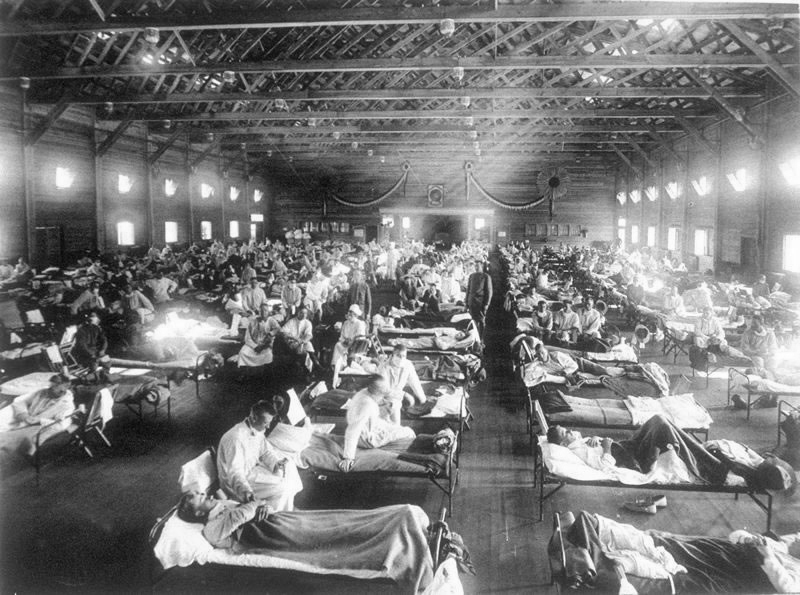
    • The flu is caused by RNA viruses of the family Orthomyxoviridae that affects both birds and mammals (e.g. bird flu H5N1, swine flu influenza A/H1N1). Influenza viruses frequently mutate, and can sometimes jump from one host species to another. Flu epidemics can cause large numbers of death. Three influenza pandemics occurred in the 20th century and killed tens of millions of people. The Spanish flu between 1918 and 1921 was one of the deadliest natural disasters in human history: Between 50 - 100 million (!) people died worldwide, especially young adults. Today, vaccines exist for a number of flu viruses, but new influenza viruses occur and frequently mutate.
US army hospital at Fort Riley, Kansas ill with Spanish influenza patients in 1918
  • Both the common cold and flu viruses are spread through airborne aerosols, which end up mostly on our hands. To limit the spreading of the viruses, wash your hands often, especially after coughing or sneezing. Avoid touching your nose or mouth. Don't sneeze or cough into your hands but in your elbow.
More info on the common cold: Colds: How You Catch a Cold