Showing posts with label Society. Show all posts

Wednesday, January 13, 2016

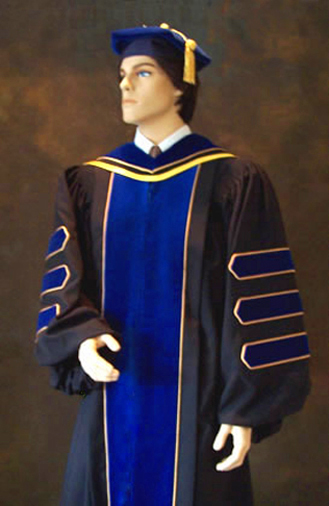
Celebrities with PhDs or MDs

Which celebrity earned a Ph.D. or a M.D.? (The list below does not include undergraduate degrees, master degrees, or honorary doctor titles).
  • The heavyweight boxer, Vitali Klitschko, holds a Ph.D. from the Ukraine and his brother, another heavyweight boxer, Wladimir Klitschko, holds a Ph.D. from Kiev National University.
  • Brian May, Guitarist of Queen (Astronomy Ph.D.): He wrote his thesis on zodiacal dust clouds
  • Greg Graffin (Singer, Bad Religion) has a PhD from Cornell University. The PhD dissertation was entitledMonism, Atheism and the Naturalist Worldview: Perspectives from Evolutionary Biology.
  • Dexter Holland (singer & guitarist: The Offspring) was a PhD candidate in Molecular and Cell Biology from the University of Southern California.
  • Dan Snaith (records as Caribou) has a Ph.D. in Mathematics
  • Mayim Bialik (Blossom, Big Bang Theory) has a Ph.D. in 2008 from U.C.L.A. in neurobiology. She did her dissertation on Prader-Willi syndrome.
  • Milo Aukerman (Punk band "The Descendents") got a Ph.D. in biochemistry at the University of Wisconsin. Dissertation title: "Analysis of Opaque-2 Function in Maize".
  • Miuccia Prada (Head of the Prada fashion house) has a P.D. in political science.
  • Condoleezza Rice has her PhD in political science from the Graduate School of International Studies at University of Denver, USA.
  • Gordon Brown has his PhD in history from the University of Edinburgh, UK.
  • Martin Luther King Junior received a PhD in systematic theology from Boston University, USA
  • General David Petraeus has a PhD from Princeton.
  • German chancellor Angela Merkel has a doctorate degree in physical chemistry.
  • Robert Vaughn (The man from U.N.C.L.E): Vaughn earned a Ph.D. in communications from the University of Southern California, in 1970. In 1972, he published his dissertation as the book, Only Victims: A Study of Show Business Blacklisting.
  • The only president of the United States with a Doctorate was Woodrow Wilson, who received his in History and Poli Sci from Johns Hopkins in 1886.
  • Dan Grimaldi (Patsy Parisi) on The Sopranos has a PhD in Data Processing from City University of New York.
  • Peter Weller. In 2013, Weller successfully defended his Ph.D. at UCLA in Italian Renaissance art history titled Alberti Before Florence: Sources Informing “De Pictura".
  • Shaquille O’Neal: In 2012, the former NBA basketball star defended his Ph.D. in leadership and education from Barry University in Miami Shores, Florida. Title: How Leaders Utilize Humor or Aggression in Leadership Styles.
  • Tennis player Mikhail Youzhny completed his Ph.D. in philosophy from Moscow University in 2010.
  • Former Major League pitcher “Iron Mike” Marshall obtained his Ph.D. in kinesiology from Michigan State University in 1978. His dissertation was entitled, A Comparison of an Estimate of Skeletal Age With Chronological Age When Classifying Adolescent Males for Motor Proficiency Norms.
  • Former quarterback Frank Ryan completed his Ph.D. in mathematics from Rice University in 1964.
  • Rachel Maddow received her Ph.D. in 2001. Maddow’s dissertation focused on AIDS health care reform in prisons.
  • Miuccia Prada (Prada Fashion House) earned her Ph.D. in political science from the University of Milan in 1973.
  • Former US secretary of defense Robert Gates obtained his Ph.D. in Russian and Soviet history at Georgetown University in 1974.
Actors working on a PhD:
  • James Franco is a Ph.D. student in English at Yale University. He also received his MFA from Columbia University in 2010. 
Actors with Medical Doctor Degrees (M.D.):
  • Ken Jeong (Community, The Hangover), M.D.
  • Graham Chapman (Monty Python), M.D.
  • Jonathan LaPaglia ("Cold Case"), M.D.
  • Jonathan Miller ("Beyond the Fringe"), M.D. As reported in IMDB, "As well as being a qualified doctor, he is a satirist, sculptor, photographer, author, television presenter, performer, and theatre, opera & film director."
  • George Miller ("Mad Max", "Babe", "Happy Feet" ), M.D. (Director)
Actors with an Doctor of Education (Ed.D)
  • In 1976, Bill Cosby earned a Doctor of Education (Ed.D) degree from the University of Massachusetts. For his doctoral research, he wrote a dissertation entitled, "An Integration of the Visual Media Via 'Fat Albert And The Cosby Kids' Into the Elementary School Curriculum as a Teaching Aid and Vehicle to Achieve Increased Learning".
See more here: http://onlinephdinnursing.com/2010/10-surprising-celebrities-with-phds/


Here is a list of celebrities with academic degrees (mostly B.A.s).

Here is a list of comedians with academic degrees (mostly B.A.s and M.A.s).

Here is a list of professional wrestlers with academic degrees (mostly B.A.s).

Wednesday, December 2, 2015

A short history of Santa Claus - from saint to secular

Santa Claus (Coca Cola version)
Santa Claus is a complex social-cultural phenomenon that developed over centuries.

  • Historically, Santa Claus is based on Bishop Nicholas of Myra who lived from 280-343 a.D. in Greece. He was made a Saint in 900 a.D. His Saints Day is December 6, which is the traditional 'Santa Claus' day in many European countries. St. Nicholas gave money and gifts to children but he did not like to be seen when he gave away presents. Therefore, he left his presents during the night. This turned into the modern day practice of telling children that Santa Claus will not arrive unless the children go to sleep early.
  • Leaving food: The catholic saint was merged with non-christian figures, such as Father Christmas and the Norse god Odin. During Yule time, Odin would visit every house on his horse Sleipnir. Children  would place their boots near the chimney (or outside of the door) with food for Sleipnir. During the night, Odin would enter the house through the chimney and reward them for their kindness with food, candy or gifts. The tradition still continues in Belgium, Germany and the Netherlands. The food for Sleipnir became milk and cookies for Santa; the boots become stockings hung on the chimney. Other norse influences are the Yule log and the mistletoe (Read more about the mistletoe tradition here). 
  • Influences: The modern Santa Claus was most strongly defined by Dutch and American influences. In the Netherlands, the figure is called 'Sinterklaas'. Dutch settlers brought the 'Sinterklaas' tradition to the US where the name changed into 'Santa Claus'. After arriving in the US, several poems, songs, and stories extended and changed the figure of Santa Claus. Instead of a horse, he now used reindeer. His workshop was placed at the North Pole, he was given an army of elves, and a wife (Mrs Claus was added by a 1956 popular song by George Melachrino, "Mrs. Santa Claus", and the 1963 children's book How Mrs. Santa Claus Saved Christmas, by Phyllis McGinley). 
  • Animals: In Europe, Santa Claus uses either horse, a donkey, or reindeer. In the US, his animals changed, most importantly due to the 1823 story "A Vist From St. Nicholas", better known today as "The Night Before Christmas". In this poem eight reindeer were introduced as Dasher, Dancer, Prancer, Vixen, Comet, Cupid, Dunder and Blixem (Dunder and Blixem came from the old Dutch words for thunder and lightning, which were later changed to the more German sounding Donner and Blitzen). The ninth, and most famous reindeer, was not added until 1939 by a poem about Rudolf the Red Nose Reindeer by Robert L. May of the Montgomery Ward Company; followed by the popular 1949 song by Johnny Marks about "Rudolph the Red-Nosed Reindeer".
  • Helpers: The European 'Sinterklaas' or 'Samichlaus' has often a helper called 'Black Peter/ Père Fouettard'. While Santa is the friendly gift-giver, Black Peter's job is to punish children who did not behave well. Similar to Black Peter, several European Alpine regions know a devil-like creature called Krampus who punishes naughty children. In Germany, Santa is linked to angel-like baby Jesus ('Christ Child') who brings gifts. The German word 'Kristkind' became Santa Claus' name 'Kris Kringle'. In the US tradition, Santa has a workshop full of elves who make all the gifts. However, in several Scandiavian countries, Santa is an elf himself (called Nisse or Tomte).
  • Outfit: In many European countries, Santa Claus wears a Bishop's attire. In the US, his religious looks were changed to a more secular apparel (a fur-lined red suit and a soft hat). Santa's outfit became standardized through the 1920s and firmly established through the work of Coca-Cola Company commissioned illustrator Haddon Sundblom who developed advertising images using Santa Claus in 1930.
Santa Claus can therefore be considered a product of cultural globalization and a merger of many traditions.

The Origin and Evolution of Santa Claus
by herrimanjoe. From Visually.


Wednesday, October 22, 2014

Characteristics of a competent human being

What are the characteristics of a competent human being, a real man/woman?

"A human being should be able to change a diaper, plan an invasion, butcher a hog, conn a ship, design a building, write a sonnet, balance accounts, build a wall, set a bone, comfort the dying, take orders, give orders, cooperate, act alone, solve equations, analyze a new problem, pitch manure, program a computer, cook a tasty meal, fight efficiently, die gallantly. Specialization is for insects."
Robert Heinlein, Time Enough for Love

Or in other words:
“If you can keep your head when all about you 
Are losing theirs and blaming it on you,
If you can trust yourself when all men doubt you,
But make allowance for their doubting too;

If you can wait and not be tired by waiting,
Or being lied about, don't deal in lies,
Or being hated, don't give way to hating,
And yet don't look too good, nor talk too wise

If you can dream - and not make dreams your master;
If you can think - and not make thoughts your aim;
If you can meet with Triumph and Disaster
And treat those two impostors just the same;

If you can bear to hear the truth you've spoken
Twisted by knaves to make a trap for fools,
Or watch the things you gave your life to, broken,
And stoop and build 'em up with worn-out tools

If you can make one heap of all your winnings 
And risk it on one turn of pitch-and-toss,
And lose, and start again at your beginnings
And never breathe a word about your loss;

If you can force your heart and nerve and sinew
To serve your turn long after they are gone,
And so hold on when there is nothing in you
Except the will which says to them: 'Hold on!'

If you can talk with crowds and keep your virtue,
Or walk with Kings - nor lose the common touch,
If neither foes nor loving friends can hurt you,
If all men count with you, but none too much;

If you can fill the unforgiving minute
With sixty seconds' worth of distance run,
Yours is the Earth and everything that's in it,
And - which is more - you'll be a Man, my son!” 

― Rudyard KiplingIf: A Father's Advice to His Son

Wednesday, July 16, 2014

What is vocational education? What are current challenges of VET in Switzerland?

Vocational Education in different contexts
(Source: technicaleducationmatters.org)
Vocational education (also called  career and technical education (CTE), technical and vocational education and training (TVET), or vocational education and training (VET)), can be described as education that prepares people for a specific trade, craft, or career.

Traditionally, vocational education refers to classic trades such as carpenter, mason, plumber, electrician, blacksmith, etc. However, the lines can get blurred when one includes programs such as engineering, accountancy, nursing, medicine, architecture, pharmacy, and law.

At the upper-secondary level in Switzerland, over 60-70% of young people enter a VET program while 30-40% go to university (OECD report). Given the above definition of VET, many university students could also be considered part of VET (such as engineers, medical doctors, architects, lawyers, psychologists, teachers, etc.).

Following this line of thought, education could (roughly) be divided into two strands:
  • Occupation-specific education: Education programs that prepare students for a specific profession (which often includes practical experiences through internships and apprenticeships).
  • General education: Education programs that teach knowledge and skills independent of specific careers, particularly the liberal arts (for example literature, languages, art history, music history, philosophy, history).
Graduates from occupation-specific programs find it often easier to find a job after their program as they have a clear(er) career path, practical experience on the job, and relevant skills. However, university education is still perceived as more desirable. In 2014, over 13,000 Swiss VET apprenticeship positions could not be filled (Newspaper article July 16 2014). In the UK, studio schools try to combine schools with VET. In the US, forming a vocational education system could improve the overall education system (see article here).

Like Germany and Austria, Switzerland has a long history for vocational education going back to apprenticeship programs in the middle ages. Today, Switzerland builds on the 'dual system' approach for VET. Students learn practical skills and procedural knowledge at the workplace (under the supervision of a vocational trainer) 3-4 days/week) and theoretical (declarative) knowledge in vocational school (under the supervision of vocational teachers) (1-2 days/week). Additionally, students also attend yearly inter-company courses (organized by their professional unions) in industry training centers to complement their skill sets (under the supervision of vocational instructors). Some professions, particularly commercial employees, attend vocational school full time. Swiss VET program can take between two and four years and lead to a Federal VET Diploma (full 3- or 4-year program) or a Federal VET Certificate (less demanding 2-year VET program). Graduates from a university of applied sciences receive a 'professional bachelor' or a 'professional master' (Newspaper article June 18 2014). Currently, PhDs can only be granted by the regular universities.

Switzerland draws a distinction between vocational education and training (VET) programs (which take place at the upper-secondary level) and professional education and training (PET) programs (which take place at tertiary level). Beyond PET, universities of applied sciences (Fachhochschulen) offer vocational education at higher tertiary levels. Pathways enable people to shift from one part of the education system to another. The line between PET and university education (particularly of the occupation-specific programs) becomes increasingly blurred.

A big difference between the two strands is the cost factor. While the state heavily subsidizes university education (students only pay about $700/ semester), higher degrees in professional education need to paid fully by the student (often around $3000-4000/ semester). A professional diploma can cost as much as $30,000 to 40,000.

The question for a society (and economy) is to find the right balance between the two education strands. A society that focuses solely on occupation-specific education might have a highly skilled workforce but lack people who see pattern across narrow contexts, think critically about bigger issues, and find innovative out-of-the-box problem solving approaches.


Friday, July 11, 2014

Gender stereotypes and the lack of women in STEM careers

Role models and encouragement can make a big difference when it comes to education program and career choices. Currently, less than 25% of STEM (Science, Technology, Engineering, and Math) in the US are held by women.

Recent research (*) suggests that boys and girls have similar psychological traits and cognitive abilities, thus gender is not the determining factor for careers in STEM.

One contributor could be repeated (but often concealed) encouragements that reinforce gender stereotypes (see video below). Women need more role models, opportunities to experience, and encouragement towards careers in STEM.


(*) Hyde, J. S., & Linn, M. C. (2006). Gender similarities in mathematics and science. Science, 314(5799), 599-600

Friday, June 27, 2014

Kidzania - a vocation education theme park

KidZania firemen roleplay
[Picture source: www.kidzania.com.sg]

KidZania model city
[Picture source: http://sentimentalfreak.wordpress.com/2013/07/30/kidzania-comes-in-manila-2014/]

KidZania is a Mexican owned company who runs a series of vocation-based theme parks around the world.

Each KidZania location features an indoor scaled-down (2/3 of full size) model city in which children can experience different professions through role-play (following the instructions of animators). Around 60 different establishments (including a hospital, fire station, beauty salon, bank, radio station, supermarket, television station, pizzeria, and theater) offer nearly 100 different role-playing activities.

To simulate the real world, KizdZania teaches capitalist-consumerist values of earning and spending money. The role-play gets rewarded with KidZania's own currency, kidZos, which can be spent within KidZania for goods and services provided by other children working in that profession.

Each Kidzania role-play activity is heavily and directly sponsored by multi-national or local brands (what they call "integrated marketing partnership"). For example, aviation professions are sponsored by American Airlines, bank professions are sponsored by HSBC, hospitality professions are sponsored by Coca Cola, Domino's pizza, Nestle, Kellogg's and Danone, Engineering professions are sponsored by Mitsubishi Motors and Honda, and so on.


Currently, the Kidzania franchise has locations in Mexico City, Monterrey (Mexico), Tokyo, Jakarta, Osaka, Lisbon, Dubai, Seoul, Kuala Lumpur, Santiago, Bangkok, Kuwait, Mumbai, Cairo, and Istanbul (with several new locations in planning).

Read another blog entry on KidZania here.

Wednesday, March 12, 2014

Farewell to the One-Laptop-Per-Child (OLPC) project

XO-1 laptop
(Source: OLPC news)
The OLPC website officially reports that "OLPC is dead" and so is the development  of the XO-1 laptops. Sections of the OLPC project seem to be still operational but the full effort has subsided.

The idealistic project who aimed to close/narrow the digital divide by giving every child a specially designed laptop did unfortunately not succeed to reach its ambitious goals.

The rugged, low-power XO-1 laptop (also known as the $100 Laptop, the Children's Machine, and the 2B1) is an inexpensive sub-notebook computer that offered many interesting design features:

  • To improve internet connection in areas with limited access, the XO-1 used a WiFi mesh networking protocol to allow many machines to share Internet access as long as at least one of them can see and connect to a router or other access point.
  • Operation system: Slimmed-down version of Fedora Linux and a GUI named Sugar 
  •  Video camera, a microphone, and a hybrid stylus/touch pad. 
  • Power: The XO-1 was designed to use minimal amounts of power. In addition to a standard plug-in power supply, human power and solar power sources are available, allowing operation far from a commercial power grid.
  • Dual screen mode: Reflective (backlight off) monochrome mode for low-power use in sunlight (ebook mode) and backlit color mode.
  • Water-resistant membrane keyboard, designed for the small hands of children.
Farewell, OLPC and XO-1. We need more idealistic projects like this.

Wednesday, March 13, 2013

Living in front of a computer screen

Children in front of computer screens
[Source: http://images.smh.com.au/2011/06/04/2408569/art-screens-420x0.jpg]
How much time do people spend in front of a computer screen? The 'Halifax Insurance Digital Home Index’ presents findings from an online survey by One Poll in January 2013 that included 2,500 adults aged 18 and over living in the UK. 

Not surprisingly  the survey data indicates that people spend a large amount of time in front of computer screens.
  • 73% of the participants would struggle to go one day without technology devices such as smartphones, laptops and MP3 players. 23% would feel ''uneasy or worried'', while 19% would feel concern about ''missing out''.
  • 74% check emails and social networks before starting work in the morning.
  • 25% check technology devices from their beds, and 10%  take theirs into the bathroom.
  • Each owns an average £4,164 worth of technology devices.
  • Almost one in 10 (9%) respondents use their phone during mealtimes - a figure that doubles for those aged 18-24. 
  • 53% of women use their laptop parallel  to watching television, compared to 43% of men.
  • 45% communicate via devices to speak with friends and family despite being in the same house.
This survey predicts that current children will spend an average of 25% of their non-working time in front of screens (not counting sleeping time). Dr Aric Sigman, psychologist, says: "As the amount of time spent looking at a screen or plugging in increases, the amount of time spent on direct eye-to-eye contact and developing real life relationships inevitably decreases. By the age of seven years, the average child born today will have spent one full year of 24 hour days watching screen technology; by the time they reach 80 they will have spent almost 18 years of 24 hour days watching non-work related screen technology. That's a quarter of their lives."

In a national study of over 2,000 young people, aged 8 to 18, researchers found that participants were able to squeeze the equivalent of 8.5 hours of electronic media into 6 chronological hours because of multitasking (or rather 'multi-device usage'). By the time Net Generation kids reach their twenties, the typical teenager has spent over 20,000 hours on the Internet and over 10,000 hours playing video games of some kind (Source: Digital game-based learning) [Read more here]. With devices like Google Glass and multi-device usage, time in front of computer screens might soon even exceed 100% of people's work and spare time).

Sources:

Thursday, October 4, 2012

Deconstructing Disney Princesses

by Beat A Schwendimann

Even the Disney Coorporation realized that their pretty-damsel-in-distress-waiting-for-a-prince model of princesses became less and less appealing to current young girls. The latest Disney movie, Tangled, tries to update the image of the princess by making her a stronger self-confident character.
Image from Disney movie "Tangled"
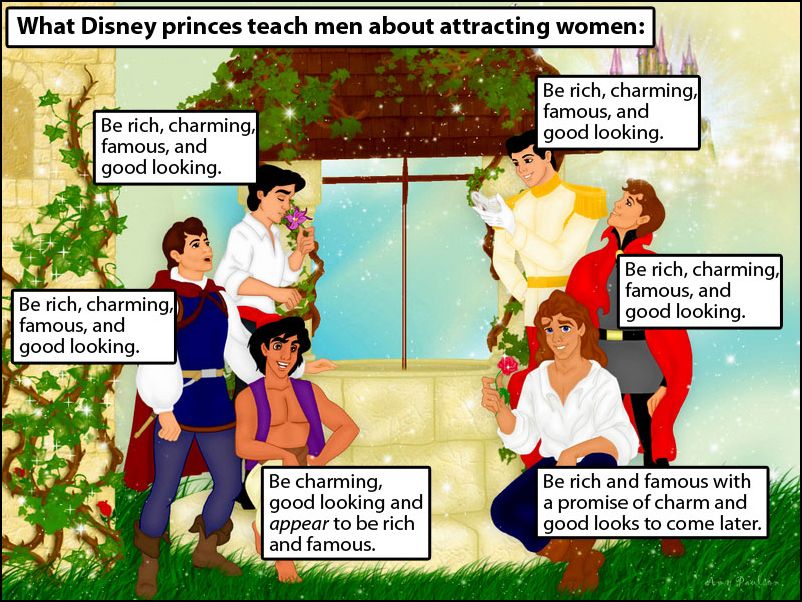
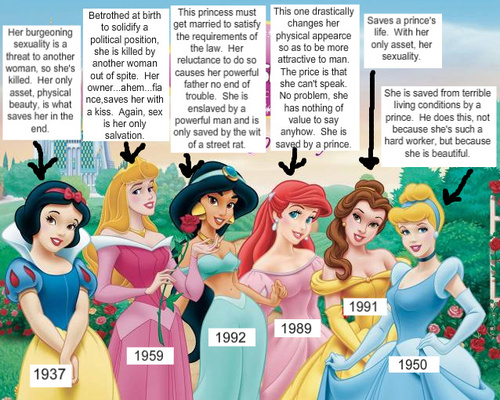
Disney princesses used to be (and maybe still are) role models for many young girls. However, the classic Disney princess presents an outdated stereotypical role model from the past (compare the two pictures below).


This youtube video discusses the gender stereotypes in Disney movies.


Among current girls, princesses and the romanticized ideal they represent — revolving around finding the man of your dreams — have a limited shelf life. With the advent of "tween" TV, the tiara-wearing ideal of femininity has been supplanted by new adolescent role models such as the Disney Channel's Selena Gomez and Nickelodeon's Miranda Cosgrove. "By the time they're 5 or 6, they're not interested in being princesses," said Dafna Lemish, chairwoman of the radio and TV department at Southern Illinois University and an expert in the role of media in children's lives. "They're interested in being hot, in being cool. Clearly, they see this is what society values." (Read full article in the L.A. Times on how Disney is closing the book on classic fairytale characters).

In Fallen Princesses, artist Dina Goldstein took a modern look at the life of a Disney princess by placing her in an environment that accentuates her conflict. The "Happily ever after" is replaced with a more realistic outcome and adresses current issues:

How about the life of a real princess? The life of a real princess does not seem to be much of a fairytale. This article by the Daily Beast: Kate's Royal Prison  describes the life that expects Kate Middleton as the wife of Prince William. Besides having no more private life or being able to say anything original, she is expected to be picture perfect for the rest of her life, every single minute will be monitored and discussed at large in the press. Each of her actions will constantly be compared to those of Queen Elisabeth and Princess Diana. I don't think many young girl would want to become a princess if they would know what it actually entails.

At least Disney princesses can have some fun (Prince Charming optional):

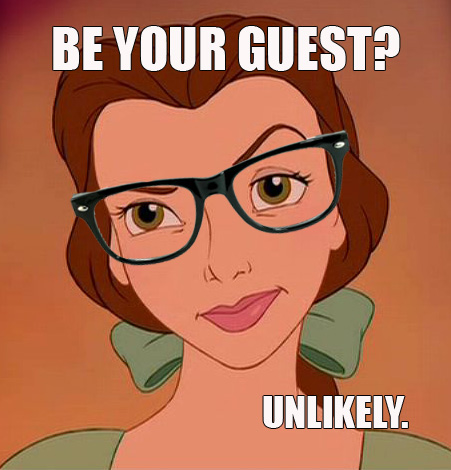
Or Disney princesses can be hipsters:
http://www.geekosystem.com/hipster-disney-princesses/
Click here to see the collection of hipster Disney princesses.

Honestly titled Disney movies might look like this:
Hamlet - With Animals
[Source: http://twentytwowords.com/2013/06/07/classic-disney-movies-honestly-retitled-5-pictures/]
See more honest Disney movie titles here.

Disney animators found a cheap way to create new princess characters: They just clone existing ones:

Friday, January 20, 2012

The Meta-Geek

Copyright Scott Johnson: http://www.flickr.com/photos/scottjohnson/1190004360/ 

With geek culture becoming more mainstream, a novel form of geek emerges - the meta-geek.

A "meta-geek", or "geek geek", is fascinated with geek culture without being deeply involved in any one sub-culture. Meta-geeks are geeks about geek culture itself.

For example:

  • A meta-geek can follow geek-related blogs and watches videos from geek-related events (such as Comic-Con, Dragon-Con, or Star Trek conventions) without going there in person.
  • A meta-geek can be knowledgeable about comic characters without reading comics themselves. 
  • A meta-geek can blog about other geek cultures (for example, see Geek hierarchy chart and Evolution of geek) or read geek-related blogs (for example Geeksaresexy.net or Geekosystem.com).

Monday, November 7, 2011

Reforming schools for the Knowledge Age

Ørestad College (Denmark)
Current public schools are based on an industrial model of schooling: Standardisation and conveyor-belt analogy.

For example:
-Students are grouped by birth-year; Bells and periods; Sitting in rows; Separate isolated subjects; Fixed time to finish a certain grade; Individual standardised testing.


We need to re-think the current schooling paradigm to create a post-industrial school model. We need schools for the Knowledge Age that focus on technology-enhanced project-based collaborative learning. We need schools that support students to learn how they learn best, monitor their own learning progress, and are driven to become life-long learners. 

For example, as an alternative to grouping students by age, they could be group by their performance level, early birds/night owls (morning school/ evening school), work individually/ in small or large groups (depends on context and personal preference).

Research found evidence that industrial-age schooling reduced creative (and divergent) thinking (as students are conditioned for "there-is-only-one-right-answer" thinking).

See this fascinating animation that illustrates the inspiring TED talk by Sir Ken Robinson:


A number of model schools world-wide lead the way towards a post-industrialist way of learning:
A few examples:
-High Tech High school in San Diego (USA)
-Northern Beaches Christian School in Sydney (Australia)
-Reggio Emilio schools (Italy)


Companies like innovative schools.org offer support for reformers to model their schools after successful models.

Education research aims to gain a more complex picture of learning through the field of the "learning sciences". The learning sciences pursue an interdisciplinary approach to further scientific understanding of learning and to implement innovative learning environments. The bi-annual conference ICLS brings togethers researchers from across the world who study learning as a complex multi-layered system.


This video shows some interesting novel physical and virtual learning environments:

Sunday, May 8, 2011

Biometric IDs in India


In India, an estimated 500 million people have no form of reliable identification. The Indian government started $430 million initiative to use modern biometric methods to identify hundreds of millions of citizens. From each volunteer participant, the government collects 10 fingerprints, 2 iris images, and a photo, and if the new data don't match any identity already enrolled, it assigns the person a unique 12-digit number. After that, a single fingerprint or iris scan should be all that's needed to verify the identity of any person.

Gathering the biometric data is challenging in the rural population of India as many fingerprints have been obscured or erased by manual labor. The combination of fingerprint, iris image, and photo reduced false positive errors in 0.0025 percent of cases in the pilot study. Biometrics data are collected at government offices by government employees or private enrollment agencies. A single sensor can collect data from up to 50 people per day.


Once people received their biometric ID, their data can be used to provide them access to banking services and improve transparency for how support money reaches people living in poverty.

Wednesday, May 4, 2011

Poverty is key factor to improve US education


The popular 2010 education documentary Waiting for Superman suggests that teachers can perform miracles (as seen in movies such as Freedom Writer and Dangerous minds). Former DC schools chancellor Michelle Rhee said, "... even in the toughest of neighborhoods and circumstances, children excel when the right adults are doing the right things for them."


On the other hand, there is evidence that the key factor influencing US education is not teachers (or teacher unions) but students' socio-economic status (a.k.a. poverty). Michael Marder is a professor at the University of Texas and co-director of the university's UTeach program. In 2009, Marder published an article which suggested that "educational outcomes for students from wealthy and poor families are very different in Texas (get article here http://bit.ly/hYbbLe). 


More recently, Reeve Hamilton conducted an interview with Michael Marder in the Texas Tribune article titled "Is Poverty the Key Factor in Student Outcomes? (Get article here http://bit.ly/mpkki0). Quote Marder (2011) (Get article here http://bit.ly/fjUquC): "For the short term, preparing teachers in mathematics and science is a wise and useful step toward improving schools. . . . . .[But]. . . As quickly as possible, we must understand the link between poverty and educational outcomes in the US, devise solutions, and test and implement them. Britain briefly tried to substitute public relations for aircraft safety and paid with the loss of its commercial aviation sector. I hope the United States can avoid a similar error, that proponents of teacher quality and charter schools will recognize the weakness of the evidence before it is too late, that we will not damage public education, let down our most vulnerable students, and lose technical leadership we take for granted."

Joe Nocera, a columnist for the New York Times, discusses the influence of poverty on education in his article "The Limits of School Reform".


If poverty is key to educational success, why are education reforms focusing on all other kinds of issues (for example charter schools, teacher unions, student-performance-based teacher salaries, standardized testing, etc.)? I see two reasons: First, poverty might be a key factor to education, but improving the US education system needs a multi-level approach that improves students' socio-economic situation and includes teachers, principals, teacher unions, and policy makers. Second, improving poverty is a problem beyond the range of education reforms on a limited budget. Poverty is a fundamental problem of the US society. Nearly 20 million US children now receive free or reduced-price lunches in the nation's schools, an all-time high, federal data show (Read more here) (In the US, free or reduced-price lunches are used as an index for low socio-economic status of students' families). A large body of research shows that an individual student who is eligible for free or reduced price lunch is at risk for academic failure (Read more here).


Unfortunately, poverty is such a large, complex, and loaded problem that few US politicians dare to address it (as it is strongly related to minority issues and because politicians want to run projects that produce results within their term). Hopefully, the US government, parents, teacher unions, the education research community, and non-profit organizations will increase their existing efforts to improve the situation of students and their families who live in poverty.

Friday, April 29, 2011

Map of Monarchies around the World

It's the 21st century, but a number of countries are still monarchies. This interactive map by NPR shows the different countries and forms of monarchies around the world. [Click on the link below to see the interactive version].

See the interactive version here: Kings (And Queens) Of The World: Where Monarchies Still Exist : NPR

Tuesday, April 26, 2011

Toilet Paper - Over or Under?

This infograph gives you the scientific exploration of the old question: Should the toilet paper roll be over or under? (Click to enlarge).


Gky7j.jpg (802×4036)

Sunday, April 17, 2011

People with impressive long names

Pablo Picasso (Image: Wikipedia)

Pablo Diego José Francisco de Paula Juan Nepomuceno María de los Remedios Cipriano de la Santísima Trinidad Ruiz y Picasso, or simply Picasso.


Paracelsus (Image: Wikipedia)
Philippus Aureolus Theophrastus Bombastus von Hohenheim, better know as Paracelsus (medieval medical doctor).

Mozart (Image: Wikipedia)
Johannes Chrysostomus Wolfgangus Theophilus Mozart, better know as Wolfgang Amadeus Mozart.


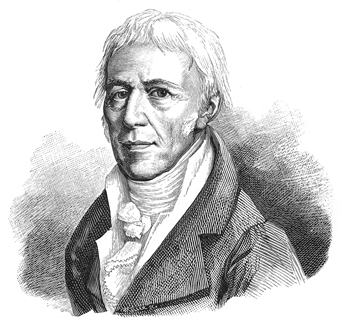
Lamarck (Image: Wikipedia)
Jean-Baptiste Pierre Antoine de Monet, Chevalier de la Marck, better known as Lamarck. He proposed an alternative theory of evolution.


-> Do you know more people with impressive names? Please et me know.

Monday, March 7, 2011

World's most average person

What does the world's most average person look like? Male or female? Average age? Ethnicity?

Have a look at this interesting National Geographic video:

Tuesday, February 22, 2011

World's biggest family


Mr. Ziona Chana is the leader of a polygamous sect in the Indian state of Mizoram. He has 39 wives, 94 children, 14-daughters-in-law, and 33 grandchildren - which probably makes it the world's largest family. See more pictures of their 100-room house here.


Read more here: The Presurfer: The Man With 39 Wives, 94 Children And 33 Grandchildren