Showing posts with label Science. Show all posts
Showing posts with label Science. Show all posts
Tuesday, November 29, 2016
An updated view of the theory of evolution
http://www.sciencealert.com/the-world-s-top-biologists-have-met-to-discuss-whether-we-should-update-evolution


Wednesday, August 3, 2016
Advances in genetics class since your high school biology class

Over the past decades, the field of genetics rapidly developed, for example in the areas of inherited diseases, cancer, personalized medicine, genetic counseling, the microbiome, diagnosis and discovery of viruses, taxonomy of species, genealogy, forensic science, epigenetics, junk DNA, gene therapy and gene editing.
Joel Eissenberg, Ph.D., associate dean for research and professor of biochemistry and molecular biology at Saint Louis University School of Medicine summarizes major advances in genetics since the 1960s:
When Did You Go to High School?
If you took high school biology in the …
1960s, you learned about the structure of the double helix and how sequences of DNA encode amino acids.
1970s, you may also have learned about cloning and the potential for recombinant DNA.
1980s, your class may have covered the clinical use of recombinant human insulin for diabetes treatment and the advent of GMO foods.
1990s, your class may have studied the molecular basis for human genetic disorders, like cystic fibrosis.
2000s, your teachers likely described how the human genome was being sequenced.
You can find further information: http://www.slu.edu/news/2016/august/Eissenberg-genetics-essay.php
---------------------What’s changed in genetics since your high school biology class?: The field of genetics has seen astonishing breakthroughs and the development of world-changing technologies in the past half century.
Wednesday, January 13, 2016
Do-It-Yourself Gene-Editing Kit for biology education
 |
| CRISPR Kit |
Moving genes from one organism to another used to be done only by big-budget labs. Three years ago, UC Berkeley developed the CRISPR gene-editing tool. CRISPR stands for 'Clustered Regularly Interspaced Short Palindromic Repeats', which refers to a protein(Cas9) that can use an RNA guide to make highly specific cuts in DNA. This allows unprecedented abilities to edit DNA. Zayer is the first to make the CRISPR tool kit available to the masses.
The DIY gene-editing kit allows altering bacteria and yeast (which can change color, fragnance, or living requirements). The DIY CRISPR kit is available for 120$: https://www.indiegogo.com/projects/diy-crispr-kits-learn-modern-science-by-doing#/
Read more here: Do-It-Yourself Gene-Editing Kit Transforming Biology | Sci-Tech Today
Tuesday, December 15, 2015
MEL science kit: Combining real and virtual science experiments
This chemistry kit combines hands on experiments with virtual ones (through Google cardboard). See more about the MEL science kit here.


Monday, October 26, 2015
EPCOT: The smart city of the future that (sadly) remained a vision
 |
| E.P.C.O.T aerial view [Image Source] |
This video explains Disney's vision for E.P.C.O.T. in his own words.:
Unfortunately, Disney didn't live to see E.P.C.O.T. becoming realty. After his death, his visionary plans were changed drastically. Today, E.P.C.O.T. can be seen in two forms:
1) As a themepark: The Epcot park (as part of Disneyworld in Florida) is a combination of science and technology-themed rides and a permanent world fair. This park is called Epcot (without the meaning of the acronym) and opened in 1982. Rather then a living city where innovations are being tested in real-life, Epcot features rides showcasing technology and science.
2) In the 1990s, Disney's plans to create the 'perfect' town took on another form. The sub-urban part of E.P.C.O.T. became a city in itself - called 'Celebration' (Florida). Designed by the Disney corporation, Celebration is a master-plan city in an early 20th-century architectural style. Today, Celebration has a population of around 7'500. Instead of the futuristic urban vision of E.P.C.O.T, Celebration aims to be the 'ideal' middle and upper-class sub-urban town. However, this utopia is strictly regulated (similar to the artificially-created experience in a Disney themepark).
E.P.C.O.T could be considered a precursor to the current trend of 'smart cities'. Smart cities incorporate networked technology in all aspects of live in an attempt to make cities more efficient, cleaner, and safer. An example of a smart city is Songdo City in South Korea, the self-proclaimed 'most modern city in the world'. By 2020, more than 250'000 people are expected to live in Songdo Eco-City.
 |
| Songodo City [Image source: http://inhabitat.com] |
 |
| Masdar City [Image source: http://imageshack.com] |
Wednesday, September 23, 2015
Tools to visualize connections between academic publications
Academic researchers publish a lot of papers. One estimate puts the count at 1.8 million articles published each year, in about 28,000 journals (in 2012). The challenge is to make sense of all these publications.
With the raise of visualization tools, one would expect that there are some great tools out there that provide researchers with easy to use visualizations of how papers and authors are connected.
I distinguish between three different types of visualization tools: Impact factor, co-authors, and citations. Unfortunately, there currently seems to be no tool available that combines all three.
1. Tools to visualize the impact factor of a journal (impact factor diagrams)
Eigenfactor [free] offers dynamic graphs of the impact factor of journal by field. One can choose the field of interest, e.g. chemistry, education, or physics. The dynamic graph shows the journals with the highest impact factors on a timeline from 1997 to the present (slider below the graph). Eigenfactor is an academic research project co-founded by Jevin West and Carl Bergstrom and sponsored by the Bergstrom Lab in the Department of Biology at the University of Washington.
2. Tools to visualize the relations between co-authors (co-author mapping)
Do you want to see which researchers published together as co-authors? The 'Visual Explorer' of Microsoft Academic Search [free] focuses on the relations between people. After selecting a certain author, one can choose 'co-author path' in the left hand menu. The dynamically generated diagram show the co-authors of this researcher ('co-author graph'), how this researcher is connected to another researcher ('co-author path' - similar to the Six degrees of Kevin Bacon index), and who cited this researcher ('citation graph').
3. Tools that visualize the citations between papers (citation mapping)
Do you want to know which papers cited a certain publication (forward mapping)? Do you want to see which papers were cited by a publication? Papercube [free] provides a visual navigation of academic citation networks. The data is a static snapshot of the CiteSeer digital library from 2004. The tools only serves to demonstrate the features but is unfortunately no longer updated.
Another tool to visualize citation networks is the Web of Science citation graph [paid through libraries]. This tool generates a dynamic graph of citations (forward and backwards). One can click on a specific publication to see details and to re-center the diagram.
The VOSviewer (which stands for 'visualizing scientific landscapes) is a free stand-alone tool developed by Leiden University. The VOSviewer tool can be used for constructing and visualizing bibliometric networks. These networks may for instance include journals, researchers, or individual publications, and they can be constructed based on co-citation, bibliographic coupling, or co-authorship relations. Reference lists can be imported from Web of Science, Scopus, and PubMed.
SciMAT (developed by the University of Granada, Spain) is an open source (GPLv3) software tool developed to perform a science mapping analysis under a longitudinal framework. SciMAT allows to conduct co-word, author co-citation, journal co-citation, author co-citation, bibliographic coupling, journal bibliographic coupling and author bibliographic coupling.
A list of other software for mapping scientific publications:
Given the advances in data analytics, it is surprising (and disappointing) that there are no better designed tools for academics to explore and discover connections between publications.
With the raise of visualization tools, one would expect that there are some great tools out there that provide researchers with easy to use visualizations of how papers and authors are connected.
I distinguish between three different types of visualization tools: Impact factor, co-authors, and citations. Unfortunately, there currently seems to be no tool available that combines all three.
1. Tools to visualize the impact factor of a journal (impact factor diagrams)
Eigenfactor [free] offers dynamic graphs of the impact factor of journal by field. One can choose the field of interest, e.g. chemistry, education, or physics. The dynamic graph shows the journals with the highest impact factors on a timeline from 1997 to the present (slider below the graph). Eigenfactor is an academic research project co-founded by Jevin West and Carl Bergstrom and sponsored by the Bergstrom Lab in the Department of Biology at the University of Washington.
 |
| Eigenfactor 'motion graphs' show the impact factor of journals (on a timeline) |
Do you want to see which researchers published together as co-authors? The 'Visual Explorer' of Microsoft Academic Search [free] focuses on the relations between people. After selecting a certain author, one can choose 'co-author path' in the left hand menu. The dynamically generated diagram show the co-authors of this researcher ('co-author graph'), how this researcher is connected to another researcher ('co-author path' - similar to the Six degrees of Kevin Bacon index), and who cited this researcher ('citation graph').
 |
| The 'Visual Explorer' by Microsoft Academic search shows relations between co-authors |
Do you want to know which papers cited a certain publication (forward mapping)? Do you want to see which papers were cited by a publication? Papercube [free] provides a visual navigation of academic citation networks. The data is a static snapshot of the CiteSeer digital library from 2004. The tools only serves to demonstrate the features but is unfortunately no longer updated.
 |
| Papercube shows academic citation networks (based on 2004 data) |
 |
| Web of Science citation graph |
 |
| VOSviewer |
 |
| SciMAT |
- Science of Science Tool (Sci2)
- Pajek Wiki http://pajek.imfm.si
- OSviewer www.vosviewer.com
- NodeXL http://nodexl.codeplex.com
- NetDraw http://sites.google.com/site/netdrawsoftware
- Cytoscape www.cytoscape.org
Given the advances in data analytics, it is surprising (and disappointing) that there are no better designed tools for academics to explore and discover connections between publications.
Thursday, July 30, 2015
Wednesday, July 29, 2015
Why does a bicycle stay upright?
This informative video by MinutePhysics explains the physics behind a bicycle rolling down a hill.
Tuesday, October 28, 2014
How humans, birds, and insects breathe differently [animated gif]
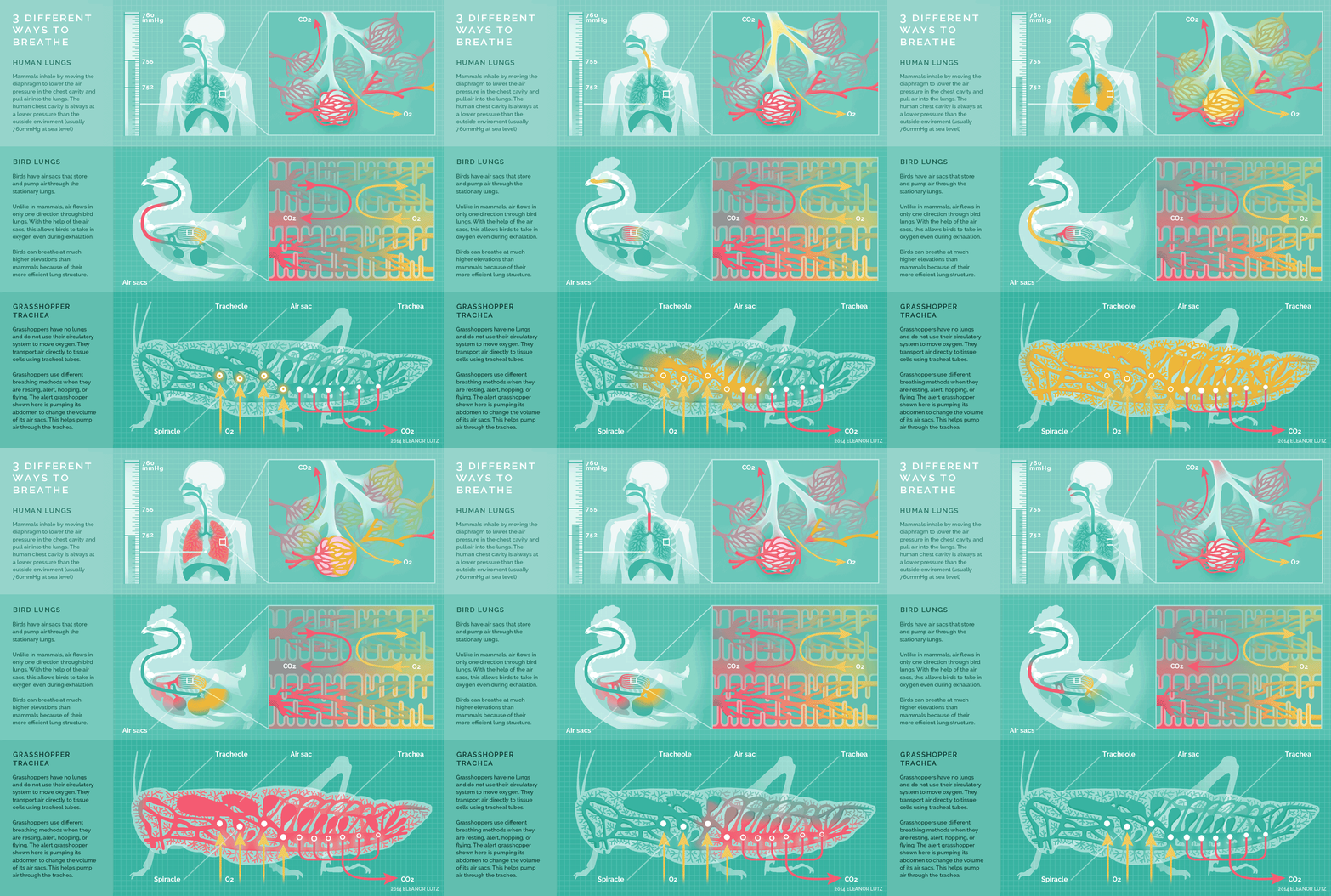 |
| Different ways of breathing [Source: http://tabletopwhale.com/img/posts/10-24-14.gif] |
Thursday, October 9, 2014
Identifying fake physics in videos to teach physics

Physics professor Rhett Allain wrote an interesting post about how you can spot if a video has been manipulated by analysing the physics. Allain's post could by used by physics teachers to teach about physics as well as a resource in a course about video editing. See Allain's post here.
Monday, July 28, 2014
Epistemological difference between science and mathematics
 |
| Difference between science and mathematics [Source: http://www.sciencedump.com/] |
Wednesday, July 16, 2014
Great movies for science geeks and science teachers
 |
| Mad Scientist (Source: http://content.science20.com/) |
Here is a short list of movies that do a better job at representing science (and show the scientist as a positive hero):
Name
of the movie
|
Focus
|
Longitude (2000)
|
Technology:
A clockmaker needs to collect convincing evidence to support the reliability
of his method to measure the position of ships out in the ocean.
|
Astronomy. An astronomer strives to
collect convincing evidence that the royal calendar is inaccurate.
|
|
The Andromeda strain
(2008)
|
Scientists run experiments to explore an alien virus.
|
Architecture. The challenges of
building a Japanese castle.
|
|
Agora (2009)
|
Astronomy. Conflict between religion and
science.
|
Friday, July 11, 2014
Gender stereotypes and the lack of women in STEM careers
Role models and encouragement can make a big difference when it comes to education program and career choices. Currently, less than 25% of STEM (Science, Technology, Engineering, and Math) in the US are held by women.
Recent research (*) suggests that boys and girls have similar psychological traits and cognitive abilities, thus gender is not the determining factor for careers in STEM.
One contributor could be repeated (but often concealed) encouragements that reinforce gender stereotypes (see video below). Women need more role models, opportunities to experience, and encouragement towards careers in STEM.
(*) Hyde, J. S., & Linn, M. C. (2006). Gender similarities in mathematics and science. Science, 314(5799), 599-600
Tuesday, May 13, 2014
How climate change should be presented in the media
TV-host John Oliver and Bill Nye, the science guy, gave a interesting demontstration of how climate change should be presented in the media.
Friday, May 2, 2014
Science Fiction books that predicted inventions
This infograph illustrates how science fiction predicted innovations in science, medicine, and technology.
 Source: http://shortlist.com/entertainment/books/books-that-predicted-the-future
Thursday, February 27, 2014
Inaccuracies in scientific illustrations
Michael Stevens provides a brief overview of some inaccuracies found in common science illustrations (including several historic ones).
Thursday, September 26, 2013
Can Scientists be Atheists?

Prominent scientists, for example Richard Dawkins and Sam Harris, promote
the idea that atheism and science are inherently linked and in support of one
another (Wikipedia list of atheist scientists). However, this essay questions the validity of using science to support
atheist viewpoints.
There are three different questions that need to be answered.
First, do you believe that a higher being (deity, God) exists? Second, if yes,
what is the nature of that higher being? Third, do you believe that you can gain
knowledge (revelation) about the nature of a higher being? See figure 1.
 |
| Figure 1: Nature of God decision diagram |
The first question (nature of a higher being) can be answered in
three different ways:
- Theism: Belief in the existence of a higher being who is responsible for the initial formation of the universe and continues to causally interact (personal God). As a theist deity continues to interfere with the world, the actions of a theist deity can be experienced (Religion with revelation).
- Deism: Belief in the existence of a higher being who is responsible for the initial formation of the universe only, but does no longer interfere (impersonal God). As a deist deity no longer interacts with the world, the deity itself cannot be experienced (Religion without revelation).
- Atheist: An atheist is a person who is certain that no deities exist (strong/hard atheist). An atheist rejects the existence of deities and holds the position that there are no deities.
The second question can be answered in two
different ways:
- Gnostic: Belief that one can gain knowledge of the nature and existence of a higher being.
- Agnostic: Thomas Henry Huxley, who coined the word “agnostic” in 1869, defined it as: “Agnosticism is not a creed but a method, the essence of which lies in the vigorous application of a single principle... Positively the principle may be expressed as in matters of intellect, do not pretend conclusions are certain that are not demonstrated or demonstrable.“ An agnostic believes that nothing can be known of the existence or nature of deities (or of anything beyond material phenomena). An agnostic is a person who claims neither faith nor disbelief in God.
Answering the two basic questions allows for
several combinations (See diagram). For example, Christians are (typically)
gnostic-theists (belief that there exists a personal higher being that
interacts with the world and that one can learn about the nature of this
deity).
Many prominent scientists label themselves as
atheists, but does science provide a basis to for atheism? Can a person, in his
or her role as a scientist, know about the nature of deities (that are
transcended = above natural principles) based on scientific evidence?
The answer must clearly be no. From a (simplified) epistemological point of view, science constructs falsifiable models that aim to explain repeated observations of phenomena in the natural world. By definition, science does not and cannot make statements about “super”-natural phenomena (phenomena that are outside of the laws of nature). The method of science only deals with the natural world. Statements about the existence and nature of deities lay outside the realm of science and scientists. Science does not provide the tools for gnosis (revelation). A theistic view would be in conflict with scientists' understanding of natural processes, as a theist deity could causally interfere and therefore alter natural processes at will, which could be empirically observed and tested. As science cannot make statement about supernatural deities, it does not support atheist viewpoints. I think the only possible position for a scientist is agnostic. Only agnostics hold the view that we cannot know about deities - because it is a question outside of the realm of science.
The answer must clearly be no. From a (simplified) epistemological point of view, science constructs falsifiable models that aim to explain repeated observations of phenomena in the natural world. By definition, science does not and cannot make statements about “super”-natural phenomena (phenomena that are outside of the laws of nature). The method of science only deals with the natural world. Statements about the existence and nature of deities lay outside the realm of science and scientists. Science does not provide the tools for gnosis (revelation). A theistic view would be in conflict with scientists' understanding of natural processes, as a theist deity could causally interfere and therefore alter natural processes at will, which could be empirically observed and tested. As science cannot make statement about supernatural deities, it does not support atheist viewpoints. I think the only possible position for a scientist is agnostic. Only agnostics hold the view that we cannot know about deities - because it is a question outside of the realm of science.
The Dutch philosopher Baruch
Spinoza asked an important fourth question: What do we mean by “God”? Spinoza disagreed
with Descartes about the duality between mind and body and concluded that
everything that exists in Nature (=everything in the universe) is one and the
same reality. Therefore, as everything is subject to the same set of rules, “God” is no longer an entity outside of the
system. “God” and “Nature” become synonymous terms. Spinoza viewed “God” not as
an entity outside of nature (super-natural) but as an emergent property of the complex
system of nature itself. Spinoza’s God is the embodiment of all intricately
connected laws of nature. From this viewpoint, scientists could be considered
religious knowledge seekers as they study the patterns of nature (aka “God”) (See
figure 2). Not surprisingly, many scientists since the enlightenment shared
Spinoza’s views of God, including Albert Einstein. Einstein said “I believe in Spinoza's God who
reveals himself in the orderly harmony of what exists, not in a God who
concerns himself with fates and actions of human beings.” (New York Times,
April 25, 1929).
 |
| Figure 2: Spinoza's God |
Spinoza’s view of God even aligns with
hard-core atheists like Richard Dawkins. Richard
Dawkins argued that he is an “atheist” because in his work as a scientist he
(so far) never needed to add “God” as a variable to explain a natural phenomenon.
In Spinoza’s view, “God” is not an external variable but all variables
combined. It can be assumed that most self-proclaimed
atheists would not have an issue with Spinoza’s view of God but only with the
idea of a personal God (theism) (who can meddle with humans and natural laws at
will). Most “atheists” would therefore be more accurately described as
“anti-theists”.
This essay concludes with two statements. First,
whenever you make a statement about “God” you should disclose in which role you
are making this statement: As an individual you are (and always should be) free
to believe whatever you like. However, if you make a statement in your role as
a scientist, then you are bound to falsifiable statements and evidence. Science,
by its very definition, does not provide the tools to prove or disprove the
existence or non-existence of supernatural deities. Astrophysicist Neil
DeGrasse Tyson describes himself as an “agnostic”. E.O. Wilson stated "I would even say I’m agnostic because I’m a scientist. Being an agnostic means saying, dogmatically, that we will never be able to know, so give it up." (Source). Even Richard Dawkins doesn't describe himself as a strong atheist but as a "de-facto atheist" (which refers to the belief that while god(s) cannot be absolutely proven not to exist, their existence could be provisionally described as extremely improbable) [which aligns with the view of science]. When talking about
supernatural deities, the only position a scientist can take is agnostic. An
agnostic answers the question “Is there a God?” with “I don’t know because I
cannot know”. Second, when talking about God you should always clarify what you
mean by “God”: Do you consider God a personal or impersonal entity? Do you
consider God to be outside of nature or an emergent property of nature itself? Applying
some philosophical rigor (and tolerance) to religious discussions could avoid
many misunderstandings and unproductive arguments.

Also, see this video on the discussion an atheism.
Astrophysicist Neil deGrasse Tyson describes himself as "agnostic":
Pablo Stanley's comic sums up the four different position on the gnostic/agnostic vs theist/deist axis:

Wednesday, November 28, 2012
Causes for the persistent denial of evolution
 |
| Source: https://blogger.googleusercontent.com/img/b/R29vZ2xl/AVvXsEiWFZbj8Rb3st3cV-wf4VGimgU0IpBZJVnDng91tAoTsL33oegAdf9igjR9kFZn-pvgEqyn97NIT7QOPW_yZhfx98NMrkw4M68pkN1c7I5qiJeQNkXvts7_s6w4PMs6wvpScoZ4g1IHrcg/s1600/denialism.jpg |
Read more here: http://nothinginbiology.org/2012/11/27/science-denial-is-rationa/
Unfortunately, the article doesn't have any concrete suggestions how to better promote scientific understanding and acceptance among religious people.
Friday, November 16, 2012
Why education research should matter to educational practice
 |
| Geek Manifesto (by Mark Henderson) [Source: http://geekmanifesto.wordpress.com/about/] |
Chapter 7 refers to the connection between science and education. Here is a quick summary of the main points:
-Currently, schools do not pay enough attention to findings from science (e.g. brain research, cognitive science, or education research). Additionally, schools don't apply scientific methods themselves by systematically implementing promising changes in quasi-experimental setups.
Some positive examples:
-brain research suggested that teenagers brains (different from younger children or adults) work better later in the morning [Most schools still operate on the industrial-age model that treats early rising as a virtue]. A UK school who pushed the first lessons for teenagers back by an hour documented great improvement in attendance and test performance (The principal also noted that other factors might have contributed to these improvements).
-Research suggests that the ability for delayed reward and self-control (findings from the famous marshmallow experiments) are major predictors of success in life (along with IQ and socio-economic background). Role-playing exercises, martial arts, or yoga could help students learn accept delayed gratification.
-Research suggests that boys and girls learn differently, especially around puberty. Education could use these findings to create different tasks for boys and girls.
Henderson suggests that education research, similar to medical research, should implement exhaustive randomized controlled trials (RCTs). Currently, school reforms are often policy-driven (or driven by for-profit companies who are pushing their educational products) instead of evidence-driven. School reforms could use RCTs by gradually rolling out new initiatives in randomly chosen schools. Only after results from these first schools show positive effects will an initiative be implemented system-wide. Later adopters can serve as a control group for study.
In the medical profession, many doctors are also researchers. As practitioner-researchers they are in the best position to evaluate new methods or suggest new ideas based on their experience. It is not necessary that all teachers become action researchers, but that they are familiar with research methodologies, interested in participating in studies, and receptive to using findings of research in their practice. Teachers should be expected to keep up with recent developments and discuss them with their peers. Schools could set up "journal clubs" in which current scientific findings relevant to education can be discussed. Teachers need accessible academic literature to keep them informed of current findings.
School science often focuses on the product of science ("facts") but not on how these findings came to be (the process of science). Understanding the nature of science should become an central focus of the science curriculum to foster students' approaching problems in a scientific way, appreciate scientific findings in the media and being able to critically evaluate them (e.g. "correlation does not equal causation"). As Carl Sagan said in Demon-Haunted World: "If we teach only the findings and products of science - no matter how useful and inspiring they may be - without communicating its critical method, how can the average person possibly distinguish science from pseudoscience?". Science education should give students the mental tools to distinguish science (e.g. theory of evolution) from non-scientific views (e.g. intelligente design and creationism). Learning about philosophy of science requires teachers who have strong disciplinary knowledge and received appropriate training in philosophy of science.
Learning science requires time. K-12 education should extend the amount of time students learn about science. Additionally, students need early career advice to see the relevance of science for future jobs. School science should have strong connections to current scientific research, e.g. through field trips to laboratories, inviting scientists as guest speakers, connect to scientists as mentors for science projects, participate in citizen science projects.
Subscribe to:
Posts (Atom)