Showing posts with label Philosophy. Show all posts

Friday, September 25, 2015

Overview of theories of learning/ theories of education


Philosophy, education research, psychology, and neuroscience offer many different theories to describe 'learning'. In general, learning theories can be categorized into six major groups:
Six major perspectives of learning
Each category includes different frameworks and educational concepts. Here is a small selection:
Expanded view of the six perspectives of learning [Click to enlarge]
The two diagrams above are a small part of a much larger diagram. To capture some of the complex relations between different theories of education and philosophical views, I created a dynamic knowledge visualization of main education theories and concepts using the dynamic mindmap tool TheBrain (one of my favorite tools). My mindmap includes major theories of education and education research methods.

This mindmap is ongoing work in progress. Your feedback and suggestions are welcome.

To navigate the dynamic mindmap below, just click on a term and it will move to the center - showing related concepts. You can also search for terms in the textbox at the bottom.


See this mindmap on the webbrain.com website (where you can find other interesting mindmaps).

Another attempt to present an overview of theories of education was created by the HoTEL project (Holistic Approach to technology-enhanced learning) [Visit their website to download an interactive version of their diagram).

Wednesday, October 22, 2014

Characteristics of a competent human being

What are the characteristics of a competent human being, a real man/woman?

"A human being should be able to change a diaper, plan an invasion, butcher a hog, conn a ship, design a building, write a sonnet, balance accounts, build a wall, set a bone, comfort the dying, take orders, give orders, cooperate, act alone, solve equations, analyze a new problem, pitch manure, program a computer, cook a tasty meal, fight efficiently, die gallantly. Specialization is for insects."
Robert Heinlein, Time Enough for Love

Or in other words:
“If you can keep your head when all about you 
Are losing theirs and blaming it on you,
If you can trust yourself when all men doubt you,
But make allowance for their doubting too;

If you can wait and not be tired by waiting,
Or being lied about, don't deal in lies,
Or being hated, don't give way to hating,
And yet don't look too good, nor talk too wise

If you can dream - and not make dreams your master;
If you can think - and not make thoughts your aim;
If you can meet with Triumph and Disaster
And treat those two impostors just the same;

If you can bear to hear the truth you've spoken
Twisted by knaves to make a trap for fools,
Or watch the things you gave your life to, broken,
And stoop and build 'em up with worn-out tools

If you can make one heap of all your winnings 
And risk it on one turn of pitch-and-toss,
And lose, and start again at your beginnings
And never breathe a word about your loss;

If you can force your heart and nerve and sinew
To serve your turn long after they are gone,
And so hold on when there is nothing in you
Except the will which says to them: 'Hold on!'

If you can talk with crowds and keep your virtue,
Or walk with Kings - nor lose the common touch,
If neither foes nor loving friends can hurt you,
If all men count with you, but none too much;

If you can fill the unforgiving minute
With sixty seconds' worth of distance run,
Yours is the Earth and everything that's in it,
And - which is more - you'll be a Man, my son!” 

― Rudyard KiplingIf: A Father's Advice to His Son

Thursday, September 26, 2013

Can Scientists be Atheists?


Prominent scientists, for example Richard Dawkins and Sam Harris, promote the idea that atheism and science are inherently linked and in support of one another (Wikipedia list of atheist scientists). However, this essay questions the validity of using science to support atheist viewpoints.

There are three different questions that need to be answered. First, do you believe that a higher being (deity, God) exists? Second, if yes, what is the nature of that higher being? Third, do you believe that you can gain knowledge (revelation) about the nature of a higher being? See figure 1.


Figure 1: Nature of God decision diagram
The first question (nature of a higher being) can be answered in three different ways:

  • Theism: Belief in the existence of a higher being who is responsible for the initial formation of the universe and continues to causally interact (personal God). As a theist deity continues to interfere with the world, the actions of a theist deity can be experienced (Religion with revelation).
  • Deism: Belief in the existence of a higher being who is responsible for the initial formation of the universe only, but does no longer interfere (impersonal God). As a deist deity no longer interacts with the world, the deity itself cannot be experienced (Religion without revelation).
  • Atheist: An atheist is a person who is certain that no deities exist (strong/hard atheist). An atheist rejects the existence of deities and holds the position that there are no deities.

The second question can be answered in two different ways:

  • Gnostic: Belief that one can gain knowledge of the nature and existence of a higher being.
  • Agnostic: Thomas Henry Huxley, who coined the word “agnostic” in 1869, defined it as: “Agnosticism is not a creed but a method, the essence of which lies in the vigorous application of a single principle... Positively the principle may be expressed as in matters of intellect, do not pretend conclusions are certain that are not demonstrated or demonstrable.“ An agnostic believes that nothing can be known of the existence or nature of deities (or of anything beyond material phenomena). An agnostic is a person who claims neither faith nor disbelief in God.

Answering the two basic questions allows for several combinations (See diagram). For example, Christians are (typically) gnostic-theists (belief that there exists a personal higher being that interacts with the world and that one can learn about the nature of this deity).

Many prominent scientists label themselves as atheists, but does science provide a basis to for atheism? Can a person, in his or her role as a scientist, know about the nature of deities (that are transcended = above natural principles) based on scientific evidence?

The answer must clearly be no. From a (simplified) epistemological point of view, science constructs falsifiable models that aim to explain repeated observations of phenomena in the natural world. 
By definition, science does not and cannot make statements about “super”-natural phenomena (phenomena that are outside of the laws of nature). The method of science only deals with the natural world. Statements about the existence and nature of deities lay outside the realm of science and scientists. Science does not provide the tools for gnosis (revelation). A theistic view would be in conflict with scientists' understanding of natural processes, as a theist deity could causally interfere and therefore alter natural processes at will, which could be empirically observed and tested. As science cannot make statement about supernatural deities, it does not support atheist viewpoints. I think the only possible position for a scientist is agnostic. Only agnostics hold the view that we cannot know about deities - because it is a question outside of the realm of science.
The Dutch philosopher Baruch Spinoza asked an important fourth question: What do we mean by “God”? Spinoza disagreed with Descartes about the duality between mind and body and concluded that everything that exists in Nature (=everything in the universe) is one and the same reality. Therefore, as everything is subject to the same set of rules,  “God” is no longer an entity outside of the system. “God” and “Nature” become synonymous terms. Spinoza viewed “God” not as an entity outside of nature (super-natural) but as an emergent property of the complex system of nature itself. Spinoza’s God is the embodiment of all intricately connected laws of nature. From this viewpoint, scientists could be considered religious knowledge seekers as they study the patterns of nature (aka “God”) (See figure 2). Not surprisingly, many scientists since the enlightenment shared Spinoza’s views of God, including Albert Einstein. Einstein said “I believe in Spinoza's God who reveals himself in the orderly harmony of what exists, not in a God who concerns himself with fates and actions of human beings.” (New York Times, April 25, 1929).


Figure 2: Spinoza's God
Spinoza’s view of God even aligns with hard-core atheists like Richard Dawkins. Richard Dawkins argued that he is an “atheist” because in his work as a scientist he (so far) never needed to add “God” as a variable to explain a natural phenomenon. In Spinoza’s view, “God” is not an external variable but all variables combined. It can be assumed that most self-proclaimed atheists would not have an issue with Spinoza’s view of God but only with the idea of a personal God (theism) (who can meddle with humans and natural laws at will). Most “atheists” would therefore be more accurately described as “anti-theists”.

This essay concludes with two statements. First, whenever you make a statement about “God” you should disclose in which role you are making this statement: As an individual you are (and always should be) free to believe whatever you like. However, if you make a statement in your role as a scientist, then you are bound to falsifiable statements and evidence. Science, by its very definition, does not provide the tools to prove or disprove the existence or non-existence of supernatural deities. Astrophysicist Neil DeGrasse Tyson describes himself as an “agnostic”. E.O. Wilson stated "I would even say I’m agnostic because I’m a scientist. Being an agnostic means saying, dogmatically, that we will never be able to know, so give it up." (Source). Even Richard Dawkins doesn't describe himself as a strong atheist but as a "de-facto atheist" (which refers to the belief that while god(s) cannot be absolutely proven not to exist, their existence could be provisionally described as extremely improbable) [which aligns with the view of science]. When talking about supernatural deities, the only position a scientist can take is agnostic. An agnostic answers the question “Is there a God?” with “I don’t know because I cannot know”. Second, when talking about God you should always clarify what you mean by “God”: Do you consider God a personal or impersonal entity? Do you consider God to be outside of nature or an emergent property of nature itself? Applying some philosophical rigor (and tolerance) to religious discussions could avoid many misunderstandings and unproductive arguments.


Also, see this video on the discussion an atheism.


Astrophysicist Neil deGrasse Tyson describes himself as "agnostic":


Pablo Stanley's comic sums up the four different position on the gnostic/agnostic vs theist/deist axis:

Friday, October 26, 2012

Open access academic publishing

The traditional academic publishing process is flawed. Tax-money funded research is published in journals that are only available through very expensive subscriptions. The public gets charged twice (for the research and access to the publications). Research should be made more accessible so  it can be used for decision-making and further research.

You can learn about open access academic publishing at Open Access Week: http://www.openaccessweek.org/

You can get open access to scientific publications here:


The video below, illustrated by Jorge Cham from PhD Comics, discusses some of the main elements of the open access debate:

Monday, July 9, 2012

Visualizing Western Philosophy

Simon Raper used Wikipedia and gephi to generate a graph the shows which philosopher influenced one another. Building on social network analysis, the graph can be used to identify most influencial philosophers (not surprisingly, Aristotle, Kant, Hegel, Marx and Nietzsche).

The original blog post also describes the procedure how the graph was generated: http://drunks-and-lampposts.com/2012/06/13/graphing-the-history-of-philosophy/

Network of Western Philosophers (Click here to enlarge)
[Created by Simon Raper]
People interested in a dynamic visualization of Western Philosophy (with a focus on education) might be interested in this Webbrain (Click on a term to read the notes below or type a search term in the box):

Friday, May 25, 2012

From knowledge hierarchies to networks

Manuel Lima is a Senior UX Design Lead at Microsoft Bing and founder of VisualComplexity.com

In his RSA talk, Lima discusses a epistemological paradigm shift from hierarchical tree structures (what philosopher Deleuse calls "arborescent") where branches are separate from each other to networks (what Deleuse calls "rhizomatic") where everything can be connected to everything with no top or bottom.

Tuesday, October 4, 2011

Science and Enlightenment


[This blog post is based on a talk given by Sir Harold Koto at the University of Sydney on the 4th of October 2011]. Harold Kroto received the Nobel Prize in Chemistry in 1996 for his work on the Buckminster Fullerene)

Before science was called "science" it was known as "natural philosophy" - referring to gaining wisdom/knowledge from observing nature. This is the defining characteristic of science: Scientific ideas are based on evidence - observations of nature.

Scientific theories are models that try to approximate nature. Science is the only method that creates knowledge with any degree of reliability. Modern science is only possible through its foundation in symbolic algebra, calculus, and statistics. The mathematical basis of science allows describing the reliability of scientific theories (how far a scientific theory is from the "truth"). [Some philosophers point out that there might not be just one "Truth" but only socially constructed "thruths".]

Many people today do not understand the nature of science - in part because science education focuses on the products of science and not the process; and because there is no mandatory course for "nature of science". Koto suggest to make "nature of science" part of every undergraduate program.

Great quote by J.F. Kennedy: "The great enemy of the truth is very often not the lie - deliberate, contrived and dishonest, but the myth - persistent, persuasive, and unrealistic. Belief in myth allows the comfort of opinion without the discomfort of thought."

Koto highly recommends the essay "Scientists as Citizens" by Sir John Cornforth.

Koto advertised his two own projects: Vega (a collection of video presentations of scientists) and Geoset (a series of instructional science and engineering videos produced by college students). The main goal is to promote science and establish scientists as role models (to replace singers, sports stars, actors, and models).

Koto's efforts for science education go along the line of other prominent scientists, for example:
-Sally Ride (first female US astronaut): Sally Ride Science 
-Leon Lederman (Nobel Prize in Physics): Lederman Science Center
-Richard Dawkins (Evolutionary biologist): The Magic of Reality (a science book for children).

The only shortcoming of these commendable efforts is that they are driven by scientists with limited involvement of the education community. Ideally, science education researchers could provide the framework to guide these projects to make them more effective.

Saturday, August 20, 2011

Strategies for how to live forever

Every human is mortal. Our time on earth is limited. This ultimate truth motivates us to find ways to overcome our mortality.

For example, 
A) by extending your lifespan [body immortality], 
B) by preserving your unique self [mind and soul immortality], or 
C) by creating a legacy that reminds people of you [social immortality].

[Click to enlarge]
There are different strategies to delay or beat the inevitable [See concept map above].

Social immortality: You can try leaving a legacy that reminds people of your unique self, for example by creating artwork (writing books, composing songs, paint a picture, etc.) or donating money (aka to have something named after you).

Mind immortality: You can try preserving your unique mind, either actively by uploading your mind (see technological singularity), or passively by passing on your ideas (for example through educating your children or through your artwork).

Body immortality: You can try preserving your body as long as possible through a healthy diet, sports, and medicine. Beyond that, you can enhance your body through robotic replacement parts, freeze your body (cryogenics), or use cloning (to get new body parts). The most common way to achieve body immortality is passing on your genes to your children. This comes with the additional benefit that you can also pass on some of your values and ideas to your children [See mind immortality].

Soul immortality: The concept of an immortal part of ourselves - the soul - is promoted by numerous religions. 

People are often heavily invested in a particular belief system that promises eternal life. Many wars have been fought over different immortality systems [For example, see the interesting and humorous book on death and afterlife "Heidegger and a Hippo walk through those Pearly Gates"].

No matter what immortality strategy you pursue, ultimately we are all on the same level - we are all mortal and should try to make the best out of the limited time we have.

Some more ideas for how to extend your life [see infograph below]:

Monday, March 7, 2011

History of Philosophy as 3D mindmap

Webbrain is a dynamic 3D mindmap. Deleuze scholar Christophe Calis used webbrain to create this overview of the history of western philosophy (with a specialfocus on the work of Gilles Deleuze). [It might take a moment to load.]

Monday, November 29, 2010

Science and the Loss of Certainty


By Beat Schwendimann

The world we live in is a complex environment. Humans are seeking to find order in chaos and longing for certainty.  Humans are driven to understand how the world works and what keeps the world together. This knowledge allows humans to predict and control the world. 
Early cultures aimed to explain natural phenomena by conceptualizing them as the doing of gods. The ancient Greeks distinguished between the gods (rational control) and the Titans (elementary forces), with the gods dominating over the titans. The concept of gods served as a higher order principle that allowed explaining a wide range of phenomena. Understanding the characteristics of gods, combined with devotion and sacrifices, gave people the comforting illusion of having some control over the chaos. (See blog entries on Representations of knowledge in mythology and Trees of Knowledge)
Humans created other mental concepts to see order in the world, for example structuring the world into a system of opposing elements. Seeing the world through the lens of basic elements made the world appear orderly, manageable, and controllable, for example the ancient Greeks distinguished four elements and the Chinese used five elements.

Aristotle distinguished two different forces that influence the world:
  • Episteme: The purpose of the universe ‘pulls’ objects towards the grand goal. The transcendental structure of the universe gives everything purpose and direction. This structure and purpose of the universe is meta-physical (non-physical). Aristotle understood this grand idea of the universe as ‘God’. However, this philosopher’s view of God as being a single impersonal ordering principle of the universe differed from the colorful pantheon of the common people. God was understood as being the order and the purpose of the universe. This allowed reasoning about why things happen (reasoning about the intentionality of phenomena).
  • Techne: This refers to the forces between material objects. The world of objects works through causal relationships. Causal connections ‘push’ objects without the need for intentionality on the side of the object.


According to Aristotle, reasoning about the world can happen on the level of Episteme (ideas, intentionality) or Techne (objects). However, Episteme was regarded as of higher order as Techne (God higher than natural elements). Over the centuries, organized religion promoted God as the controlling force. Belief in God was a comforting certainty for many people. The Christian Church actively silenced any critical voices who dared to question God’s existence or the Church’s authority (which was based on the belief of God’s existence). Christian philosophers attempted to prove God’s existence through a series of logic proofs. However, skeptics showed that none of the proposed ‘proofs’ of God’s existence finally held true. Descartes showed that everything could be doubted - except one’s own realization of existence. Even one’s own existence could still be an illusion, but at the least there must be some form of consciousness that creates that illusion. Rationalism brought an end to Episteme reasoning (belief in God) as no logic proof for the existence of God could be found. Nietzsche provocatively declared the death of God. He reasoned that God only exists as long as there are followers who believe in him. Since the Enlightenment period, the Christian Church lost significant influence and people started looking for alternative ways to find certain true knowledge.

People turned from Episteme to Techne as the way to find Truth. Since the Enlightenment, empiricist science became increasingly popular. At first, science was mostly considered a hobby of aristocrats displayed in for entertainment in social clubs. However, science found its way into the school curriculum and became a major enterprise. Science focuses exclusively on the natural world, which is composed of objects that behave according the certain causal natural laws. Empirical natural science began to replace religion as the source of trustworthy knowledge [1] . Scientific laws appear to be certain and reliable, based on repeatedly cross-checked evidence.


Scientists shattered many previously held false beliefs. Humankind, especially in the Western world, was certain that earth is the center of the universe. This geocentric view was challenged by Copernicus and Gallilei. Considering their observations of star movements, they concluded that only a heliocentric model of the solar system could explain their observations. Humankind lost its place in the center of the universe. Modern astronomy moved earth even further away from being central in the universe: Earth is not the only planet but only one of many. Our sun is only one of many and not even in the center of the galaxy but far out in one of the branches. Our galaxy is not the only one but only one of many.
Humankind may have lost its place in the center of the universe, but people could still be certain about the space around them and the flow of time. Einstein took this certainty away. He discovered that time and space are connected to each other, making both of them relative to each other. Space and time are not absolute but change with the influence of mass, for example the curvature of space around a black hole, or speed, for example the difference in the speed of time as seen from objects that move at different speeds.

Humankind lost the certainty of being in the center of the universe, space and time. However, people could still hold on to the belief that humankind holds a unique place in nature. Darwin took the belief that the existence of humankind and every individual human has a higher purpose away. He presented evidence that there is no divine plan in nature, but that life changes according to the undirected mechanism of natural selection. Since Darwin, his ideas of evolution got extended and confirmed by many different branches of science. Humans are no longer God’s special creation, but cousins of apes. 
The scientific view does not offer the comfort of a benevolent divine plan and an afterlife. However, science offered humankind the comforting belief in the certainty of causal natural laws. Hume shattered this certainty. His skepticism destroyed the very foundations of science. Hume pointed out that natural “laws” are not necessarily true, but only contingent. Natural “laws” and principles are based on repeated observation, for example the rising of the sun. However, repeated observation of a phenomenon is no sufficient and necessary guarantee that it will happen again. Hume changed our understanding of science as resulting in necessary Truth to statistical ‘truth’. Science does not and cannot result in Truth [2]. There are several reasons for this: First, as Hume pointed out, causal relationships are only contingent not necessary. Statistical methods were developed to estimate how far we are from the Truth, without ever reaching it. Second, measurements with scientific instruments always include certain measurement errors. We can never measure the world with finite precision. Third, scientific measurements need interpretation. They do not tell us truth in their raw data form. For example, a probe delivers a string of numbers. The scientist needs to decide how to group those numbers to find patterns, defines certain values as desirable, and decides which outliers to exclude.

Hume’s critique ended Aristotle’s Techne reasoning the way Descartes critique ended Aristotle’s Episteme reasoning. This left the world in an epistemological void. Scientific findings are by definition always tentative and do not give us the comfort of certainty. 

Since Hume, many philosophers responded to his critique of science in an attempt to open up another path towards Truth. Kant argued that while we cannot find causal connections in nature itself, our brain is hardwired (a priori) to construct causal understanding. Kant proposed that all humans are born with the same hardwired capacity to construct such causal views of the world. In Kant’s view, there was one Truth out there (‘the thing in itself’) but we cannot ever perceive the true world directly. We can only perceive phenomena and construct causal mental models of them. As all humans are born with the same senses and basic mental processing capabilities, we all perceive the world in a similar but not identical way. As all humans have the same rational capacities, we can detect and eliminate false ideas.
Hegel responded to Kant by criticizing his view that all humans have the same hardwired (a priori) rational capacities. The existence of rationality cannot be justified without already presuming rationality. If Truth is not to be found out there in the world but only in our heads, then our minds will be fundamentally influenced by the society we live in. Hegel reasoned that the human mind is not hardwired (a priori) but formed through experience (a posteriori). Depending on which society we grow up and live in, we will acquire different mental concepts (some of them false and some of the true). Hegel believed that societies need to go through a dialectic process in which each next generation eliminates the false ideas of the previous one until one generation reaches the ultimate Truth.
Marx critiqued Hegel’s dialectic process by pointing out that as long as the power relations remain the same from generation to generation false ideas cannot be eliminated. Marx suggested that society should not be ruled by the wealthy, but by a group of intellectuals who would know best how to create an egalitarian society. Neo-Marxists, for example the Frankfurt School, criticized Marx’s view by pointing out that a ruling class of intellectuals would not eliminate power structures but only shift them. To ultimately eliminate false ideas, humankind would need to become truly egalitarian by overcoming all hierarchies of power and becoming a multicultural and class-free society. Hegel, Marx, and the Neo-Marxists were all positive that their utopian society could indeed be created and Truth be found (liberation from all false consciousness).

Post-modernism criticized this positive view that power structures can ever be truly overcome. Power is pervasive. There can never be a society without hegemony and therefore interest-free Truth can never be reached (if it exists at all). Dewey responded in a pragmatic way: If we cannot ever overcome power structures, then we should abandon the illusion to ever find that one Truth altogether and focus instead on finding pragmatic “truths” that allow us solving practical problems. Dewey viewed scientific inquiry not as a way to find Truth, but as a way to find practical solutions to solve problems. Through systematic inquiry, society can determine which ideas work and which do not. Dewey’s vision is a society, which is open to scientifically try out new ideas, learns from its experiences, and continually grows in whatever direction it functions best (similar to natural evolution).  Pragmatism seems to work well to advance technology and solve problems, but it gave up on ever finding Truth.

As we cannot find Truth independent of cultural influences, Dilthey suggested approaching Truth by going to opposite way - by further deepening our understanding of cultural influences in our mental frameworks. Studying another human means to communicate from one mental framework to another. There is no “view from nowhere”. Projecting one’s own framework onto another person’s framework does not lead to true understanding. Noddings suggests to perceive the other person’s view instead of projecting one’s own views onto the other. 

Truth is no longer seen as being external and to be discovered, but as a construct through negotiation. This is a different definition of truth than the transcendental absolute Truth that exists outside of language in humans’ heads. This is the practice in communities of scholars: The scientific community aims to create a shared understanding by creating shared definitions and agreeing on certain methods.  If truth is defined as a mental construct, then truth is no longer an external fix point, but is only “relatively true”. Instead of looking for Truth-out-there, we can try to understand how truth inside our heads is constructed. This is a loop back to Aristotle’s Episteme. This line of (qualitative) research aims to understand the factors that influence human thought and how human thought is structured. Humans are no longer seen as objects that behave according to causal “laws” but as subjects who have intentions (will). As a researcher cannot step outside his or her own conceptual framework, it is important to make underlying factors of conceptual frameworks explicit, for example our conventions, definitions, and social visions. To understand another person’s intentions, one needs to understand one’s own intentions. However, Freud destroyed our belief that we understand our own intentions. Our intentions (our will) are not primarily controlled by our conscious verbal rational mind (ego), but by the nonverbal subconscious (Id and super-ego). Only through indirect methods (symbols, dreams, self-reflective psychoanalysis) can we try to access the subconscious (which contains also cultural and social experience). Understanding of the human mind (its conscious or subconscious parts) is ultimately an interpretative activity with no ultimate answer. Our trust in knowledge (certainty) cannot be found in an external ultimate foundation, but can only be grounded in our capacity to interpret what is there. 
This review of the search for certain Truth showed that the current approaches fail to find absolute Truth. I believe that there is only one reality (Truth) out there that existed long before humans came along. Being human however, we cannot ever perceive this true reality unbiased. Through our limited senses, we do not see the world as it is, but perceive only a filtered and interpreted representation of it. Depending on our existing mental framework, we interpret what we see differently. This perception varies from person to person to some degree. We do not passively perceive the world, but rather actively construct our view of the world. I agree with Kant that all humans have certain inherited mental processing capabilities. However, the interpretations of those perceptions are dependent on our concepts, which are culturally acquired. We cannot step outside of those cultural bonds.

While I consider it desirable to find ultimate Truth that could give us the comfort of certainty, philosophy showed that our current epistemological approaches couldn’t lead us there. Science aims to find culture-neutral truth, but it can only lead to pragmatic approximations. Science made the development of modern technology possible, but it cannot discover or construct Truth. Constructs of truth are always influenced by culture. This can lead to the view that there are many truths and that no judgment can ever be made (no certainty; anything goes) over another viewpoint (hard relativism). However, while I agree that we cannot know which idea is absolutely right or ultimately best, we can at least say which ideas are wrong (soft relativism). Based on Popper’s falsification concept, evidence shows which ideas did not work in the past. This pragmatist view represent a middle ground between only one Truth (ONE Truth) and everything goes (MANY truths). Evidence-based judgment of false ideas is justified and necessary while still allowing for alternative ideas (SOME truths).

Living in a world dominated by science means living in a world without the comfort of (albeit illusionary) certainty of pre-scientific times. Science took our false trust in the certainty of knowledge away (See blog entry Knowledge comes at a high price). However, science does not provide us with ultimate Truth either, it can only show us in a piecemeal fashion what is not true. I find it disappointing that there seems to be no way to ever reach Truth. Living in a science world comes with the price tag of living in a world without the comfort of certainty of what is true.  Our next best approach is to pragmatically construct relative truths that aim to approximate Truth, without ever reaching it. I agree with Popper who said “I believe in absolute Truth, but I don’t believe anybody has it in his pocket.” Despite all our scientific and technological advances, finding ultimate certain Truth still seems to be as far away as it ever was. As all our knowledge is influenced by culture, we need to critically self-reflect on our own and our culture's concepts, definitions, conventions, methods, and goals. This allows us to define a social vision and ethics, but they will always remain relative and only one of many possible ideas.


_______
[1] Knowledge is traditionally defined as “justified true belief”. Therefore “trustworthy knowledge” is a pleonasm. In vernacular language, “belief” is often used in a religious or moral context. In philosophy, “belief” refers to all the content in a human’s mind. In vernacular use, “knowledge” refers to justified/trustworthy beliefs, while philosophy considers only “true” beliefs as knowledge. (This implies that there is one Truth out there against which beliefs can be compared to (absolute truth). Otherwise, “true” could also mean “internally consistent”, “no contradicting evidence found yet”, or “true according to a self-defined value” (relative truth).
[2] Truth (capital t) refers to the one absolute Truth (independent from humans, language, or cultural influences), while truth (minor case t) refers to multiple possible human constructed truth.

Sunday, November 28, 2010

Representations of Wisdom and Knowledge in Mythology

By Beat Schwendimann

Humans like to visualize abstract ideas to make them more tangible. In ancient times, people described abstract ideas often in the form of various gods and goddesses. Among the most abstract ideas are the concepts of knowledge and wisdom themselves. Many cultures imagined gods and goddesses of knowledge and wisdom (See previous blog entry on the difference between knowledge and wisdom).


The wisest of the Egyptian gods was Thoth (Djhuty, Djehuty, Tehuty) (depicted with the head of an isis or a baboon). Thoth was one of the earlier Egyptian gods, thought to be scribe to the gods, who kept a great library of scrolls, over which one of his wives, Seshat (the goddess of writing) was thought to be mistress. He was associated by the Egyptians with speech, literature, arts, learning. He, too, was a measurer and recorder of time, as was Seshat. The magical powers of Thoth were so great, that the Egyptians had tales of a 'Book of Thoth', which would allow a person who read the sacred book to become the most powerful magician in the world. The Book which "the god of wisdom wrote with his own hand" was, though, a deadly book that brought nothing but pain and tragedy to those that read it, despite finding out about the "secrets of the gods themselves" and "all that is hidden in the stars".


Sarasvati - Goddess of Learning
Sarasvati (also spelled Saraswati) is the goddess of learning and the inspiration for all music, poetry, drama and science. Hindu musicians pray to her before performing and students ask for her help before taking a test. Sarasvati has four hands: in one she holds a book; in another she holds prayer beads (because she is the source of spiritual knowledge, too); her other two hands hold a vina, a sitar-like musical instrument. Not suprisingly, Sarasvati is especially revered by students and teachers. At the beginning of spring (January-February), her image is taken out in a jubilant procession.

I find it interesting that Sarasvati represents learning, the PROCESS of gaining knowledge, not knowledge itself. Saravsati illustrates that knowledge needs to be gained through learning and not through some magical transfer.
Ganesha - God of Wisdom and Prudence
Ganesha is the Hindu god of wisdom and prudence. These qualities are signified through his two wives Buddhi(wisdom) and Siddhi (prudence).Ganesha has a thorough knowledge of the scriptures and is a superb scribe. Ganesha has an elephant's head with one broken tusk. According to one legend, Ganesha was asked to scribe down the epic of Mahabharata, dictated to him by its author, sage Vyasa. Taking into note the enormity and significance of the task, Ganesha realized the inadequacy of any ordinary 'pen' to undertake the task. He thus broke one of his own tusks and made a pen out of it. The lesson offered here is that no sacrifice is big enough in the pursuit of knowledge.


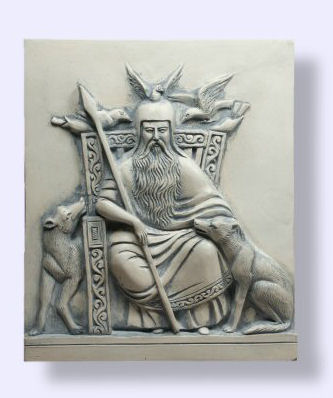
Odin with his two ravens, Huginn and Muninn
Odin was the god of battle and also of wisdom, magic, and poetry. His name means "fury" or "frenzy," the quality of fierce inspiration that guided warriors and poets alike. Despite his warrior appearance, Odin was an intellectual god. Odin was credited with great wisdom, including knowledge of magic and divination. Odin also gained knowledge of the world (Midgard) through his two ravens Huginn ("thought"), and Muninn("Memory" or "Mind").These circled the Earth each day, seeing all, and then at night reported to Odin what they had learnt.


Athena - Goddess of Wisdom (Statue in front of parlament building in Vienna)
Athena (called Minerva by romans) is the daughter of Zeus and Metis. Metis was the Titaness of the forth day and the planet Mercury. She presided over all wisdom and knowledge. She was seduced by Zeus and became pregnant with Athena. Zeus became concerned over prophecies that her second child would replace Zeus. To avoid this, Zeus devoured Metis. Athena emerged in full armor from Zeus' forehead. Athena is fierce and brave in battle but, only fights to protect the state and home from outside enemies. She is the goddess of the city of Athens, handicrafts, and agriculture. She invented the bridle, which permitted man to tame horses, the trumpet, the flute, the pot, the rake, the plow, the yoke, the ship, and the chariot. She is the embodiment of wisdom, reason, and purity. She was Zeus's favorite child and was allowed to use his weapons including his thunderbolt. Her tree is the olive. The owl is her bird. She is a virgin goddess.

Prometheus (by Heinrich Fueger 1817)
Prometheus, was the wisest Titan. His name means "forethought" and he was able to foretell the future. He was the god of fire. A master craftsman considered the wisest of his race, he was credited with the creation of humans and with giving them fire and various types of skills and knowledge. His name means "forethought." Prometheus was a wise craftsman who taught humans many useful skills, including navigation, writing, and architecture, and he brought the knowledge of fire to man (read more on how Prometheus got punished for his deed here)

In addition to the goddess Athena and the titan Prometheus who were wise and knowledgeable, ancient greeks also knew Sophia (being wisdom impersonate) and Episteme (being knowledge impersonate).

Sophia - The greek goddess of wisdom
Episteme - The greek goddess of knowledge
Today, we describe abstract concepts no longer as deities but use the language of mathematics, science, and philosophy.

Further information: Wikipedia list of Knowledge Deities

Tuesday, November 16, 2010

Robot Learns to Make Ethical Decisions

Researchers at the University of Connecticut are working on a robot that can make ethical decisions. Philosopher Susan Anderson and her research partner and husband Michael Anderson, a computer scientist, have programmed a robot to weigh decisions and make choices about what to do. In the video, the robot is asked to make a decision how often to remind a person to take medication.


Would you like to be dependent on a robot to take your medication?


Robot Makes Ethical Decisions : Discovery News