Showing posts with label Biology. Show all posts
Showing posts with label Biology. Show all posts
Tuesday, November 29, 2016
An updated view of the theory of evolution
http://www.sciencealert.com/the-world-s-top-biologists-have-met-to-discuss-whether-we-should-update-evolution


Thursday, August 18, 2016
Examples of recent evolutionary changes in humans
http://www.iflscience.com/plants-and-animals/7-strange-and-surprising-ways-that-humans-have-recently-evolved/all/
Wednesday, August 3, 2016
Advances in genetics class since your high school biology class

Over the past decades, the field of genetics rapidly developed, for example in the areas of inherited diseases, cancer, personalized medicine, genetic counseling, the microbiome, diagnosis and discovery of viruses, taxonomy of species, genealogy, forensic science, epigenetics, junk DNA, gene therapy and gene editing.
Joel Eissenberg, Ph.D., associate dean for research and professor of biochemistry and molecular biology at Saint Louis University School of Medicine summarizes major advances in genetics since the 1960s:
When Did You Go to High School?
If you took high school biology in the …
1960s, you learned about the structure of the double helix and how sequences of DNA encode amino acids.
1970s, you may also have learned about cloning and the potential for recombinant DNA.
1980s, your class may have covered the clinical use of recombinant human insulin for diabetes treatment and the advent of GMO foods.
1990s, your class may have studied the molecular basis for human genetic disorders, like cystic fibrosis.
2000s, your teachers likely described how the human genome was being sequenced.
You can find further information: http://www.slu.edu/news/2016/august/Eissenberg-genetics-essay.php
---------------------What’s changed in genetics since your high school biology class?: The field of genetics has seen astonishing breakthroughs and the development of world-changing technologies in the past half century.
Wednesday, January 13, 2016
Do-It-Yourself Gene-Editing Kit for biology education
 |
| CRISPR Kit |
Moving genes from one organism to another used to be done only by big-budget labs. Three years ago, UC Berkeley developed the CRISPR gene-editing tool. CRISPR stands for 'Clustered Regularly Interspaced Short Palindromic Repeats', which refers to a protein(Cas9) that can use an RNA guide to make highly specific cuts in DNA. This allows unprecedented abilities to edit DNA. Zayer is the first to make the CRISPR tool kit available to the masses.
The DIY gene-editing kit allows altering bacteria and yeast (which can change color, fragnance, or living requirements). The DIY CRISPR kit is available for 120$: https://www.indiegogo.com/projects/diy-crispr-kits-learn-modern-science-by-doing#/
Read more here: Do-It-Yourself Gene-Editing Kit Transforming Biology | Sci-Tech Today
Monday, June 29, 2015
Multi-level analysis strategy to make sense of concept maps
I presented my paper 'Multi-level analysis strategy to make sense of concept maps' at the sixth international conference on concept mapping in Santos (Brazil).
You find find more resources about concept maps here.
You find find more resources about concept maps here.
Friday, June 26, 2015
The difference between fruits and vegetables
This video explains why bananas are berries but strawberries are not.

Tuesday, October 28, 2014
How humans, birds, and insects breathe differently [animated gif]
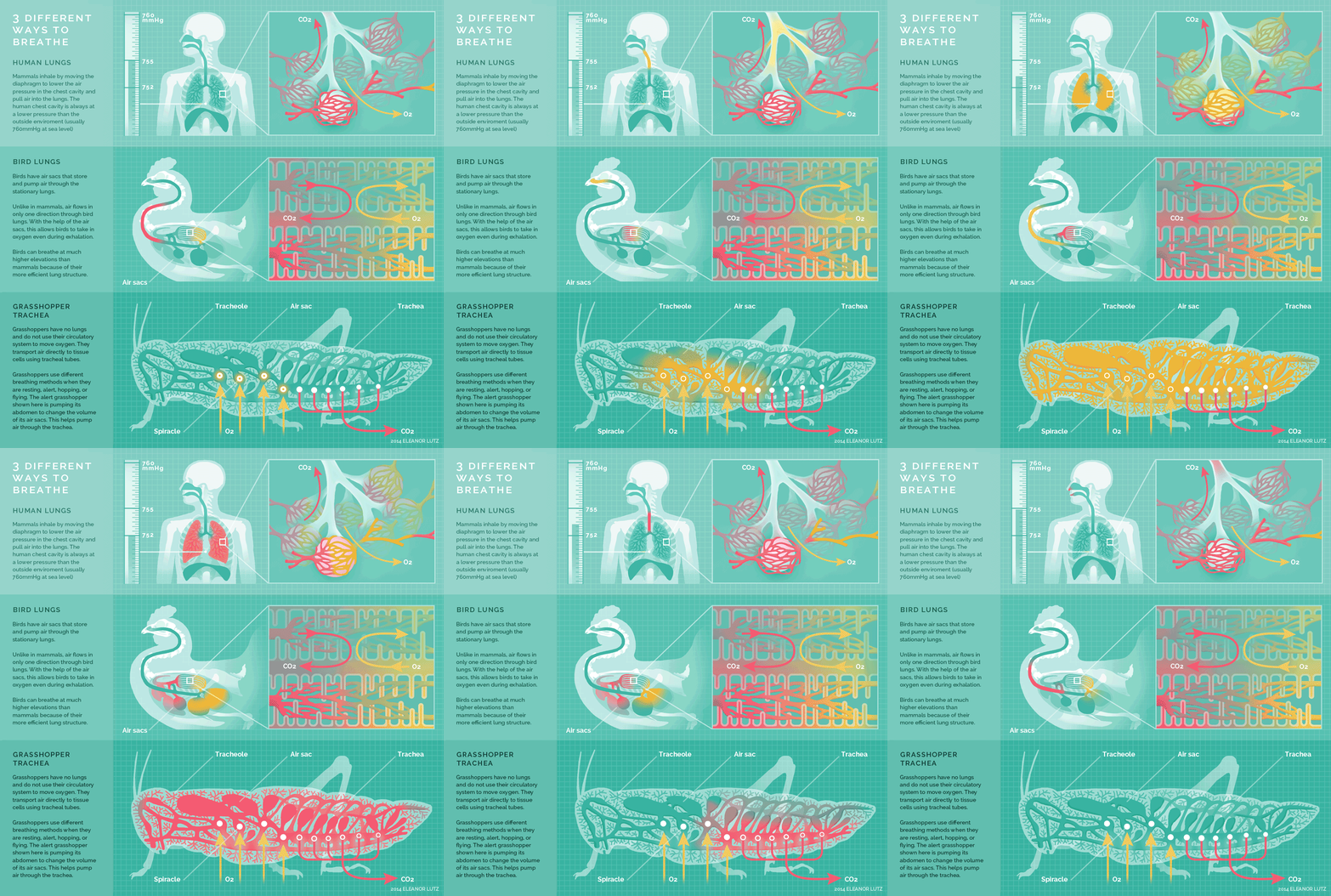 |
| Different ways of breathing [Source: http://tabletopwhale.com/img/posts/10-24-14.gif] |
Friday, October 17, 2014
Comparing two forms of concept map critique activities
 |
| Knowledge Integration Map (KIM) Source: Wikipedia |
I presented a paper at the 6th international conference on concept mapping in Santos, Brazil in October 2014 (See conference program with links to papers here). The paper introduces a new form of concept map, called Knowledge Integration Map (KIM). Different from Novakian concept maps, KIMs divide the drawing area into discipline-specific sections (see example above). Placing concept in these designated areas elicits how learners categorize these concepts and it highlights cross-links between sections. Cross-links can be seen as particularly interesting as they link concepts in different categories.
The empirical study presented in the paper compares two forms of KIM activities implemented in biology classrooms. Concept map activities often lack a subsequent revision step that facilitates knowledge integration. This study compares two kinds of concept map critique activities embedded in an evolution unit: Student dyads in one group compared their concept maps against an expert map while dyads in the other group conducted a peer-review. Analysis of the concept maps suggests that both treatment groups significantly improved their understanding of evolution. However, the two groups developed different criteria: The expert-map group focused mostly on concept-focused criteria like concept classification while the peer-review group used more link-focused criteria like link labels and missing connections. This paper suggests that both critique activities can be beneficial to making more coherent connections across different topics in biology.
The paper is available here (as PDF). The title of the paper is 'Comparing two forms of concept map critique activities to support knowledge integration in biology education'.
Thursday, February 6, 2014
Creationist education in Swiss private schools

A newspaper article published in "Le Temps" reports that three private schools in the French-speaking part of Switzerland are teaching creationist ideas in their classrooms. A representative of the three schools stated that "the theory of evolution is also presented, but not as a truth."
Teaching creationism as truth violates the local education policies that demand that students in private schools receive an education equivalent to public schools.
I find it interesting to note that the journalist found it necessary to provide a description of what creationism is "Creationism is a doctrine which, in its minimalist version postulates that the universe and living beings were created ex nihilo by God, as opposed to the theory of evolution." [I doubt that a US journalist would have found it necessary to provide a definition of creationism.]
Source: "Les écoles créationnistes réveillent les autorités romandes", Friday 31 January 2014, Le Temps (Switzerland)
Friday, March 22, 2013
Examples of directly observed evolutionary changes
 |
| Anolis Lizards |
The website phylointelligence.com has a great list (with scientific references) of examples of evolutionary changes that have been directly observed by scientists. A great resource for science teachers (and everyone interested in evolution).
See the list of observed evolutionary changes here. The examples also include the occurance of human lactase persistence which I used as a case study in my PhD (see PDF here).
Friday, January 25, 2013
A brief introduction to evolution
This youtube video by "Stated Clearly" introduces the basic mechanisms of evolution.
Friday, November 30, 2012
Knowledge Integration Maps (KIM)
 |
| Knowledge Integration Map (KIM) |
Knowledge Integration Maps (KIMs) have been developed at the University of California, Berkeley by Beat A. Schwendimann in the research group of Marcia Linn.
You can learn more about Knowledge Integration Maps in this Wikipedia article.
More about the research on Knowledge Integration Maps in my dissertation (available for free here).
Wednesday, November 28, 2012
Causes for the persistent denial of evolution
 |
| Source: https://blogger.googleusercontent.com/img/b/R29vZ2xl/AVvXsEiWFZbj8Rb3st3cV-wf4VGimgU0IpBZJVnDng91tAoTsL33oegAdf9igjR9kFZn-pvgEqyn97NIT7QOPW_yZhfx98NMrkw4M68pkN1c7I5qiJeQNkXvts7_s6w4PMs6wvpScoZ4g1IHrcg/s1600/denialism.jpg |
Read more here: http://nothinginbiology.org/2012/11/27/science-denial-is-rationa/
Unfortunately, the article doesn't have any concrete suggestions how to better promote scientific understanding and acceptance among religious people.
Monday, November 5, 2012
Understanding where new genes come from
 |
| New mutation in DNA [Image source: http://www.topnews.in/health/genetic-mutation-may-have-allowed-great-expansion-early-humans-216902] |
In their model, a mutated copy of an existing gene first gains a weak function next to its primary function. If conditions change, the secondary function might become increasingly more important.
The researchers tested their model in the bacterium Salmonella and observed changes for over 3.000 generations.
The new model aims to explain how new functional genes emerge (given that cells have mechanisms in place to constantly remove mutations).
Read more here: Evolution of new genes captured
Wednesday, August 15, 2012
Why is evolution so hard to understand?
I gave a talk today at the University of Sydney Institute for Innovation in Science and Mathematics education (IISME) on the topic "Why is evolution so hard to understand?". You can find my slides below.
Friday, August 3, 2012

Sunday, June 17, 2012
Thursday, June 14, 2012
Weird science toy: Kangaroo Egg
 |
| Kangaroo Egg |
An example of a highly confusing "science toy" (found in the gift store of the otherwise recommendable Australian Reptile Park): The "Kangaroo Egg"!
Children are instructed to put the kangaroo egg into a glass of water to watch a "pet kangaroo" hatch within 48h. Ironically, the emerging kangaroo carries a joey (baby kangaroo) in its pouch. How confusing is that! There is no explanatory text on the box that would clarify that kangaroos are marsupials that do not lay eggs.


Wednesday, June 13, 2012
Concept maps as knowledge integration tools for evolution education [Talk]
I presented a study from my dissertation (open access here) at the CoCo seminar at the University of Sydney. My talk focused on the implementation and iterative development of concept maps as collaborative tools to support the integration of concepts of evolution.
I used TheBrain as a presentation tool in combination with a SmartBoard. The Adobe Connect recording of my talk is available here. My TheBrain mindmap is available online here or see embedded dynamic map below (Click on the nodes to explore).
I used TheBrain as a presentation tool in combination with a SmartBoard. The Adobe Connect recording of my talk is available here. My TheBrain mindmap is available online here or see embedded dynamic map below (Click on the nodes to explore).
Subscribe to:
Posts (Atom)