I presented my paper 'Multi-level analysis strategy to make sense of concept maps' at the sixth international conference on concept mapping in Santos (Brazil).
You find find more resources about concept maps here.
Showing posts with label Teaching. Show all posts
Showing posts with label Teaching. Show all posts
Monday, June 29, 2015


Friday, July 11, 2014
Gender stereotypes and the lack of women in STEM careers
Role models and encouragement can make a big difference when it comes to education program and career choices. Currently, less than 25% of STEM (Science, Technology, Engineering, and Math) in the US are held by women.
Recent research (*) suggests that boys and girls have similar psychological traits and cognitive abilities, thus gender is not the determining factor for careers in STEM.
One contributor could be repeated (but often concealed) encouragements that reinforce gender stereotypes (see video below). Women need more role models, opportunities to experience, and encouragement towards careers in STEM.
(*) Hyde, J. S., & Linn, M. C. (2006). Gender similarities in mathematics and science. Science, 314(5799), 599-600
Recent research (*) suggests that boys and girls have similar psychological traits and cognitive abilities, thus gender is not the determining factor for careers in STEM.
One contributor could be repeated (but often concealed) encouragements that reinforce gender stereotypes (see video below). Women need more role models, opportunities to experience, and encouragement towards careers in STEM.
(*) Hyde, J. S., & Linn, M. C. (2006). Gender similarities in mathematics and science. Science, 314(5799), 599-600
Friday, June 28, 2013
Using superheroes to teach science
 |
| Superpowers have their limits too [Image source: http://images2.wikia.nocookie.net/] |
Find all the super-power lessons and videos here.
As an example, below is the video about super-speed.
Thursday, April 4, 2013
Inspirational future of learning video
What will the future of learning look like? GOOD magazine created a video that discusses technology-oriented visions from Whole-in-the-Wall and Khan academy to serious gaming. The video features education innovators like Dr. Sugata Mitra, visiting professor at MIT; Sal Khan, founder of Khan Academy; and Dr. Catherine Lucey, Vice Dean of Education at UCSF.
The video suggests that the current school system is still based on Victorian-age ideals (such as submission) and industrial age skills (such as arithmetic . People featured in the video suggest that education needs to prepare students for the post-industrial world. Basic arithmetic skills are now less relevant than reading comprehension, information search and retrieval skills, and critical evaluation skills.
The video suggests that the current school system is still based on Victorian-age ideals (such as submission) and industrial age skills (such as arithmetic . People featured in the video suggest that education needs to prepare students for the post-industrial world. Basic arithmetic skills are now less relevant than reading comprehension, information search and retrieval skills, and critical evaluation skills.
Tuesday, January 15, 2013
Gallup poll indicates students' loss of interest in school over time
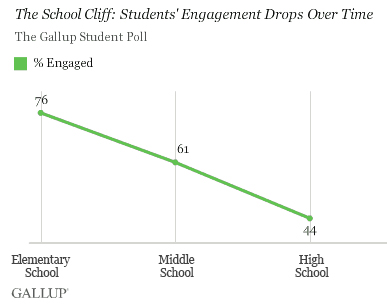
Albert Einstein said that "Education is what remains after one has forgotten what one has learned in school.“ Sadly, a recent Gallup survey of nearly 500,000 students from grades five through 12 from more than 1,700 public schools in 37 US states in 2012 suggests that students increasingly loose their interest in going to school in the first place. By the time students get to high school only about 4 in 10 qualify as engaged.
Larry Ferlazzo rightly points out that this is not a statistically valid survey as there was no random sampling involved; schools and students participated on a volunteer basis. However, the large sample size still provides an interesting dataset.
Another critique point is the measure for the construct "engagement". Here are some sample questions:
8. I have a best friend at school.
9. I feel safe in this school.
10. My teachers make me feel my schoolwork is important.
11. At this school, I have the opportunity to do what I do best every day.
12. In the last seven days, I have received recognition or praise for doing good schoolwork.
13. My school is committed to building the strengths of each student.
14. In the last month, I volunteered my time to help others.
9. I feel safe in this school.
10. My teachers make me feel my schoolwork is important.
11. At this school, I have the opportunity to do what I do best every day.
12. In the last seven days, I have received recognition or praise for doing good schoolwork.
13. My school is committed to building the strengths of each student.
14. In the last month, I volunteered my time to help others.
The data however fits well with other surveys who indicated waining interest in STEM education (See http://proto-knowledge.blogspot.com.au/2012/05/usa-fails-to-make-progress-in-stem.html)
Mark Twain suggested: Don't let school interfere with your education.
Source: A Bad Start to Lifelong Learning? - Mission to Learn - Lifelong Learning Blog
Wednesday, November 28, 2012
Causes for the persistent denial of evolution
 |
| Source: https://blogger.googleusercontent.com/img/b/R29vZ2xl/AVvXsEiWFZbj8Rb3st3cV-wf4VGimgU0IpBZJVnDng91tAoTsL33oegAdf9igjR9kFZn-pvgEqyn97NIT7QOPW_yZhfx98NMrkw4M68pkN1c7I5qiJeQNkXvts7_s6w4PMs6wvpScoZ4g1IHrcg/s1600/denialism.jpg |
Read more here: http://nothinginbiology.org/2012/11/27/science-denial-is-rationa/
Unfortunately, the article doesn't have any concrete suggestions how to better promote scientific understanding and acceptance among religious people.
Friday, November 16, 2012
Imagining the ideal teacher

I imagine the ideal teacher to be involved in three different domains (see diagram above):
-Educator: Naturally, the first domain of a teacher is education.The ideal teacher has the knowledge and skills to create an inspiring and safe environment that facilitates learning. The ideal teacher knows and cares about the backgrounds of learners. Classroom and organizational management skills allow the ideal teacher to create a well structured learning environment in which student behaviour leads to positive and negative consequences. The ideal teacher has a clear understanding of educational goals and the curriculum.
-Practitioner: A master in an apprenticeship situation is a practitioner of his/her field. For example a master carpenter, master musician, or master athlete is an active member in a community of practitioners and can demonstrate desirable skills in practice. Teachers on the other hand often do not practice their own fields. The ideal teacher would practice his/her field, for example a history teacher would conduct historical research and publish on it, a language teacher would publish novels or poems, a science teacher would be involved in current scientific research projects, etc. The ideal teacher would use his/her mastery knowledge and skills to guide students towards increasing expertise and demonstrate the practical use of knowledge in a profession. Students can respect a person who is able to put theory into practice and demonstrate mastery in his/her field.
-Researcher: Currently, there is only a limited exchange between educational research and educational practice. Teachers have unique insights and understanding of current learning environments. The ideal teacher would act as an action researcher conducting research on how to improve the learning environment for his/her students and participate in larger educational research projects. The ideal teacher would be actively involved in the educational research community be publishing in journals and presenting at conferences.
Even an ideal teacher would not be able to be an educator, practitioner, and researcher without institutional support Teachers need adequate time, salaries, and financial support. The medical professions can serve as model for such teacher-practitioner-researchers. Medical doctors are expected and required to stay up-to-date with current research in their fields. Many doctors conduct research and are active members in research communities. Similarly, teachers should be given the opportunity to be researchers and practitioners, and such outstanding efforts should be adequately recognized. The ideal teacher is an artisan and a professional who skillfully designs learning environments. Overly restrictive top-down settings (such as standardized tests and standarized curricula) are a hindrance to the professional freedom of teachers.
To get ideal teachers, the whole system requires reform: Only highly qualified students would be selected into a teacher-training program. The teacher training program is comprehensive and prepares pre-service teachers to act as researchers and educators. Job conditions for in-service teachers are comparable to medical doctors. Junior in-service teacher receive systematic mentoring by more senior teachers and are part of supportive teacher communities (both offline and online). Schools recognize teachers' achievements as educators, researchers, and practitioners. Schools give teachers the time and support needed to succeed in all three areas.
"Ideal" teacher as described above already exist, but they are much too few in numbers. The goal is to change conditions to get more teachers to approximate the ideal teacher.
Tuesday, November 6, 2012
Job searching strategies for science education researchers
Below are the slides of a short presentation I gave at the Institute for Innovation in Science and Mathematics Education (IISME) on the topic of how science education researchers can find jobs after graduation.
Tuesday, July 10, 2012
A review of 20 years of research in the Learning Sciences
 |
| Janet Kolodner |
The Learning Sciences started in the late 1980s with the foundation of the "Journal of the Learning Sciences" (JLS). The Learning Sciences (LS) are a multi-disciplinary field that aims to develop models of learning in real-world situations. LS combines constructs and methods from a variety of fields, such as cognitive science, computer science, educational psychology, anthropology, science education research, and linguistics. Findings from the Learning Sciences appeal to multiple audiences and aim to have an impact on education.
Basic observations:
-In the 21st century, everyone needs to continue learning to fully participate in the workforce and citizenry (because available tools are changing fast).
-Education may be the way to close the equity gap.
-Schools (in the dominant industrial-model as we know them) can't do it all.
After 20 years of Learning Sciences research, what do we know about learning?
1) Learning deeply (as a process of mental model building) requires sustained and long-term effort and requires a lot of help (facilitation, scaffolding): Helping learners build mental models.
a) From a cognitive perspective, learning is a process of iteratively constructing, revising, and connecting concepts (mental models, ideas, etc.): Factual knowledge and procedural knowledge.
-Becoming fluid at reasoning skills is an iterative process of composing and debugging sequences of procedural knowledge ("How-to") [Schank & Abelson; Anderson; Newell, Rosenbloom & Laird]
b) We can only learn on the edges of what we already know (Zone of proximal development) [Vygotsky]
-We realise a need for learning if we can't do something we want to do, something turns out differently than expected, or something happens that we can't explain [Schank & Abelson; Anderson]
c) Revising one's mental models requires a great deal of reflection and interpretation [Bransford; Collins; Schank]
-Framing first, details later [Collins]
-Repeated deliberate practice: Help learners to repeatedly experience the result of their decisions and interpret and reflect on those results to debug their reasoning.
-Promote asking questions and wonder to identify holes in one's mental models.
-Tell only when learners are ready (A time for telling); Give learners a role in telling their peers.
-Give learners learning goals that are relevant to them to put in the mental energy to revise mental models.
-Help learners to connect ideas (mental models) by helping them recognise and revisit prior ideas [Linn]
2) Promoting and sustaining active engagement is key to learning: Intrinsic motivation
a) Personal and epistemological connections promote engagement [Papert; Resnick]
-Learners connect when they can connect to prior knowledge.
-Learners connect when they are interested, e.g. by using authentic real-world settings such as real audiences.
b) "Communities of Practice" [Lave, Wenger]
-Encouraging community (affinity groups, interest groups, communities of practice) encourages engagement.
-Community can be created in formal and informal learning environments by creating activities that promote shared values and ways of doing [Kolodner]
-Community engagement gives learners opportunities to imagine what they might be.
c) "Thick authenticity" for maintaining integrity [Schaffer and Resnick]
-Solving authentic problems relevant to the world learners live in by having available the same kinds of tools and resources professionals would have
-Big questions or challenges promote personal connection [Krajcik; Edelson; Reiser; Kolodner]
-Assessment should be authentic, embedded and meaningful to learners.
d) Turning over agency to learners allows learners to decide for themselves to participate [Holland]\
-Knowledge building with a community results in collective cognitive responsibility, mental model building and knowledge integration [Scardamalia; Bereiter; Linn].
e) Provide scaffolds that promote success (including productive failure) and self-assessment
3) The one-size-fits-all approach does not work, as everyone's interests and Zone of Proximal Development (ZPD) are different (This also applies to teachers as learners).
_____________________________________
A vision for learning environments of the future:
-Less emphasis on "lessons" and more emphasis on "challenges": Lessons are about doing something, challenges are about achieving something.
-Lectures will be for purposes identified by learners. Lectures will be often short, interactive, and impromptu. Lectures should be recorded to allow revisiting.
-Reading will be for purposes identified by learners to answer questions they have raised.
-Classrooms will be places where students and teachers address challenges together. Solving design challenges provide rich learning opportunities. Challenges can be of local relevance. Challenges can be done in groups (both within class and external).
-Learning will be purposeful: Skills and practices for living a life; for stewarding a planet; for health and well-being; for someday joining a workforce; for actively participating in civic life.
-Assessment will be purposeful: Assessment not only for accountability (e.g. current standardized assessments) but for the purpose of scaffolding and promoting self-monitoring.
-Learning technologies will be integrated in purposeful ways, e.g. models (show hidden mechanisms); simulations (allow to understand what happens when); communications to connect with communities, resources, and experts; videos; visual interfaces to access and analyse data; sharing data with real audiences; embedded assessments. Needed: Technologies should not be stand-alone but integrated across disciplines, grades and time (learning trajectories); used for learning and assessment; used by teachers and students; used in and out of school. Learning often happens during the interaction between community members while using technology - make that part of the design.
Some good examples:
-Students learn about chemistry through the challenge of improving the air quality in their community.
-Students learn about the process of science by improving cooking recipes.
How can Learning Sciences research gain more influence?
1) Practice what we preach! e.g. in teacher education courses, curriculum design
2) Building on each others' work to focus on integration: Work on coordinated projects. Integrate findings.
3) Shift towards implementing research in the community: Work with interpreters and integrators (who take the best of our ideas and products and hold them into integrated platforms and packages). Not every researcher has to take research to practice, but all should be willing to make their findings and products available.
4) In order to successfully implement technology in the classroom, teachers need to know how to use it.
5) We need to evaluate under what circumstances technology and instructional strategies are effective: First, identify why and under what circumstances technology works effectively in small trials (understand affordances and challenges); second, large controlled random trials; third, implement your innovative product (scale up, but not before rigorous testing). To make implementations successful, they need appropriate teacher professional development.
6) Work on what's important: Start by identifying challenges of national or international importance.
7) Learning science research should draw from at least three different literatures (cross- and inter-disciplinary), otherwise your work is not important enough.
Tuesday, March 27, 2012
Arguments against "Teaching the Controversy" in science education
 |
| Source: http://controversy.wearscience.com/ |
In a remarkable display of twisted thinking, the legislators stated that the bills aims to protect teachers from being "punished" for covering the "scientific strengths and scientific weaknesses of existing scientific theories" (I find it hard to believe that teachers in bible belt states have to fear punishment for criticising the theory of evolution). Despite the authors' affirmation that the bills "shall not be construed to promote any religious or nonreligious doctrine", they are quite obviously thinly veiled creationist agenda.
The goals of the bills sound noble: To "help students develop critical thinking skills they need in order to become intelligent, productive, and scientifically informed citizens." While "teaching the controversy" could indeed be used to improve science education, there are three (or more) arguments against implementing such a curriculum:
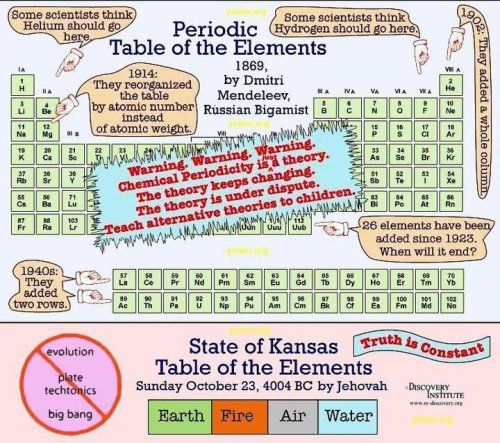 |
| The Periodic Table of the Elements is also just a theory! |
2) Time in science classroom is both limited and valuable. U.S. high school science teachers spend only an average of 13.7 hours on evolution (Berkman, et. al. (2008)). Building a deep understanding of complex scientific theories is hard cognitive work and takes time (even without spending time on non-scientific alternatives). Spending valuable time on alternative theories will take away valuable time that could be spend on helping students grasp accepted scientific theories. U.S. students are already lacking in scientific understanding (see PISA test results) and around 50% of U.S. citizens reject the theory of evolution (see survey results here).
 |
| Teach the Controversy |
- Geocentrism (rejected since the introduction of the theory of heliocentrism)
- Phrenology (abandoned due to lack of evidence)
- Aether theory (abandoned since introduction of theory of relativity and quantum theory)
- Impetus theory (abandoned since the introduction of the theory of gravity)
- Illness caused by bad odours (abandoned since the introduction of the theory of bacteria and viruses)
- Flat earth theory (abandoned since the introduction of the spherical earth theory)
- Four humors of the human body theory (abandoned since the advancement of physiology and modern medicine)
- Unchanging nature of organisms over generations (abandoned since the introduction of the theory of evolution)
- Four elements theory (abandoned since introduction of theory of chemical elements)
An integrated understanding of major scientific theories and the nature of science is important in a science-based democratic society to 1) make informed evidence-based decisions, 2) understand the complexity and inter-connectedness of the underlaying mechanisms behind natural phenomena (see Richard Dawkins' book "The magic of reality"), and 3) appreciate scientific theories as major human accomplishments (See more detailed discussion in essay "Why science education").
Sources:
- "Teach the controversy" science education bills advance in Tennessee, Oklahoma
- http://wpln.org/?p=35472
- Berkman, M. B., Pacheco, J. S., & Plutzer, E. (2008). Evolution and creationism in america's classrooms: A national portrait. PLoS Biology, 6(5), 920-924
Thursday, March 22, 2012
Teachers as 21st century knowledge workers
 |
| 21st century teachers as knowledge workers |
A 2012 OECD study, headed by Andreas Schleicher, concludes that if schools systems want to be competitive in the 21st century they need to recruit and reward top teachers. The study suggests that teachers should be recruited from the top tier of university graduates (not the bottom third) and the teaching profession should be made more attractive to knowledge-age workers who are able to support children's learning in the digital age.
However, many high achieving knowledge workers are currently not attracted to work in schools settings that still operate on an industrial age model: Organised like an assembly line with strictly regulated hours, students grouped by age, and strictly artificial divisions between disciplines. Teachers are seen as interchangeable and replaceable. If technology is used, it is used in a very restricted way: Many schools limit free internet access and ban the use of social tools such as Facebook, Youtube, Wikipedia, and Twitter in the classrooms - tools which are essential for many knowledge age workers.
An knowledge age teacher must be able to model knowledge age work to students. For example, how to build and maintain a network of contacts through social media to exchange ideas with other
Knowledge-age workers want to be seen as professionals who continuously learn, adapt to new situations, creatively design instructional material, work on cross-discipline projects, and implement a wide range of technologies.
Becoming a teacher should not be a "last alternative" or a "higher calling without proper reward". Teacher education programs in Finland and Singapore are highly competitive (comparable to medical schools) and only accept 10% of applying top students. In return, graduates from teaching programs receive salaries competitive to other knowledge workers and have a high social status. Imagine a world in which you ask somebody for his/her profession and your response to him/her being a teacher is "Wow! You are a teacher!"
Two great examples for schools who see teachers as 21st century knowledge workers are High Tech High (in San Diego) and Northern Beaches Christian Schools (in Sydney). Read more here Reforming-schools-for-knowledge-age
 |
| UFM furniture for education |
Reforming schools for 21st century learning needs to happen on multiple levels (guided by a shared vision):
 |
| Reforming schools for 21st century teaching |
- Each NBCS student has a laptop (either a personal one or a school's one).
- The school uses a blended learning approach that combines online and offline learning environments. Teachers post activities and resources online which students access as starting points for their assignments. Students use different online learning environments in different grades (based on Moodle):"Primary uses PETE (Primary Education Through e-Learning) to manage research projects, submit and document work, assessments and day-to-day tasks, as well as a way of communicating with parents. Secondary’s LEARN environment is a tightly integrated portal for students and teachers to manage assessments, work and to provide course material. Class forums, wikis and other online tools enhance collaboration and allow students to work more effectively and efficiently - even when at home. Senior students from schools around NSW use HSC Online for online course delivery." Despite (and because) students' accessto a wide range of online material, NBCS understands that students need clear boundaries and structures (for example posting indecent pictures or cyber-bullying). The school employs web-designers to create and support the online learning environment and teaches its teachers how to create online activities.
- NBCS does not use bells (as "there are no bells in real life"). Instead, teachers (and students) decide when it is time for a break ("periods" are called "learning sessions") or to change topics.
- In middle school, students of different ages work together in mixed groups which are facilitated by multiple teachers. This gives students the opportunity to work with different teachers and students of different ages. Students are encouraged to be independent learners who know best with whom, where, and how they learn best: Some prefer working alone, in pairs, or in groups; some like sitting on a table, laying on a couch or on the carpet; some prefer quiet, talking, or music.
- NBCS teachers hardly lecture. Their work consists of designing learning activities and facilitate students in class. Teachers model knowledge-age skills by having their own professional blogs, youtube channels, and twitter feeds; by connecting with experts outside of schools for projects; by organising online and in-school exhibits open to the public; by publishing innovative instructional material in teacher forums and presenting at conferences.
- The school understands that innovative pedagogy also needs innovative physical spaces: Inspired by creative design spaces (such as architecture bureaus and design studios), NBCS replaced small classrooms with open-floor multi-purpose "learning spaces" with versatile furniture that fosters collaboration and re-arrangement (created by UFM solutions).
 |
| NBCS middle school learning space |
- Teachers attend a "skill workshop"every Friday afternoon where they explore new technologies or activities. Taking innovation to all levels, teachers try out new forms for meetings in their own meetings.
- Teachers frequently integrate current technology such as iPod/iPad apps, SecondLife, moodle, or google maps.
- Teachers record their sessions through hover cams (document cameras) and digital pens to make them available online. After hours, students can contact their teachers by email or text message. For example, a student might send the teacher a screenshot of a math problem he/she is struggling with. The teacher uses screen recording software to record his response to the student. The teacher then uploads the screen recording for other students who might have a similar issue.
- Traditional classrooms have rows of benches with students facing the teacher standing at the whiteboard. At NBCS, most walls have been turned into whiteboard walls (using idea paint). This allows teachers and students to use a shared drawing area wherever they are in the room. The design of the physical space follows the socio-cultural perspective of learning that centers on students learning from each other (with the teacher as a facilitator): Instead of facing the teacher (as the center of attention), students sit around smaller tables facing one another.
For inspiration, see A vision of the classroom of the future.
 |
| Northern Beaches Christian School (NBCS) learning space |
Consider this:
"In 1900, 8 out of 10 jobs involved building things with your hands. In 2010, 8 out of 10 jobs will involve working with ideas. In large part, the bricks and mortar of the industrial age have been replaced. Concepts and connections now lay the foundation for the 21st Century. A recent survey of over 400 employers in the US shows thinking skills are among the most important skills found in new hires. Whether the goal is professional success, personal self-fulfillment, national competitiveness in science and technology, or solving complex global problems, new skills are needed to thrive. The 21st century knowledge age requires people: to be adept thinkers and learners; to use and build knowledge; to differentiate and combine, compare and contrast, and construct and deconstruct ideas. In short, in the knowledge age people will need to be knowledge-able." (Source: Edgewood College, Madison, Wisconsin)
It is time to bring schools from the industrial age to the 21st century knowledge age. This can only be achieved through visionary leadership (by policy makers and principals) and attracting high-achieving knowledge-age teachers.
A more radical step would be to reconsider the public education system from the ground up. If the public education system would be designed from scratch to meet the needs of the knowledge age, the outcome would not be our current school system. Innovative schools like NBCS or High Tech High lead the way, but they only reach a relatively small number of students. The question remains how innovation can be scaled up to improve the entire school system.
"In 1900, 8 out of 10 jobs involved building things with your hands. In 2010, 8 out of 10 jobs will involve working with ideas. In large part, the bricks and mortar of the industrial age have been replaced. Concepts and connections now lay the foundation for the 21st Century. A recent survey of over 400 employers in the US shows thinking skills are among the most important skills found in new hires. Whether the goal is professional success, personal self-fulfillment, national competitiveness in science and technology, or solving complex global problems, new skills are needed to thrive. The 21st century knowledge age requires people: to be adept thinkers and learners; to use and build knowledge; to differentiate and combine, compare and contrast, and construct and deconstruct ideas. In short, in the knowledge age people will need to be knowledge-able." (Source: Edgewood College, Madison, Wisconsin)
It is time to bring schools from the industrial age to the 21st century knowledge age. This can only be achieved through visionary leadership (by policy makers and principals) and attracting high-achieving knowledge-age teachers.
A more radical step would be to reconsider the public education system from the ground up. If the public education system would be designed from scratch to meet the needs of the knowledge age, the outcome would not be our current school system. Innovative schools like NBCS or High Tech High lead the way, but they only reach a relatively small number of students. The question remains how innovation can be scaled up to improve the entire school system.
TED launched TED for Education (TED-Ed)
TED (Technology, Entertainment, Design) launched a new section focused on education issues: TED-Ed.
For a start, TED-Ed added 15 videos to their YouTube channel. Some of them enhance the talk through animations, for example see "How Simple Ideas Lead to Scientific Discoveries" by MythBusters' Adam Savage below.
For a start, TED-Ed added 15 videos to their YouTube channel. Some of them enhance the talk through animations, for example see "How Simple Ideas Lead to Scientific Discoveries" by MythBusters' Adam Savage below.
Friday, December 2, 2011
What is learning?
There no single and simple answer to the question "what is learning". This blog post aims to give a short visual overview over major theories of learning: Behaviorism, Cognitivsm, Constructivism (classic and socio-cultural), and Networked learning/ Connectivism.
"Learning" is defined differently by different research fields and frameworks. The illustrations below are my attempt to visualize the progression of major theories of learning:
Figure: Theories of Learning (by Beat A. Schwendimann)
Learning is often closely connected to the nature of knowledge (Epistemology). Like learning, knowledge can be defined in many different ways. In relation to knowledge, Paavola (2005) distinguishes two types of learning. Based on Paavola's paper, I created the following table:

I created the dynamic mindmap below to provide an overview over some major theories of learning and education concepts. This mindmap is ongoing work in progress. Your feedback and suggestions are welcome.
To navigate the dynamic mindmap below, just click on a term and it will move to the center - showing related concepts. You can also search for terms in the textbox at the bottom.
See this mindmap on the webbrain.com website (where you can find other interesting mindmaps).
"Learning" is defined differently by different research fields and frameworks. The illustrations below are my attempt to visualize the progression of major theories of learning:
| Individual Knowledge Acquisition |
 |
Individual Knowledge Acquisition |
 |
| Collaborative Knowledge Participation |
 |
Collaborative Knowledge Participation |
 |
Collaborative Knowledge Participation |
 |
Learning is often closely connected to the nature of knowledge (Epistemology). Like learning, knowledge can be defined in many different ways. In relation to knowledge, Paavola (2005) distinguishes two types of learning. Based on Paavola's paper, I created the following table:
To navigate the dynamic mindmap below, just click on a term and it will move to the center - showing related concepts. You can also search for terms in the textbox at the bottom.
See this mindmap on the webbrain.com website (where you can find other interesting mindmaps).
Friday, April 22, 2011
International Teacher Salary Comparison Graph
How much do elementary school teachers earn in different countries (after 15 years on the job)? And how many hours do they have to work?

Source: tumblr_ljy48yJbTA1qedj2ho1_1280.jpg (715×961)

Source: tumblr_ljy48yJbTA1qedj2ho1_1280.jpg (715×961)
Elementary School Teacher International Comparison Infograph
This infograph compares conditions of elementary school teachers in different countries. How much money do elementary teachers (after 15 years on the job) make? How large are their classes? Do better payed teachers improve the performance of their students?
The data in this infograph is based on the OECD 2009 indicators.

Original source: A Teacher’s Worth Around The World [Infographic]
The data in this infograph is based on the OECD 2009 indicators.

Original source: A Teacher’s Worth Around The World [Infographic]
Wednesday, February 16, 2011
Great science education videos from the Cassiopeia Project

Sunday, January 16, 2011
Several US states plan to eliminate teacher tenure
 |
| New Jersey Governor Chris Christie |
A recent poll by the Associated Press-Stanford University found that 78 percent think it should be easier for school administrators to fire poorly performing teachers. Yet overall, the public wants to reward teachers – 57 percent say they are paid too little, with just 7 percent believing they are overpaid and most of the rest saying they're paid about right. (Read more about the poll here)
Similar plans to eliminate teacher tenure are underway in Idaho. Idaho school superintendent Tom Luna described his plan to eliminate tenure for new teachers and make them work on two-year contracts similar to principals' contracts. He says it is important to reward good teachers and identify poor teachers, and the current system makes that difficult.
Read about other controversial school reform ideas in California and Florida here.
Similar plans to eliminate teacher tenure are underway in Idaho. Idaho school superintendent Tom Luna described his plan to eliminate tenure for new teachers and make them work on two-year contracts similar to principals' contracts. He says it is important to reward good teachers and identify poor teachers, and the current system makes that difficult.
Read about other controversial school reform ideas in California and Florida here.
Thursday, January 13, 2011
New School in Brooklyn has over 60 children per class

But the New American Academy is one of the toughest learning environments in the US, in a high poverty neighborhood in which 20 percent of the children have been found to have emotional, physical or learning disabilities. Read more here: New American Academy in Brooklyn Is an Experiment in Class Size - NYTimes.com
Sunday, December 5, 2010
Improving US education by learning from other countries

One of the top performing countries in the worldwide PISA test (Program for International Student Assessment) is Finnland (while the USA ranked 24th out of 29 tested countries). What is Finnland doing right?
In the 1950s, Finnland was considered a rural backwater. Through the 1970s and ’80s, Finland’s economy depended on trade with its neighbor, the Soviet Union. But the collapse of the U.S.S.R. in 1991 opened up trade to other parts of the world for Russia — Finland had lost its captive market. A crisis ensued. Unemployment in Finland shot up to nearly 20 percent. The nation’s leaders convened in emergency meetings to brainstorm ways to reinvent themselves. As a small country covered in snow for half the year, Finland does not enjoy the luxury of easily accessible natural resources.
Eventually, the leaders concluded that the country’s most valuable resource was its own people. After all, it’s a creative population: The country boasts more musical composers and orchestras per capita than anywhere else in the world. The leaders decided to build an economy based on knowledge, which required providing its citizens with the finest public education anywhere.
The plan was effective. Today, it is not easy to become a teacher in Finnland. Only 1 in 10 applicants get the job, which affords the position a certain cachet. In keeping with the country’s creative past, all students take performing and creative arts until they graduate high school. With an eye toward the country’s economic future, students are also exposed to a rigorous math and science curriculum.
On a policy level, the standards and expectations are clear but broad: Local educators enjoy a good deal of professional flexibility. The details of the curricula are decided not by the government but the local teachers themselves, who hammer it out together in a culture of trust and cooperation. The teachers feel like they are a part of something large and important.
Moreover, there is no standardized testing. Every year a random sample of students is assessed but only to decipher how well any given school is performing. This discourages instructors from “teaching to the test,” because they don’t know who will be tested.
Moreover, there is no standardized testing. Every year a random sample of students is assessed but only to decipher how well any given school is performing. This discourages instructors from “teaching to the test,” because they don’t know who will be tested.
Critics point out that small, homogenous countries like Finnland can’t be compared to large, diverse nations such as the United States. However, there other other examples of how successful school reforms can be that focus on strengthening teacher autonomy and support, for example a London suburb with a high number of immigrants (See link to the article at the bottom of the post). As in Finnland, it took the combination of strong leadership and direct involvement of teachers in the reforms (and not just top-down).
Teachers need high quality pre-service education and sustained in-service support. An example for a successful in-service mentoring program is the Chicago New Teacher Center. Every new teacher in the schools serving the roughest areas of the city receives a coach for two years. The coach provides feedback, which is expected to be non-threatening because the coaches are employed by the nonprofit New Teacher Center, not the school district.
Teachers need high quality pre-service education and sustained in-service support. An example for a successful in-service mentoring program is the Chicago New Teacher Center. Every new teacher in the schools serving the roughest areas of the city receives a coach for two years. The coach provides feedback, which is expected to be non-threatening because the coaches are employed by the nonprofit New Teacher Center, not the school district.
In my view, teachers should have similar rigorous selection, intense education, and high payment as medical doctors. We put trust in medical doctors' professional judgement while teachers (in the US) are often only at the receiving end of a long chain-of-command. For example, some US school districts introduced "pacing guides" that force each teacher to cover material according to a strict hour-by-hour guideline. The public should have a teacher corps it can trust in making its own professional judgements (instead of becoming a "teaching robot"). Teachers should have the professional freedom to have ownership of their urgent mission. Becoming a teacher should be a profession college students aspire to. Programs such as CalTeach at UC Berkeley and Uteach at UT Austin that aim to introduce undergraduate college students to teaching as a carrer are a promising start.
Teachers need to be well trained, carefully selected, and supported once on the job. Improving teacher quality comes at a high cost. For example, a new Californian public high school teachers makes only around $40'000/year. Such a low salary does not attract the most qualified people in the field. Becoming a good teacher takes high quality theoretical and practical pre-service education, on-the-job mentoring for new teachers, and continued professional development. As always, it is a question of money: Where does the money come from to pay teachers competitive salaries, to pay mentors and teaching assistants, to pay for continuos professional development, and to pay for in-depth teacher evaluation?
Teachers need to be well trained, carefully selected, and supported once on the job. Improving teacher quality comes at a high cost. For example, a new Californian public high school teachers makes only around $40'000/year. Such a low salary does not attract the most qualified people in the field. Becoming a good teacher takes high quality theoretical and practical pre-service education, on-the-job mentoring for new teachers, and continued professional development. As always, it is a question of money: Where does the money come from to pay teachers competitive salaries, to pay mentors and teaching assistants, to pay for continuos professional development, and to pay for in-depth teacher evaluation?
It may take many years for a teacher to develop high proficiency. Schools need to find the right balance between giving teachers the time and support to improve to a certain level and replacing teachers that fail to do so. So far, there is no quick, cheap, and reliable way to measure teacher quality. Education research and foundations (such as the Gates Foundation) are currently working on developing methods to evaluate teacher quality and ways to provide support for teachers.
The education system is a highly complex system that cannot be "fixed" (I prefer "improved") by changing only one element. Creating a corps of highly qualified teachers is an important step, but only one of many elements to consider (such as the difference of the socio-economic backgrounds of students on the persisting achievement gap.)
The education system is a highly complex system that cannot be "fixed" (I prefer "improved") by changing only one element. Creating a corps of highly qualified teachers is an important step, but only one of many elements to consider (such as the difference of the socio-economic backgrounds of students on the persisting achievement gap.)
Wednesday, November 24, 2010
Should teachers get a raise for earning a master degree?

I think that professional development (for example through lesson studies) could have more impact on improving student performance than master degrees that focus on theoretical knowledge.
Should teachers get a raise for earning a master's? | Marketplace From American Public Media
Subscribe to:
Posts (Atom)