Showing posts with label History. Show all posts

Wednesday, December 2, 2015

A short history of Santa Claus - from saint to secular

Santa Claus (Coca Cola version)
Santa Claus is a complex social-cultural phenomenon that developed over centuries.

  • Historically, Santa Claus is based on Bishop Nicholas of Myra who lived from 280-343 a.D. in Greece. He was made a Saint in 900 a.D. His Saints Day is December 6, which is the traditional 'Santa Claus' day in many European countries. St. Nicholas gave money and gifts to children but he did not like to be seen when he gave away presents. Therefore, he left his presents during the night. This turned into the modern day practice of telling children that Santa Claus will not arrive unless the children go to sleep early.
  • Leaving food: The catholic saint was merged with non-christian figures, such as Father Christmas and the Norse god Odin. During Yule time, Odin would visit every house on his horse Sleipnir. Children  would place their boots near the chimney (or outside of the door) with food for Sleipnir. During the night, Odin would enter the house through the chimney and reward them for their kindness with food, candy or gifts. The tradition still continues in Belgium, Germany and the Netherlands. The food for Sleipnir became milk and cookies for Santa; the boots become stockings hung on the chimney. Other norse influences are the Yule log and the mistletoe (Read more about the mistletoe tradition here). 
  • Influences: The modern Santa Claus was most strongly defined by Dutch and American influences. In the Netherlands, the figure is called 'Sinterklaas'. Dutch settlers brought the 'Sinterklaas' tradition to the US where the name changed into 'Santa Claus'. After arriving in the US, several poems, songs, and stories extended and changed the figure of Santa Claus. Instead of a horse, he now used reindeer. His workshop was placed at the North Pole, he was given an army of elves, and a wife (Mrs Claus was added by a 1956 popular song by George Melachrino, "Mrs. Santa Claus", and the 1963 children's book How Mrs. Santa Claus Saved Christmas, by Phyllis McGinley). 
  • Animals: In Europe, Santa Claus uses either horse, a donkey, or reindeer. In the US, his animals changed, most importantly due to the 1823 story "A Vist From St. Nicholas", better known today as "The Night Before Christmas". In this poem eight reindeer were introduced as Dasher, Dancer, Prancer, Vixen, Comet, Cupid, Dunder and Blixem (Dunder and Blixem came from the old Dutch words for thunder and lightning, which were later changed to the more German sounding Donner and Blitzen). The ninth, and most famous reindeer, was not added until 1939 by a poem about Rudolf the Red Nose Reindeer by Robert L. May of the Montgomery Ward Company; followed by the popular 1949 song by Johnny Marks about "Rudolph the Red-Nosed Reindeer".
  • Helpers: The European 'Sinterklaas' or 'Samichlaus' has often a helper called 'Black Peter/ Père Fouettard'. While Santa is the friendly gift-giver, Black Peter's job is to punish children who did not behave well. Similar to Black Peter, several European Alpine regions know a devil-like creature called Krampus who punishes naughty children. In Germany, Santa is linked to angel-like baby Jesus ('Christ Child') who brings gifts. The German word 'Kristkind' became Santa Claus' name 'Kris Kringle'. In the US tradition, Santa has a workshop full of elves who make all the gifts. However, in several Scandiavian countries, Santa is an elf himself (called Nisse or Tomte).
  • Outfit: In many European countries, Santa Claus wears a Bishop's attire. In the US, his religious looks were changed to a more secular apparel (a fur-lined red suit and a soft hat). Santa's outfit became standardized through the 1920s and firmly established through the work of Coca-Cola Company commissioned illustrator Haddon Sundblom who developed advertising images using Santa Claus in 1930.
Santa Claus can therefore be considered a product of cultural globalization and a merger of many traditions.

The Origin and Evolution of Santa Claus
by herrimanjoe. From Visually.


Friday, May 2, 2014

Some of the most beautiful libraries in the world


In the age of digital information and eBook readers, one could question the usefulness of storing paper books. However, libraries can be beautiful inspiring places. Libraries often form the shared space for scholarly communities. Today, libraries redefined themselves as learning spaces instead of book storage halls.

See a gallery of beautiful libraries here: http://shortlist.com/entertainment/books/the-most-beautiful-libraries-in-the-world#

Science Fiction books that predicted inventions

This infograph illustrates how science fiction predicted innovations in science, medicine, and technology.
Source: http://shortlist.com/entertainment/books/books-that-predicted-the-future

Monday, October 14, 2013

Animated maps of US Civil War battles

Animated US Civil War maps
The US Civil War Trust presents a collection of animated maps that bring battles of the American Civil War to life, complete with troop movement animations, narratives, video, and more. There are animated maps of the battles of Antietam, Gettysburg, Shiloh, Vicksburg and Chickamauga.

Wednesday, December 5, 2012

The future of digital [Slideshow]

This extensive slideshow presents an interesting overview of the history, present, and future of digital spaces. [Click on "Slide Deck" below]

Monday, July 9, 2012

Visualizing Western Philosophy

Simon Raper used Wikipedia and gephi to generate a graph the shows which philosopher influenced one another. Building on social network analysis, the graph can be used to identify most influencial philosophers (not surprisingly, Aristotle, Kant, Hegel, Marx and Nietzsche).

The original blog post also describes the procedure how the graph was generated: http://drunks-and-lampposts.com/2012/06/13/graphing-the-history-of-philosophy/

Network of Western Philosophers (Click here to enlarge)
[Created by Simon Raper]
People interested in a dynamic visualization of Western Philosophy (with a focus on education) might be interested in this Webbrain (Click on a term to read the notes below or type a search term in the box):

Friday, May 25, 2012

From knowledge hierarchies to networks

Manuel Lima is a Senior UX Design Lead at Microsoft Bing and founder of VisualComplexity.com

In his RSA talk, Lima discusses a epistemological paradigm shift from hierarchical tree structures (what philosopher Deleuse calls "arborescent") where branches are separate from each other to networks (what Deleuse calls "rhizomatic") where everything can be connected to everything with no top or bottom.

Wednesday, March 21, 2012

Chronozoom: A dynamic view of history, the universe, and everything


Chronozoom is an innovative dynamic animation of the history of the universe.


In their own words:
"ChronoZoom is an open source community project dedicated to visualizing the history of everything to bridge the gap between the humanities and sciences using the story of Big History to easily understand all this information. This project has been funded and supported by Microsoft Research Connections in collaboration with University California at Berkeley and Moscow State University.
You can browse through history on ChronoZoom to find data in the form of articles, images, video, sound, and other multimedia. ChronoZoom links a wealth of information from five major regimes that unifies all historical knowledge collectively known as Big History."


Try out ChronoZoom here.

Monday, October 24, 2011

Knowledge Web and Connections

How is Mozart connected to the invention of the helicopter? Or cornflakes to communism? Such and other questions will be answered by the "Knowledge Web".


The "Knowledge Web" is a project currently under development by the James Burke Institute. So far, visitors can go on "Mystery Tours". James Burke a historian, best known for his work as the author, host, and narrator of the acclaimed television series "Connections".


See all episodes of the outstanding series "Connections" online on youtube.

Friday, April 29, 2011

Map of Monarchies around the World

It's the 21st century, but a number of countries are still monarchies. This interactive map by NPR shows the different countries and forms of monarchies around the world. [Click on the link below to see the interactive version].

See the interactive version here: Kings (And Queens) Of The World: Where Monarchies Still Exist : NPR

Sunday, April 17, 2011

People with impressive long names

Pablo Picasso (Image: Wikipedia)

Pablo Diego José Francisco de Paula Juan Nepomuceno María de los Remedios Cipriano de la Santísima Trinidad Ruiz y Picasso, or simply Picasso.


Paracelsus (Image: Wikipedia)
Philippus Aureolus Theophrastus Bombastus von Hohenheim, better know as Paracelsus (medieval medical doctor).

Mozart (Image: Wikipedia)
Johannes Chrysostomus Wolfgangus Theophilus Mozart, better know as Wolfgang Amadeus Mozart.


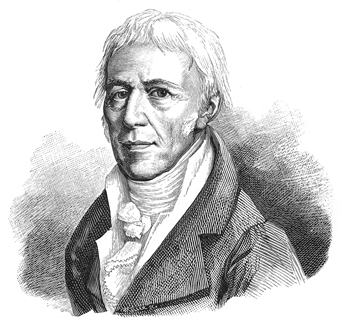
Lamarck (Image: Wikipedia)
Jean-Baptiste Pierre Antoine de Monet, Chevalier de la Marck, better known as Lamarck. He proposed an alternative theory of evolution.


-> Do you know more people with impressive names? Please et me know.

Tuesday, March 8, 2011

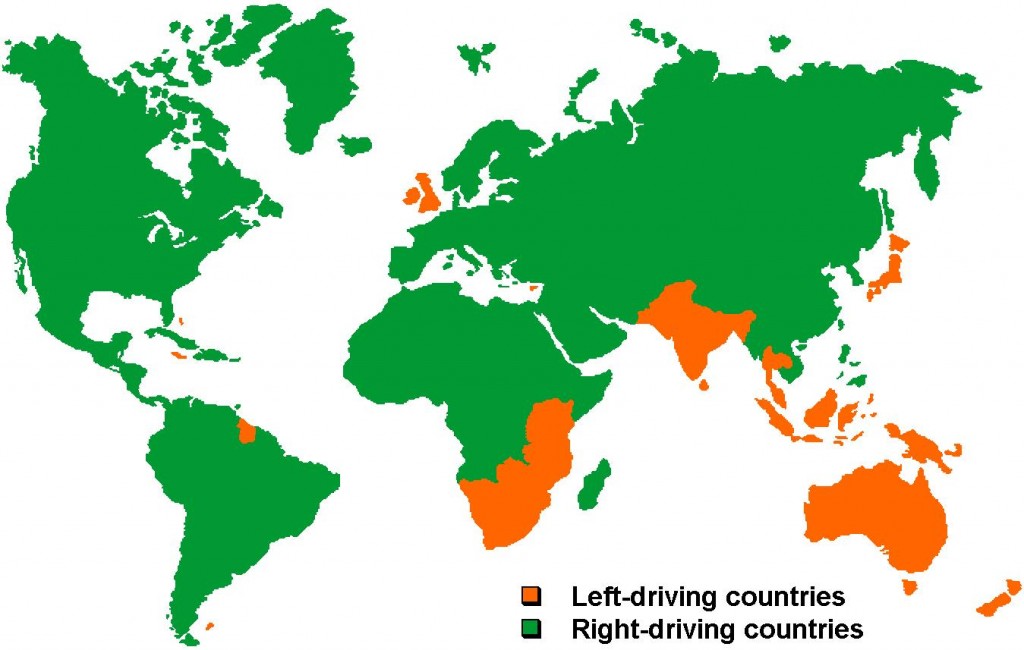
Why some countries drive on the right or the left side

Did you ever wonder why in some countries cars drive on the left side of the road and in other countries they drive on the right side?

You can find some answers in this interesting essay on Why Some Countries Drive on the Right and Some Countries Drive on the Left

Monday, February 14, 2011

Cell phone in 1986

In 1986, Walker Industries introduces a new cell phone - to a market that had consisted of only two other phones. The introduction price was $3300. How times have changed!


[via]

Tuesday, February 8, 2011

Prehistoric Fish Still Alive Today

Frilled Shark
See this fascinating list of pre-historic fish that are still with alive today: Top 10 Prehistoric Fish Alive Today

See this youtube video of a frilled shark in action:

Monday, February 7, 2011

Animals brought to extinction by humans

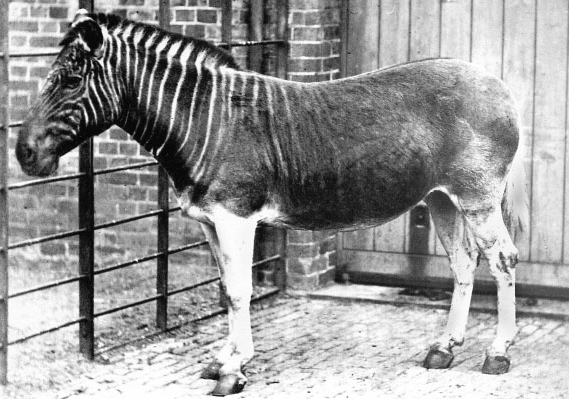
Quagga (extinct since 1883)
Neatorama has an interesting but sad list of seven animals that are now extinct because of human interference, from the tasmanian tiger and the Quagga to the Dodo and the passenger pigeon.

See list here: 7 Animals Humans Brought to Extinction

Sunday, February 6, 2011

Prehistoric humans had foxes as pets


Honey, I am taking the fox for a walk....
Before dog became man's best friend, our ancestors might have kept foxes as pets.

Bones from a pre-historic burial ground (about 16,500 years old) in northern Jordan indicate that people got buried with their favorite pets, which include dogs as well as foxes.

I find it interesting to imagine how our world would look different if humans adopted foxes instead of dogs as our pets; current dogs breeds are variations of original Asian wolves (read more about evolutionary origins of dogs here). Imagine how many different breeds of pet foxes we might have instead.

Meaning of country names

This map shows the etymology (origin of) the names of countries around the globe [Click on the map for a larger view].

Unfortunately, the map does not include references for further information.

etymology-map.jpeg (4500×2234)