 |
| Google Classroom |
Showing posts with label School. Show all posts
Showing posts with label School. Show all posts
Friday, May 9, 2014
Google announces "Google Classroom"


Wednesday, March 12, 2014
Farewell to the One-Laptop-Per-Child (OLPC) project
 |
| XO-1 laptop (Source: OLPC news) |
The idealistic project who aimed to close/narrow the digital divide by giving every child a specially designed laptop did unfortunately not succeed to reach its ambitious goals.
The rugged, low-power XO-1 laptop (also known as the $100 Laptop, the Children's Machine, and the 2B1) is an inexpensive sub-notebook computer that offered many interesting design features:
- To improve internet connection in areas with limited access, the XO-1 used a WiFi mesh networking protocol to allow many machines to share Internet access as long as at least one of them can see and connect to a router or other access point.
- Operation system: Slimmed-down version of Fedora Linux and a GUI named Sugar
- Video camera, a microphone, and a hybrid stylus/touch pad.
- Power: The XO-1 was designed to use minimal amounts of power. In addition to a standard plug-in power supply, human power and solar power sources are available, allowing operation far from a commercial power grid.
- Dual screen mode: Reflective (backlight off) monochrome mode for low-power use in sunlight (ebook mode) and backlit color mode.
- Water-resistant membrane keyboard, designed for the small hands of children.
Farewell, OLPC and XO-1. We need more idealistic projects like this.
Thursday, February 6, 2014
Creationist education in Swiss private schools

A newspaper article published in "Le Temps" reports that three private schools in the French-speaking part of Switzerland are teaching creationist ideas in their classrooms. A representative of the three schools stated that "the theory of evolution is also presented, but not as a truth."
Teaching creationism as truth violates the local education policies that demand that students in private schools receive an education equivalent to public schools.
I find it interesting to note that the journalist found it necessary to provide a description of what creationism is "Creationism is a doctrine which, in its minimalist version postulates that the universe and living beings were created ex nihilo by God, as opposed to the theory of evolution." [I doubt that a US journalist would have found it necessary to provide a definition of creationism.]
Source: "Les écoles créationnistes réveillent les autorités romandes", Friday 31 January 2014, Le Temps (Switzerland)
Tuesday, January 15, 2013
Gallup poll indicates students' loss of interest in school over time
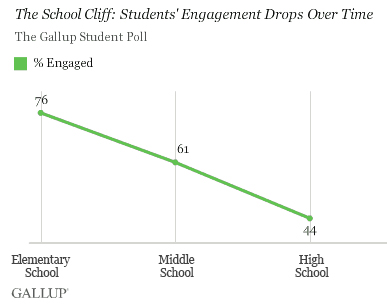
Albert Einstein said that "Education is what remains after one has forgotten what one has learned in school.“ Sadly, a recent Gallup survey of nearly 500,000 students from grades five through 12 from more than 1,700 public schools in 37 US states in 2012 suggests that students increasingly loose their interest in going to school in the first place. By the time students get to high school only about 4 in 10 qualify as engaged.
Larry Ferlazzo rightly points out that this is not a statistically valid survey as there was no random sampling involved; schools and students participated on a volunteer basis. However, the large sample size still provides an interesting dataset.
Another critique point is the measure for the construct "engagement". Here are some sample questions:
8. I have a best friend at school.
9. I feel safe in this school.
10. My teachers make me feel my schoolwork is important.
11. At this school, I have the opportunity to do what I do best every day.
12. In the last seven days, I have received recognition or praise for doing good schoolwork.
13. My school is committed to building the strengths of each student.
14. In the last month, I volunteered my time to help others.
9. I feel safe in this school.
10. My teachers make me feel my schoolwork is important.
11. At this school, I have the opportunity to do what I do best every day.
12. In the last seven days, I have received recognition or praise for doing good schoolwork.
13. My school is committed to building the strengths of each student.
14. In the last month, I volunteered my time to help others.
The data however fits well with other surveys who indicated waining interest in STEM education (See http://proto-knowledge.blogspot.com.au/2012/05/usa-fails-to-make-progress-in-stem.html)
Mark Twain suggested: Don't let school interfere with your education.
Source: A Bad Start to Lifelong Learning? - Mission to Learn - Lifelong Learning Blog
Friday, November 16, 2012
Why education research should matter to educational practice
 |
| Geek Manifesto (by Mark Henderson) [Source: http://geekmanifesto.wordpress.com/about/] |
Chapter 7 refers to the connection between science and education. Here is a quick summary of the main points:
-Currently, schools do not pay enough attention to findings from science (e.g. brain research, cognitive science, or education research). Additionally, schools don't apply scientific methods themselves by systematically implementing promising changes in quasi-experimental setups.
Some positive examples:
-brain research suggested that teenagers brains (different from younger children or adults) work better later in the morning [Most schools still operate on the industrial-age model that treats early rising as a virtue]. A UK school who pushed the first lessons for teenagers back by an hour documented great improvement in attendance and test performance (The principal also noted that other factors might have contributed to these improvements).
-Research suggests that the ability for delayed reward and self-control (findings from the famous marshmallow experiments) are major predictors of success in life (along with IQ and socio-economic background). Role-playing exercises, martial arts, or yoga could help students learn accept delayed gratification.
-Research suggests that boys and girls learn differently, especially around puberty. Education could use these findings to create different tasks for boys and girls.
Henderson suggests that education research, similar to medical research, should implement exhaustive randomized controlled trials (RCTs). Currently, school reforms are often policy-driven (or driven by for-profit companies who are pushing their educational products) instead of evidence-driven. School reforms could use RCTs by gradually rolling out new initiatives in randomly chosen schools. Only after results from these first schools show positive effects will an initiative be implemented system-wide. Later adopters can serve as a control group for study.
In the medical profession, many doctors are also researchers. As practitioner-researchers they are in the best position to evaluate new methods or suggest new ideas based on their experience. It is not necessary that all teachers become action researchers, but that they are familiar with research methodologies, interested in participating in studies, and receptive to using findings of research in their practice. Teachers should be expected to keep up with recent developments and discuss them with their peers. Schools could set up "journal clubs" in which current scientific findings relevant to education can be discussed. Teachers need accessible academic literature to keep them informed of current findings.
School science often focuses on the product of science ("facts") but not on how these findings came to be (the process of science). Understanding the nature of science should become an central focus of the science curriculum to foster students' approaching problems in a scientific way, appreciate scientific findings in the media and being able to critically evaluate them (e.g. "correlation does not equal causation"). As Carl Sagan said in Demon-Haunted World: "If we teach only the findings and products of science - no matter how useful and inspiring they may be - without communicating its critical method, how can the average person possibly distinguish science from pseudoscience?". Science education should give students the mental tools to distinguish science (e.g. theory of evolution) from non-scientific views (e.g. intelligente design and creationism). Learning about philosophy of science requires teachers who have strong disciplinary knowledge and received appropriate training in philosophy of science.
Learning science requires time. K-12 education should extend the amount of time students learn about science. Additionally, students need early career advice to see the relevance of science for future jobs. School science should have strong connections to current scientific research, e.g. through field trips to laboratories, inviting scientists as guest speakers, connect to scientists as mentors for science projects, participate in citizen science projects.
Wednesday, May 16, 2012
Increased investment and failure of the US education system
This infograph illustrates several points:
1) Increasing investment in the US education system did not lead to improvements;
2) Investing in technology (hardware) alone does not improve education (without changes in pedagogy through changes in pre-service training and professional development).
Overall, the infograhp suggests that investment in an education system (without restructuring the system) does not lead to improvements. For example, Finland spends less money on education but achieves higher results (even compared to countries with a similar culture such as Norway). Norway, similar to the US, builds on a business-view model of education that focuses on assessment. Finland on the other hand builds on a humanist model that focuses on equity and high quality teachers (See documentary "The Finland Phenomenon").

Via: OnlineEducation.net
1) Increasing investment in the US education system did not lead to improvements;
2) Investing in technology (hardware) alone does not improve education (without changes in pedagogy through changes in pre-service training and professional development).
Overall, the infograhp suggests that investment in an education system (without restructuring the system) does not lead to improvements. For example, Finland spends less money on education but achieves higher results (even compared to countries with a similar culture such as Norway). Norway, similar to the US, builds on a business-view model of education that focuses on assessment. Finland on the other hand builds on a humanist model that focuses on equity and high quality teachers (See documentary "The Finland Phenomenon").
Via: OnlineEducation.net
Tuesday, March 27, 2012
Arguments against "Teaching the Controversy" in science education
 |
| Source: http://controversy.wearscience.com/ |
In a remarkable display of twisted thinking, the legislators stated that the bills aims to protect teachers from being "punished" for covering the "scientific strengths and scientific weaknesses of existing scientific theories" (I find it hard to believe that teachers in bible belt states have to fear punishment for criticising the theory of evolution). Despite the authors' affirmation that the bills "shall not be construed to promote any religious or nonreligious doctrine", they are quite obviously thinly veiled creationist agenda.
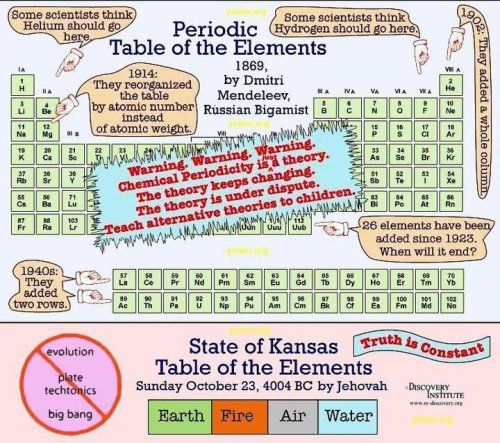
The goals of the bills sound noble: To "help students develop critical thinking skills they need in order to become intelligent, productive, and scientifically informed citizens." While "teaching the controversy" could indeed be used to improve science education, there are three (or more) arguments against implementing such a curriculum:
 |
| The Periodic Table of the Elements is also just a theory! |
2) Time in science classroom is both limited and valuable. U.S. high school science teachers spend only an average of 13.7 hours on evolution (Berkman, et. al. (2008)). Building a deep understanding of complex scientific theories is hard cognitive work and takes time (even without spending time on non-scientific alternatives). Spending valuable time on alternative theories will take away valuable time that could be spend on helping students grasp accepted scientific theories. U.S. students are already lacking in scientific understanding (see PISA test results) and around 50% of U.S. citizens reject the theory of evolution (see survey results here).
 |
| Teach the Controversy |
- Geocentrism (rejected since the introduction of the theory of heliocentrism)
- Phrenology (abandoned due to lack of evidence)
- Aether theory (abandoned since introduction of theory of relativity and quantum theory)
- Impetus theory (abandoned since the introduction of the theory of gravity)
- Illness caused by bad odours (abandoned since the introduction of the theory of bacteria and viruses)
- Flat earth theory (abandoned since the introduction of the spherical earth theory)
- Four humors of the human body theory (abandoned since the advancement of physiology and modern medicine)
- Unchanging nature of organisms over generations (abandoned since the introduction of the theory of evolution)
- Four elements theory (abandoned since introduction of theory of chemical elements)
An integrated understanding of major scientific theories and the nature of science is important in a science-based democratic society to 1) make informed evidence-based decisions, 2) understand the complexity and inter-connectedness of the underlaying mechanisms behind natural phenomena (see Richard Dawkins' book "The magic of reality"), and 3) appreciate scientific theories as major human accomplishments (See more detailed discussion in essay "Why science education").
Sources:
- "Teach the controversy" science education bills advance in Tennessee, Oklahoma
- http://wpln.org/?p=35472
- Berkman, M. B., Pacheco, J. S., & Plutzer, E. (2008). Evolution and creationism in america's classrooms: A national portrait. PLoS Biology, 6(5), 920-924
Thursday, March 22, 2012
Teachers as 21st century knowledge workers
 |
| 21st century teachers as knowledge workers |
A 2012 OECD study, headed by Andreas Schleicher, concludes that if schools systems want to be competitive in the 21st century they need to recruit and reward top teachers. The study suggests that teachers should be recruited from the top tier of university graduates (not the bottom third) and the teaching profession should be made more attractive to knowledge-age workers who are able to support children's learning in the digital age.
However, many high achieving knowledge workers are currently not attracted to work in schools settings that still operate on an industrial age model: Organised like an assembly line with strictly regulated hours, students grouped by age, and strictly artificial divisions between disciplines. Teachers are seen as interchangeable and replaceable. If technology is used, it is used in a very restricted way: Many schools limit free internet access and ban the use of social tools such as Facebook, Youtube, Wikipedia, and Twitter in the classrooms - tools which are essential for many knowledge age workers.
An knowledge age teacher must be able to model knowledge age work to students. For example, how to build and maintain a network of contacts through social media to exchange ideas with other
Knowledge-age workers want to be seen as professionals who continuously learn, adapt to new situations, creatively design instructional material, work on cross-discipline projects, and implement a wide range of technologies.
Becoming a teacher should not be a "last alternative" or a "higher calling without proper reward". Teacher education programs in Finland and Singapore are highly competitive (comparable to medical schools) and only accept 10% of applying top students. In return, graduates from teaching programs receive salaries competitive to other knowledge workers and have a high social status. Imagine a world in which you ask somebody for his/her profession and your response to him/her being a teacher is "Wow! You are a teacher!"
Two great examples for schools who see teachers as 21st century knowledge workers are High Tech High (in San Diego) and Northern Beaches Christian Schools (in Sydney). Read more here Reforming-schools-for-knowledge-age
 |
| UFM furniture for education |
Reforming schools for 21st century learning needs to happen on multiple levels (guided by a shared vision):
 |
| Reforming schools for 21st century teaching |
- Each NBCS student has a laptop (either a personal one or a school's one).
- The school uses a blended learning approach that combines online and offline learning environments. Teachers post activities and resources online which students access as starting points for their assignments. Students use different online learning environments in different grades (based on Moodle):"Primary uses PETE (Primary Education Through e-Learning) to manage research projects, submit and document work, assessments and day-to-day tasks, as well as a way of communicating with parents. Secondary’s LEARN environment is a tightly integrated portal for students and teachers to manage assessments, work and to provide course material. Class forums, wikis and other online tools enhance collaboration and allow students to work more effectively and efficiently - even when at home. Senior students from schools around NSW use HSC Online for online course delivery." Despite (and because) students' accessto a wide range of online material, NBCS understands that students need clear boundaries and structures (for example posting indecent pictures or cyber-bullying). The school employs web-designers to create and support the online learning environment and teaches its teachers how to create online activities.
- NBCS does not use bells (as "there are no bells in real life"). Instead, teachers (and students) decide when it is time for a break ("periods" are called "learning sessions") or to change topics.
- In middle school, students of different ages work together in mixed groups which are facilitated by multiple teachers. This gives students the opportunity to work with different teachers and students of different ages. Students are encouraged to be independent learners who know best with whom, where, and how they learn best: Some prefer working alone, in pairs, or in groups; some like sitting on a table, laying on a couch or on the carpet; some prefer quiet, talking, or music.
- NBCS teachers hardly lecture. Their work consists of designing learning activities and facilitate students in class. Teachers model knowledge-age skills by having their own professional blogs, youtube channels, and twitter feeds; by connecting with experts outside of schools for projects; by organising online and in-school exhibits open to the public; by publishing innovative instructional material in teacher forums and presenting at conferences.
- The school understands that innovative pedagogy also needs innovative physical spaces: Inspired by creative design spaces (such as architecture bureaus and design studios), NBCS replaced small classrooms with open-floor multi-purpose "learning spaces" with versatile furniture that fosters collaboration and re-arrangement (created by UFM solutions).
 |
| NBCS middle school learning space |
- Teachers attend a "skill workshop"every Friday afternoon where they explore new technologies or activities. Taking innovation to all levels, teachers try out new forms for meetings in their own meetings.
- Teachers frequently integrate current technology such as iPod/iPad apps, SecondLife, moodle, or google maps.
- Teachers record their sessions through hover cams (document cameras) and digital pens to make them available online. After hours, students can contact their teachers by email or text message. For example, a student might send the teacher a screenshot of a math problem he/she is struggling with. The teacher uses screen recording software to record his response to the student. The teacher then uploads the screen recording for other students who might have a similar issue.
- Traditional classrooms have rows of benches with students facing the teacher standing at the whiteboard. At NBCS, most walls have been turned into whiteboard walls (using idea paint). This allows teachers and students to use a shared drawing area wherever they are in the room. The design of the physical space follows the socio-cultural perspective of learning that centers on students learning from each other (with the teacher as a facilitator): Instead of facing the teacher (as the center of attention), students sit around smaller tables facing one another.
For inspiration, see A vision of the classroom of the future.
 |
| Northern Beaches Christian School (NBCS) learning space |
Consider this:
"In 1900, 8 out of 10 jobs involved building things with your hands. In 2010, 8 out of 10 jobs will involve working with ideas. In large part, the bricks and mortar of the industrial age have been replaced. Concepts and connections now lay the foundation for the 21st Century. A recent survey of over 400 employers in the US shows thinking skills are among the most important skills found in new hires. Whether the goal is professional success, personal self-fulfillment, national competitiveness in science and technology, or solving complex global problems, new skills are needed to thrive. The 21st century knowledge age requires people: to be adept thinkers and learners; to use and build knowledge; to differentiate and combine, compare and contrast, and construct and deconstruct ideas. In short, in the knowledge age people will need to be knowledge-able." (Source: Edgewood College, Madison, Wisconsin)
It is time to bring schools from the industrial age to the 21st century knowledge age. This can only be achieved through visionary leadership (by policy makers and principals) and attracting high-achieving knowledge-age teachers.
A more radical step would be to reconsider the public education system from the ground up. If the public education system would be designed from scratch to meet the needs of the knowledge age, the outcome would not be our current school system. Innovative schools like NBCS or High Tech High lead the way, but they only reach a relatively small number of students. The question remains how innovation can be scaled up to improve the entire school system.
"In 1900, 8 out of 10 jobs involved building things with your hands. In 2010, 8 out of 10 jobs will involve working with ideas. In large part, the bricks and mortar of the industrial age have been replaced. Concepts and connections now lay the foundation for the 21st Century. A recent survey of over 400 employers in the US shows thinking skills are among the most important skills found in new hires. Whether the goal is professional success, personal self-fulfillment, national competitiveness in science and technology, or solving complex global problems, new skills are needed to thrive. The 21st century knowledge age requires people: to be adept thinkers and learners; to use and build knowledge; to differentiate and combine, compare and contrast, and construct and deconstruct ideas. In short, in the knowledge age people will need to be knowledge-able." (Source: Edgewood College, Madison, Wisconsin)
It is time to bring schools from the industrial age to the 21st century knowledge age. This can only be achieved through visionary leadership (by policy makers and principals) and attracting high-achieving knowledge-age teachers.
A more radical step would be to reconsider the public education system from the ground up. If the public education system would be designed from scratch to meet the needs of the knowledge age, the outcome would not be our current school system. Innovative schools like NBCS or High Tech High lead the way, but they only reach a relatively small number of students. The question remains how innovation can be scaled up to improve the entire school system.
Tuesday, January 31, 2012
Suggestions how to improve the U.S. education system
 |
| A paradigm shift is needed |
1) The current U.S. education paradigm is based on the "conveyor belt" analogy of the Industrial Age. All students learn the same content in the same amount of time. As Campbell and Monson (1994) state "This may be a model of efficiency, but certainly not for effectiveness". The current paradigm of standardized education allows for valid comparison of students with each other and sort them out efficiently, but does not aim to educate every student (Reigeluth, 1992). When an educational system holds the time of instruction constant, achievement must vary. It is well documented that students learn at different paces. What is the alternative? Instead of grouping students by age group that passes through the education system, schools need to give each learner the time he or she needs to reach the learning goals.
2) Besides the Industrial Age paradigm, the U.S. education system still uses elements from the older Agricultural Age: The three month long summer break was intended to allow children to help during the harvest on farms. Instead of one long summer break, the U.S. could introduce several shorter 2-3 week breaks spread out throughout the year. Research provided strong documentation that the long summer break increases the achievement gap between poor and middle class students (See Summer learning loss and The Case Against Summer Vacation). This also links to the main reason for the education achievement gap in the U.S.: Poverty (or "socio-economic disadvantage") (See Poverty is key factor to improve U.S. education).
3) A dual education system, with an academic and a vocational pathway, offers students valuable alternatives. Unfortunately, the U.S. does not have a well-structured vocational school system as found in many European countries. In Finland, around 50% of students choose vocational school over University education (See The Finland Phenomenon). In the U.S. there exists no alternative to high school, and the current high school curriculum was created to prepare students for higher education not a vocation. In other words, a seventeen year old in the U.S. has only one option: He/She is either a high school student or a dropout (See Americas misplaced disdain for vocational education and Strengthening vocational education could improve U.S. education).
Instead of piecemeal reforms, like "No child left behind" that encourage standardization and assessment (=> sorting), the outdated paradigm itself needs to be changed (See Changing Education Paradigms). Changing the content (educational content standards) or assessment (standardized tests) is not sufficient to meet the needs of the Knowledge Age for the very structure of education discourages self-guided learning, initiative, and creative diversity.
References:
Campbell, R., & Monson, D. (1994). Building a goal-based scenario learning environment. Educational Technology, 34(9), 9-14
Reigeluth, C. M. (1992). The imperative for systemic change. Educational Technology, 32, n11
Reigeluth, C. M. (1999). What is instructional design theory and how is it changing? In C. M. Reigeluth (Ed.), Instructional-Design theories and models, vol 2: A new paradigm of instructional theory. Lawrence Erlbaum Associates
Tuesday, April 26, 2011
Toilet Paper - Over or Under?
This infograph gives you the scientific exploration of the old question: Should the toilet paper roll be over or under? (Click to enlarge).

Gky7j.jpg (802×4036)

Gky7j.jpg (802×4036)
Friday, April 22, 2011
International Teacher Salary Comparison Graph
How much do elementary school teachers earn in different countries (after 15 years on the job)? And how many hours do they have to work?

Source: tumblr_ljy48yJbTA1qedj2ho1_1280.jpg (715×961)

Source: tumblr_ljy48yJbTA1qedj2ho1_1280.jpg (715×961)
Elementary School Teacher International Comparison Infograph
This infograph compares conditions of elementary school teachers in different countries. How much money do elementary teachers (after 15 years on the job) make? How large are their classes? Do better payed teachers improve the performance of their students?
The data in this infograph is based on the OECD 2009 indicators.

Original source: A Teacher’s Worth Around The World [Infographic]
The data in this infograph is based on the OECD 2009 indicators.

Original source: A Teacher’s Worth Around The World [Infographic]
Sunday, February 13, 2011


Sunday, January 16, 2011
Laptops instead teachers in Idaho
 |
| Idaho School Superintendent Tom Luna |
Larger classes to pay for technology: Learn more about Idaho schools Superintendent Tom Luna's reform plan | Idaho Legislature | Idaho Statesman
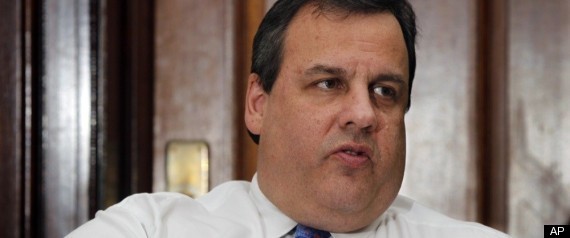
Several US states plan to eliminate teacher tenure
 |
| New Jersey Governor Chris Christie |
A recent poll by the Associated Press-Stanford University found that 78 percent think it should be easier for school administrators to fire poorly performing teachers. Yet overall, the public wants to reward teachers – 57 percent say they are paid too little, with just 7 percent believing they are overpaid and most of the rest saying they're paid about right. (Read more about the poll here)
Similar plans to eliminate teacher tenure are underway in Idaho. Idaho school superintendent Tom Luna described his plan to eliminate tenure for new teachers and make them work on two-year contracts similar to principals' contracts. He says it is important to reward good teachers and identify poor teachers, and the current system makes that difficult.
Read about other controversial school reform ideas in California and Florida here.
Similar plans to eliminate teacher tenure are underway in Idaho. Idaho school superintendent Tom Luna described his plan to eliminate tenure for new teachers and make them work on two-year contracts similar to principals' contracts. He says it is important to reward good teachers and identify poor teachers, and the current system makes that difficult.
Read about other controversial school reform ideas in California and Florida here.
Thursday, January 13, 2011
New School in Brooklyn has over 60 children per class

But the New American Academy is one of the toughest learning environments in the US, in a high poverty neighborhood in which 20 percent of the children have been found to have emotional, physical or learning disabilities. Read more here: New American Academy in Brooklyn Is an Experiment in Class Size - NYTimes.com
Revising Advanced Placement Biology

Next month, the College board, the nonprofit organization that owns the A.P. exams, is going to change A as well as the SAT, will release a wholesale revamping of A.P. biology. Read whole article here: Rethinking Advanced Placement - NYTimes.com
Friday, December 17, 2010
Controversial school reforms in California and Florida
 |
| California Governor Jerry Brown |
California's Governor-elect Jerry Brown plans some controversial changes in the Californian education system. Education is the biggest component in California's upcoming budget. Schools are being confronted by a lack of funding that threatens to further harm students' education. Schools' financial health is intricately tied to the state budget because roughly 40% of it is earmarked for K-12 education. California's per-pupil spending is now lower than that in nearly every other state, resulting in widespread teacher layoffs, the cancellation of summer school, the shortening of the school year and the overcrowding of classrooms.
The outgoing state superintendent of public instruction, Jack O'Connell, attributes the three point increase in the dropout rate (now 22%) to some extent on the 2008-9 budget cuts — leading to fewer counselors, fewer classes in music and the arts, less career-technical education," said Jack O'Connell.
____
 |
| Florida Governor Rick Scott |
Newly elected Florida Governor Rick Scott is making waves with his proposal that all children should receive education vouchers they can use to attend private, public or charter schools.
The Republican Governor-elect said "The parent should figure out where the dollars for that student are spent. So if the parents want to spend it on virtual school, then spend it on virtual school. If they want to spend it on, you know, whatever education system they believe in, whether it's this public school or that public school or this private school or that private school, that's what ought to happen."
There is one major hitch: The Florida Supreme Court has ruled private-school vouchers unconstitutional, concluding that they endanger the free public school system. Many educators agree that vouchers endager the quality of public schools as a hallmark of a democratic society. While some argue that free school choice might lead to a healthy competition and increase school quality, others point out that there is no clear evidence that private schools can lead to better performance than public schools.
Besides introducing education vouchers, Scott is also expected to tackle teacher tenure and institute a new teacher evaluation system partly based on student test scores.
Thursday, December 9, 2010
Chinese students from Shanghai show top performance in international PISA test [Updated]
 |
| Shanghai High School Students during hands-on work |
The PISA assessment items focus not on rote learning but creative problem solving of real-life cases (see examples here).The 5,100 15-year-olds assessed in Shanghai outperformed students from all other countries by a margin. Shanghai — an industrial powerhouse with some 20 million residents - is a magnet for the best students in the country, and therefore not representative of all of China.
The real significance of these results is that they refute the commonly held hypothesis that China just produces rote learning. Chinese students spend less time than US students on athletics, music and other activities not geared toward success on exams in core subjects (see documentary: Two million minutes). In recent years, teaching has become a more attractive profession with rising salaries in China. In Shanghai, the authorities have undertaken important curricular reforms, and educators have been given more freedom to experiment.
US president Obama adressed these new findings in a recent speech in which he called it 'the Sputnik moment of this generation'. He refers to the wake-up call when the first man-made object in space was Sowjet and not American. Now the new competition is which country can create the most educated workforce.
Read article about PISA results: In PISA Test, Top Scores From Shanghai Stun Experts - NYTimes.com
Sunday, December 5, 2010
Improving US education by learning from other countries

One of the top performing countries in the worldwide PISA test (Program for International Student Assessment) is Finnland (while the USA ranked 24th out of 29 tested countries). What is Finnland doing right?
In the 1950s, Finnland was considered a rural backwater. Through the 1970s and ’80s, Finland’s economy depended on trade with its neighbor, the Soviet Union. But the collapse of the U.S.S.R. in 1991 opened up trade to other parts of the world for Russia — Finland had lost its captive market. A crisis ensued. Unemployment in Finland shot up to nearly 20 percent. The nation’s leaders convened in emergency meetings to brainstorm ways to reinvent themselves. As a small country covered in snow for half the year, Finland does not enjoy the luxury of easily accessible natural resources.
Eventually, the leaders concluded that the country’s most valuable resource was its own people. After all, it’s a creative population: The country boasts more musical composers and orchestras per capita than anywhere else in the world. The leaders decided to build an economy based on knowledge, which required providing its citizens with the finest public education anywhere.
The plan was effective. Today, it is not easy to become a teacher in Finnland. Only 1 in 10 applicants get the job, which affords the position a certain cachet. In keeping with the country’s creative past, all students take performing and creative arts until they graduate high school. With an eye toward the country’s economic future, students are also exposed to a rigorous math and science curriculum.
On a policy level, the standards and expectations are clear but broad: Local educators enjoy a good deal of professional flexibility. The details of the curricula are decided not by the government but the local teachers themselves, who hammer it out together in a culture of trust and cooperation. The teachers feel like they are a part of something large and important.
Moreover, there is no standardized testing. Every year a random sample of students is assessed but only to decipher how well any given school is performing. This discourages instructors from “teaching to the test,” because they don’t know who will be tested.
Moreover, there is no standardized testing. Every year a random sample of students is assessed but only to decipher how well any given school is performing. This discourages instructors from “teaching to the test,” because they don’t know who will be tested.
Critics point out that small, homogenous countries like Finnland can’t be compared to large, diverse nations such as the United States. However, there other other examples of how successful school reforms can be that focus on strengthening teacher autonomy and support, for example a London suburb with a high number of immigrants (See link to the article at the bottom of the post). As in Finnland, it took the combination of strong leadership and direct involvement of teachers in the reforms (and not just top-down).
Teachers need high quality pre-service education and sustained in-service support. An example for a successful in-service mentoring program is the Chicago New Teacher Center. Every new teacher in the schools serving the roughest areas of the city receives a coach for two years. The coach provides feedback, which is expected to be non-threatening because the coaches are employed by the nonprofit New Teacher Center, not the school district.
Teachers need high quality pre-service education and sustained in-service support. An example for a successful in-service mentoring program is the Chicago New Teacher Center. Every new teacher in the schools serving the roughest areas of the city receives a coach for two years. The coach provides feedback, which is expected to be non-threatening because the coaches are employed by the nonprofit New Teacher Center, not the school district.
In my view, teachers should have similar rigorous selection, intense education, and high payment as medical doctors. We put trust in medical doctors' professional judgement while teachers (in the US) are often only at the receiving end of a long chain-of-command. For example, some US school districts introduced "pacing guides" that force each teacher to cover material according to a strict hour-by-hour guideline. The public should have a teacher corps it can trust in making its own professional judgements (instead of becoming a "teaching robot"). Teachers should have the professional freedom to have ownership of their urgent mission. Becoming a teacher should be a profession college students aspire to. Programs such as CalTeach at UC Berkeley and Uteach at UT Austin that aim to introduce undergraduate college students to teaching as a carrer are a promising start.
Teachers need to be well trained, carefully selected, and supported once on the job. Improving teacher quality comes at a high cost. For example, a new Californian public high school teachers makes only around $40'000/year. Such a low salary does not attract the most qualified people in the field. Becoming a good teacher takes high quality theoretical and practical pre-service education, on-the-job mentoring for new teachers, and continued professional development. As always, it is a question of money: Where does the money come from to pay teachers competitive salaries, to pay mentors and teaching assistants, to pay for continuos professional development, and to pay for in-depth teacher evaluation?
Teachers need to be well trained, carefully selected, and supported once on the job. Improving teacher quality comes at a high cost. For example, a new Californian public high school teachers makes only around $40'000/year. Such a low salary does not attract the most qualified people in the field. Becoming a good teacher takes high quality theoretical and practical pre-service education, on-the-job mentoring for new teachers, and continued professional development. As always, it is a question of money: Where does the money come from to pay teachers competitive salaries, to pay mentors and teaching assistants, to pay for continuos professional development, and to pay for in-depth teacher evaluation?
It may take many years for a teacher to develop high proficiency. Schools need to find the right balance between giving teachers the time and support to improve to a certain level and replacing teachers that fail to do so. So far, there is no quick, cheap, and reliable way to measure teacher quality. Education research and foundations (such as the Gates Foundation) are currently working on developing methods to evaluate teacher quality and ways to provide support for teachers.
The education system is a highly complex system that cannot be "fixed" (I prefer "improved") by changing only one element. Creating a corps of highly qualified teachers is an important step, but only one of many elements to consider (such as the difference of the socio-economic backgrounds of students on the persisting achievement gap.)
The education system is a highly complex system that cannot be "fixed" (I prefer "improved") by changing only one element. Creating a corps of highly qualified teachers is an important step, but only one of many elements to consider (such as the difference of the socio-economic backgrounds of students on the persisting achievement gap.)
Subscribe to:
Posts (Atom)