Showing posts with label Science Fiction. Show all posts
Showing posts with label Science Fiction. Show all posts
Tuesday, December 15, 2015


Thursday, December 3, 2015
Visions of a technology-enhanced future
Chinese technology giant Baidu, Samsung, and Microsoft produced interesting conceptual videos of what the near future might look like.
Shih-Ting Hung | Baidu : Beyond Technology from Shih-Ting Hung on Vimeo.
Samsung predicts this kind of future:
The tech companies’ visions share a lot in common, including:
You might also be interested in Corning's video of near-future technology and Microsoft's vision of the future (2011).
Shih-Ting Hung | Baidu : Beyond Technology from Shih-Ting Hung on Vimeo.
Samsung predicts this kind of future:
The tech companies’ visions share a lot in common, including:
- Augmented reality as a part of everyday life
- Big touchscreen surfaces everywhere
- Real-time speech and text translation
- Tablets
- Remote health monitoring, especially of the elderly
You might also be interested in Corning's video of near-future technology and Microsoft's vision of the future (2011).
Thursday, July 30, 2015
Tuesday, February 3, 2015
Designing the future: The Venus Project
The Venus Project, initiated by designer Jacque Fresco, offers a technology-centric approach to designing the future of humanity. It is an example of Technological Utopianism.
The Venus Project captivates with futuristic looking architecture and technology but it is not without criticism: The Venus Project Debunked or this video:
The Venus/Zeitgeist Project goes beyond architecture and technology and envisions a world without government, private ownership, or money where everybody lives in futuristic houses and all the work is done by robots. It is interesting that the project wants to 'design' the future but without having anybody in charge.
The Venus Project captivates with futuristic looking architecture and technology but it is not without criticism: The Venus Project Debunked or this video:
The Venus/Zeitgeist Project goes beyond architecture and technology and envisions a world without government, private ownership, or money where everybody lives in futuristic houses and all the work is done by robots. It is interesting that the project wants to 'design' the future but without having anybody in charge.
Friday, May 2, 2014
Science Fiction books that predicted inventions
This infograph illustrates how science fiction predicted innovations in science, medicine, and technology.
 Source: http://shortlist.com/entertainment/books/books-that-predicted-the-future
Thursday, June 27, 2013

Wednesday, November 28, 2012
Building "A Young Lady's Illustrated Primer"

Neil Stephenson's book "The Diamond Age" presents a fascinating piece of educational technology called "A Young Lady's Illustrated Primer" (See diagram below).
The primer is an interactive book that can answer a learner's questions (spoken in natural language), teach through allegories that incorporate elements of the learner's environment, and presents contextual just-in-time information.
The primer includes sensors that monitor the learner's actions and provide feedback. The learner is in a cognitive apprenticeship with the book: The primer models a certain skill (through allegorical fairy tale characters) which the learner then imitates in real life.
The primer follows a learning progression with increasingly more complex tasks. The educational goals of the primer are humanist: To support the learner to become a strong and independently thinking person.
 |
| A Young Lady's Illustrated Primer Diagram [Click to Enlarge] |
For example, the IBM Watson computer can understand natural spoken language and give simple answers. Educational toy company LeapFrog developed the LeapPad - a tablet computer for children that resembles the "Young Lady's Illustrated Primer" - except for the goal of subversive critical thinking.
Another example, the teaching software for the One-Laptop-Per-Child (OLPC) wis directly inspired by the "Young Lady's Illustrated Primer". It is even named "Nell" (after the main protagonist in the novel).
Dvice.com posted an example of how children in a remote Ethiopian village use Nell. Nell uses an evolving, personalized narrative to help kids learn to learn without beating them over the head with standardized lessons and traditional teaching methods:
Miles from the nearest school, a young Ethiopian girl named Rahel turns on her new tablet computer. The solar powered machine speaks to her: "Hello! Would you like to hear a story?"
She nods and listens to a story about a princess. Later, when the girl has learned a little more, she will tell the machine that the princess is named "Rahel" like she is and that she likes to wear blue--but for now the green book draws pictures of the unnamed Princess for her and asks her to trace shapes on the screen. "R is for Run. Can you trace the R?" As she traces the R, it comes to life and gallops across the screen. "Run starts with R. Roger the R runs across the Red Rug. Roger has a dog named Rover." Rover barks: "Ruff! Ruff!" The Princess asks, "Can you find something Red?" and Rahel uses the camera to photograph a berry on a nearby bush. "Good work! I see a little red here. Can you find something big and red?"
As Rahel grows, the book asks her to trace not just letters, but whole words. The book's responses are written on the screen as it speaks them, and eventually she doesn't need to leave the sound on all the time. Soon Rahel can write complete sentences in her special book, and sometimes the Princess will respond to them. New stories teach her about music (she unlocks a dungeon door by playing certain tunes) and programming with blocks (Princess Rahel helps a not very-bright turtle to draw different shapes).
Rahel writes her own stories about the Princess, which she shares with her friends. The book tells her that she is very good at music, and her lessons begin to encourage her to invent silly songs about what she's learning. An older Rahel learns that the block language she used to talk with the turtle is also used to write all the software running inside her special book. Rahel uses the blocks to write a new sort of rhythm game. Her younger brother has just received his own green book, and Rahel writes him a story which uses her rhythm game to help him learn to count.
[Source: http://dvice.com/archives/2012/10/ethiopian-kids.php] Read more in this paper.
The video by CGP Grey outlines a vision for a individualized learning tool called "Digital Aristotle":
Thursday, September 13, 2012
Microsoft is working on a holodeck for your living room
 |
| Microsoft Holodeck Room [Image: Microsoft/USPTO] |
[Source: http://presurfer.blogspot.com.au/2012/09/star-treks-holodeck-in-your-living-room.html?utm_source=feedburner&utm_medium=feed&utm_campaign=Feed:+presurfer+(The+Presurfer)]
Tuesday, July 31, 2012
A scary vision of augmented reality and gamification
A somewhat scary vision of what augmented reality and gamification of our lives might look like in the future.
Saturday, May 26, 2012
The dark side of augmented reality
 |
| Augmented Reality (Source: http://extensiveideas.com/) |
This New Scientist article (see below) discusses the possible dark sides of augmented reality: Digital graffiti, cyber-bullying, digital political demonstrations, or cyber-stalking.
Law makers need to catch up to regulate the use of augmented reality information - and hopefully find a sensible balance between giving users creative freedom and protecting them.
Augmented reality offers a new layer of intrigue - opinion - 25 May 2012 - New Scientist:
'via Blog this'
Thursday, March 8, 2012
The Jedi Career Path
 |
| The Jedi Path (Source: Wookieepedia) |
I created the diagram below to illustrate the different career paths of a Jedi (in the time of the Galactic Republic) [Click to Enlarge]:
 |
| The Jedi Career Path |
If a Jedi Padawan passed the Jedi trials and became a Jedi Knight, he/she could join one of three branches: Jedi Guardian (typically blue lightsabers), Jedi Consular (typically green lightsabers), or Jedi Sentinel (typically yellow lightsabers).
From an educational perspective, the Jedi career path is a good example of apprenticeship learning: An initiate becomes part of a community of practice, mentored by a practicing master who assigns increasingly more challenging tasks, and learns from observing the master in action. Such situated learning is often used in trades, music, martial arts and other sports.
Monday, February 13, 2012
A vision of the classroom of the future?
Corning is a leading specialty glass and ceramics manufacturer. To showcase future uses of their glass, they created the video "A Day Made of Glass".
This video shows visions for home life, school, and work - all using touch sensitive glass that doubles as computer displays. I found the vision for the classroom of the future of particular interest. I'll break the scene down into separate pictures for further discussion.
The video shows two girls in school uniforms entering a modern elementary school building. Upon entering the classroom, they dock their tablet computers in their desks. [Click on picture to enlarge]

This action automatically uploads their homework and takes their attendance (as shown on the floor-to-ceiling screen in the front). The student's desk automatically opens a digital notebook for note taking, a calendar, a virtual keyboard, and a chat folder with student questions. From personal experience, typing on digital keyboards is cumbersome and slow. [Click on picture to enlarge]
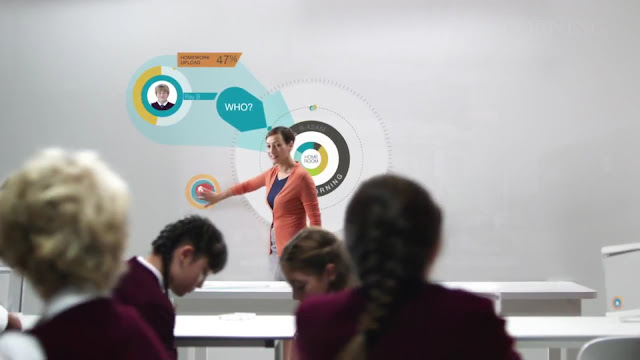
The teacher uses her floor-to-ceiling touch screen to call up today's lesson: A physics lesson on optics. The wall screen also offers room controls (e.g. light dimmer). The teacher's actions on the main screen are mirrored on each students' screen. I don't know what the mirroring function serves: It seems it would distract students from looking at the main screen. [Click on picture to enlarge]

The teacher uses an interactive mindmap diagram to search through different topics. Through a drag-and-drop motion, the teacher transfers a physics activity to a multitouch table. I wonder if all the activities are created and scripted by for-profit education companies. This would leave the teacher hardly any creative freedom in which she could apply her expertise. [Click on picture to enlarge]

The students gather around the multitouch table for an optics activity. The students drag-and-drop color circles to explore additive color combinations. I found it noticeable that the class consists of only ten students. This optics activity could easily be achieved using real coloured glass and a light beam. Physics is about exploring the natural world, for which a computer activity provides no physical evidence. Computer-enhanced activities can be useful when showing phenomena that are too large/small or too fast/slow to experience directly. The goal should not become to replace all real-life experiments with computers simulations, but to carefully decide when which activity is more effective. [Click on picture to enlarge].
 In a later scene, the students are seen on a field trip to a forest where they use their tablet computers for an augmented reality activity. [Click on picture to enlarge]
 The Corning video makes no mention of the costs or durability of these glass-based tablet computers. Given the current financial situations of many public schools, such technology seems only affordable by wealthy private schools (as implied in the video).
The Corning video resembles Microsoft's vision of the classroom of the future:
This video shows visions for home life, school, and work - all using touch sensitive glass that doubles as computer displays. I found the vision for the classroom of the future of particular interest. I'll break the scene down into separate pictures for further discussion.
The video shows two girls in school uniforms entering a modern elementary school building. Upon entering the classroom, they dock their tablet computers in their desks. [Click on picture to enlarge]

This action automatically uploads their homework and takes their attendance (as shown on the floor-to-ceiling screen in the front). The student's desk automatically opens a digital notebook for note taking, a calendar, a virtual keyboard, and a chat folder with student questions. From personal experience, typing on digital keyboards is cumbersome and slow. [Click on picture to enlarge]
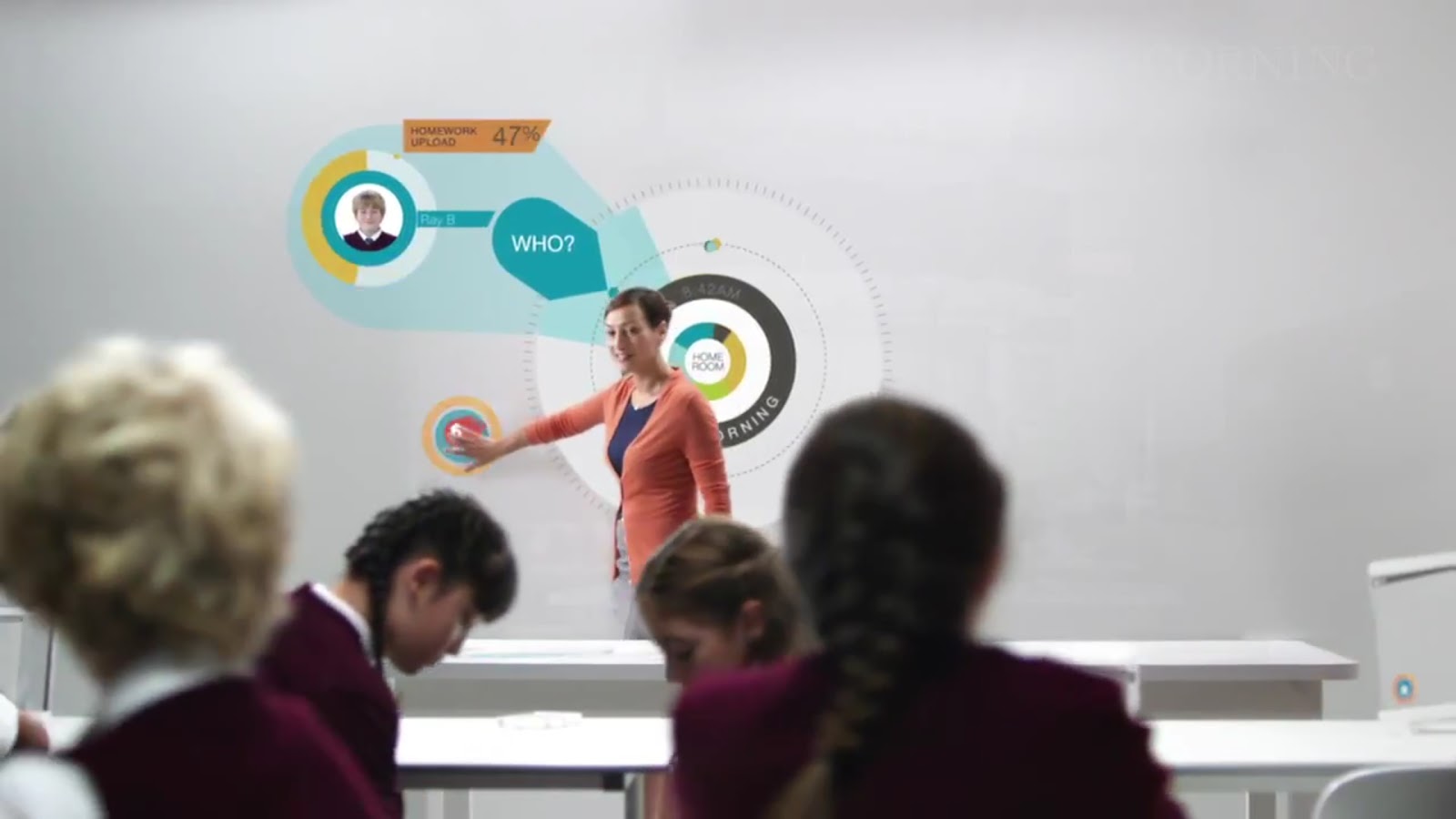
The teacher uses her floor-to-ceiling touch screen to call up today's lesson: A physics lesson on optics. The wall screen also offers room controls (e.g. light dimmer). The teacher's actions on the main screen are mirrored on each students' screen. I don't know what the mirroring function serves: It seems it would distract students from looking at the main screen. [Click on picture to enlarge]

The teacher uses an interactive mindmap diagram to search through different topics. Through a drag-and-drop motion, the teacher transfers a physics activity to a multitouch table. I wonder if all the activities are created and scripted by for-profit education companies. This would leave the teacher hardly any creative freedom in which she could apply her expertise. [Click on picture to enlarge]

The students gather around the multitouch table for an optics activity. The students drag-and-drop color circles to explore additive color combinations. I found it noticeable that the class consists of only ten students. This optics activity could easily be achieved using real coloured glass and a light beam. Physics is about exploring the natural world, for which a computer activity provides no physical evidence. Computer-enhanced activities can be useful when showing phenomena that are too large/small or too fast/slow to experience directly. The goal should not become to replace all real-life experiments with computers simulations, but to carefully decide when which activity is more effective. [Click on picture to enlarge].


The Corning video resembles Microsoft's vision of the classroom of the future:
Friday, January 20, 2012
The Meta-Geek
 |
| Copyright Scott Johnson: http://www.flickr.com/photos/scottjohnson/1190004360/ |
With geek culture becoming more mainstream, a novel form of geek emerges - the meta-geek.
A "meta-geek", or "geek geek", is fascinated with geek culture without being deeply involved in any one sub-culture. Meta-geeks are geeks about geek culture itself.
For example:
- A meta-geek can follow geek-related blogs and watches videos from geek-related events (such as Comic-Con, Dragon-Con, or Star Trek conventions) without going there in person.
- A meta-geek can be knowledgeable about comic characters without reading comics themselves.
- A meta-geek can blog about other geek cultures (for example, see Geek hierarchy chart and Evolution of geek) or read geek-related blogs (for example Geeksaresexy.net or Geekosystem.com).
Monday, October 31, 2011
Microsoft Vision of the Future Video (2011 edition)
This video shows Microsoft's technocratic vision of the future: Augmented reality and technology embedded in glasses, tables, and refrigerators.
Monday, August 15, 2011
Star Trek theme park planned in Jordan

King Abdullah of Jordan, who is a big Star Trek fan and had a brief cameo on an episode of Star Trek: Voyager in 1995, invests 1.5 billion US dollars to build a 74-hectare Star Trek amusement theme park. Construction start is scheduled for 2012.
Read more here: Jordan theme park treks ahead - The National
Sunday, June 19, 2011
Transparent Airbus Airplane of the Future

Airbus showed off their concept airplane that will be efficient and environmentally friendly. By 2050, air travelers can enjoy bio-morphing seats, automated luggage handling, high-tech holographic amenities at your fingertips, acupressure seats, and oh, yeah, a see-through airplane skin.
This goes along well with the airport check-in of the future:
Sources: Airbus 2050 Concept Cabin Has Transparent Skin | Geekosystem
Sources: IATA Checkpoint of the Future (Geekosystem)
Sunday, June 5, 2011
The Immersive Cocoon: Get your own Holodeck
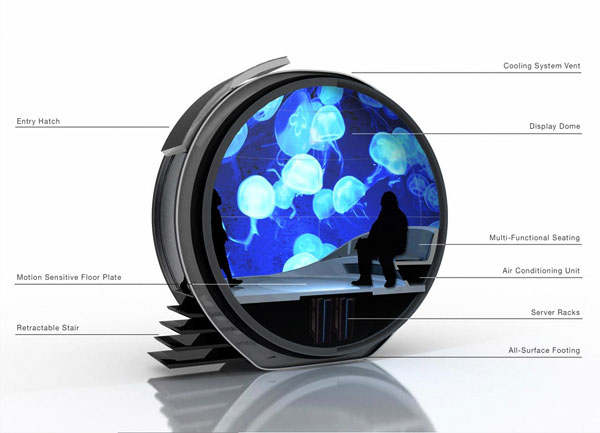
Read more here: The Immersive Cocoon: Your Very Own Holodeck
RIFD tags to track food intake
Designer Hannes Harms suggests to add disposable rfid tags to our food. This would allow to automatically track our food intake.
NutriSmart from HannesRemote on Vimeo.
NutriSmart on Vimeo
NutriSmart from HannesRemote on Vimeo.
NutriSmart on Vimeo
Wednesday, May 25, 2011
Japanese company plans to build a ring of solar panels around the moon

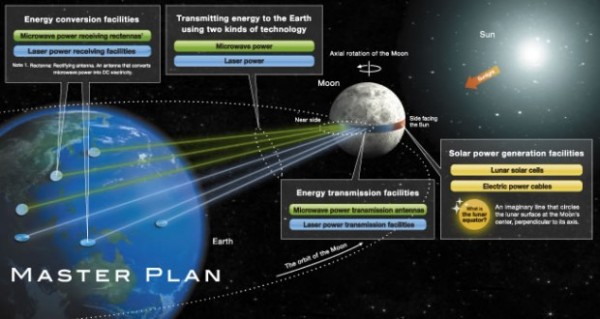

Subscribe to:
Posts (Atom)