
Saturday, May 7, 2011


Education Theories Overview Mindmap

This mindmap is ongoing work in progress. Your feedback and suggestions are welcome.
To navigate the dynamic mindmap below, just click on a term and it will move to the center - showing related concepts. You can also search for terms in the textbox at the bottom.
See this mindmap on the webbrain.com website (where you can find other interesting mindmaps).
Electronic Paper Demo
This video demonstrates a new flexible computer screen.
YouTube - Paper computer shows flexible future for smartphones and tablets
YouTube - Paper computer shows flexible future for smartphones and tablets
Map of Science History
This map, inspired by subway maps, shows leading scientist arranged by discipline.

www.crispian.net/CrispiansScienceMap.html
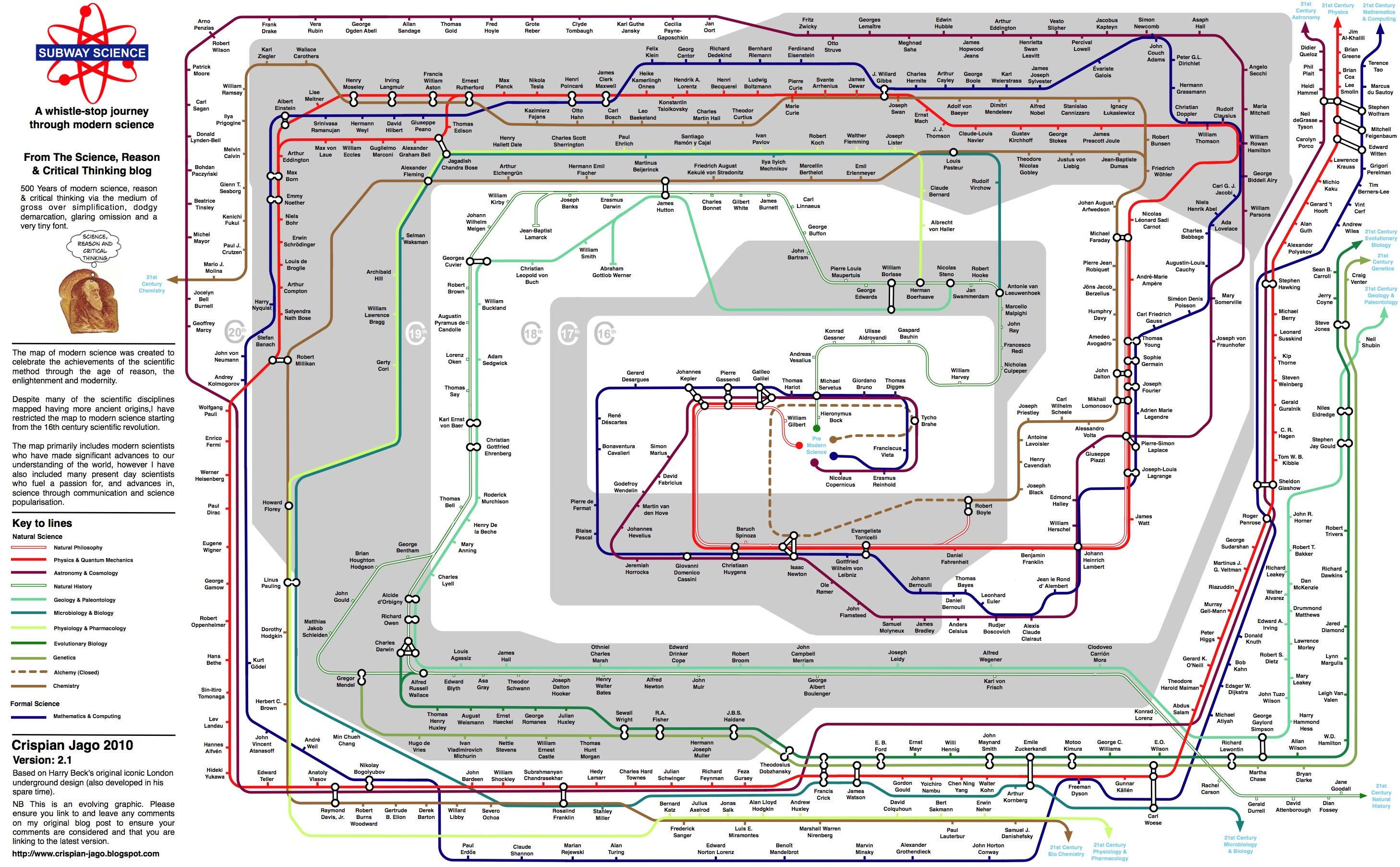
www.crispian.net/CrispiansScienceMap.html
Wednesday, May 4, 2011
Poverty is key factor to improve US education


The popular 2010 education documentary Waiting for Superman suggests that teachers can perform miracles (as seen in movies such as Freedom Writer and Dangerous minds). Former DC schools chancellor Michelle Rhee said, "... even in the toughest of neighborhoods and circumstances, children excel when the right adults are doing the right things for them."
On the other hand, there is evidence that the key factor influencing US education is not teachers (or teacher unions) but students' socio-economic status (a.k.a. poverty). Michael Marder is a professor at the University of Texas and co-director of the university's UTeach program. In 2009, Marder published an article which suggested that "educational outcomes for students from wealthy and poor families are very different in Texas (get article here http://bit.ly/hYbbLe).
More recently, Reeve Hamilton conducted an interview with Michael Marder in the Texas Tribune article titled "Is Poverty the Key Factor in Student Outcomes? (Get article here http://bit.ly/mpkki0). Quote Marder (2011) (Get article here http://bit.ly/fjUquC): "For the short term, preparing teachers in mathematics and science is a wise and useful step toward improving schools. . . . . .[But]. . . As quickly as possible, we must understand the link between poverty and educational outcomes in the US, devise solutions, and test and implement them. Britain briefly tried to substitute public relations for aircraft safety and paid with the loss of its commercial aviation sector. I hope the United States can avoid a similar error, that proponents of teacher quality and charter schools will recognize the weakness of the evidence before it is too late, that we will not damage public education, let down our most vulnerable students, and lose technical leadership we take for granted."
Joe Nocera, a columnist for the New York Times, discusses the influence of poverty on education in his article "The Limits of School Reform".
If poverty is key to educational success, why are education reforms focusing on all other kinds of issues (for example charter schools, teacher unions, student-performance-based teacher salaries, standardized testing, etc.)? I see two reasons: First, poverty might be a key factor to education, but improving the US education system needs a multi-level approach that improves students' socio-economic situation and includes teachers, principals, teacher unions, and policy makers. Second, improving poverty is a problem beyond the range of education reforms on a limited budget. Poverty is a fundamental problem of the US society. Nearly 20 million US children now receive free or reduced-price lunches in the nation's schools, an all-time high, federal data show (Read more here) (In the US, free or reduced-price lunches are used as an index for low socio-economic status of students' families). A large body of research shows that an individual student who is eligible for free or reduced price lunch is at risk for academic failure (Read more here).
Unfortunately, poverty is such a large, complex, and loaded problem that few US politicians dare to address it (as it is strongly related to minority issues and because politicians want to run projects that produce results within their term). Hopefully, the US government, parents, teacher unions, the education research community, and non-profit organizations will increase their existing efforts to improve the situation of students and their families who live in poverty.
The Crux with Educational Jargon

This leads to statements like "Aligned instruction with buy-in by highly qualified teachers for authentic inquiry-based learning and student engagement in professional learning communities will produce 21st century skills in our youngsters."
Does jargon disguise vacuity? Author and blogger John Merrow (The Joys of Educational Jargon) offers this analysis: "I have come to the conclusion that it exists because of a professional lack of esteem. Other professions requiring college degrees have a specific language -- medicine, the sciences, engineering, law. But educators only have plain English, so they change it into a "professional" language that sounds fancy and inaccessible when it ought to be the most accessible profession of all."
While I agree with Merrow that there is an abundance of jargon in education research, it is not because of vacuity. New terms allow to precisely describe new concepts and theories which reflects the research community's increasing understanding of how learning works. Words are vessels for thoughts, and creating new terms allows us to think in new ways.
However, there is a trend for education researchers to develop one's own jargon ("research framework"). For example, I collected a number of terms that all describe the same idea "students' knowledge before receiving formal instruction on a topic":
While I agree with Merrow that there is an abundance of jargon in education research, it is not because of vacuity. New terms allow to precisely describe new concepts and theories which reflects the research community's increasing understanding of how learning works. Words are vessels for thoughts, and creating new terms allows us to think in new ways.
However, there is a trend for education researchers to develop one's own jargon ("research framework"). For example, I collected a number of terms that all describe the same idea "students' knowledge before receiving formal instruction on a topic":
- Prior Knowledge
- Misconceptions (Fisher, 1983),
- Alternative framework (Driver & Easley, 1978),
- Intuitive belief (McKloskey, 1983),
- Preconception (Anderson & Smith, 1983)
- Naive belief (Caramazza, McCloskey, & Green, 1981)
- Alternative ideas (Linn, 2004)
- Naive theories
- Erroneous concepts
- False Beliefs
The saying goes that educational theories and jargon are like toothbrushes: Everyone has one and uses it frequently, but nobody likes to use somebody elses. The crux with educational jargon is that it makes communication within the education research community difficult. More importantly, it makes it more difficult for teachers, policy makers, and the general public to understand education research theories and findings. There is a well-know (unfortunate) disconnect between education research and teachers. Too few education researchers take their time to publish their findings in journals for teachers in an accessible language. Education research could have a much stronger impact on education practice if there would be a shared jargon.
Geek Zodiac
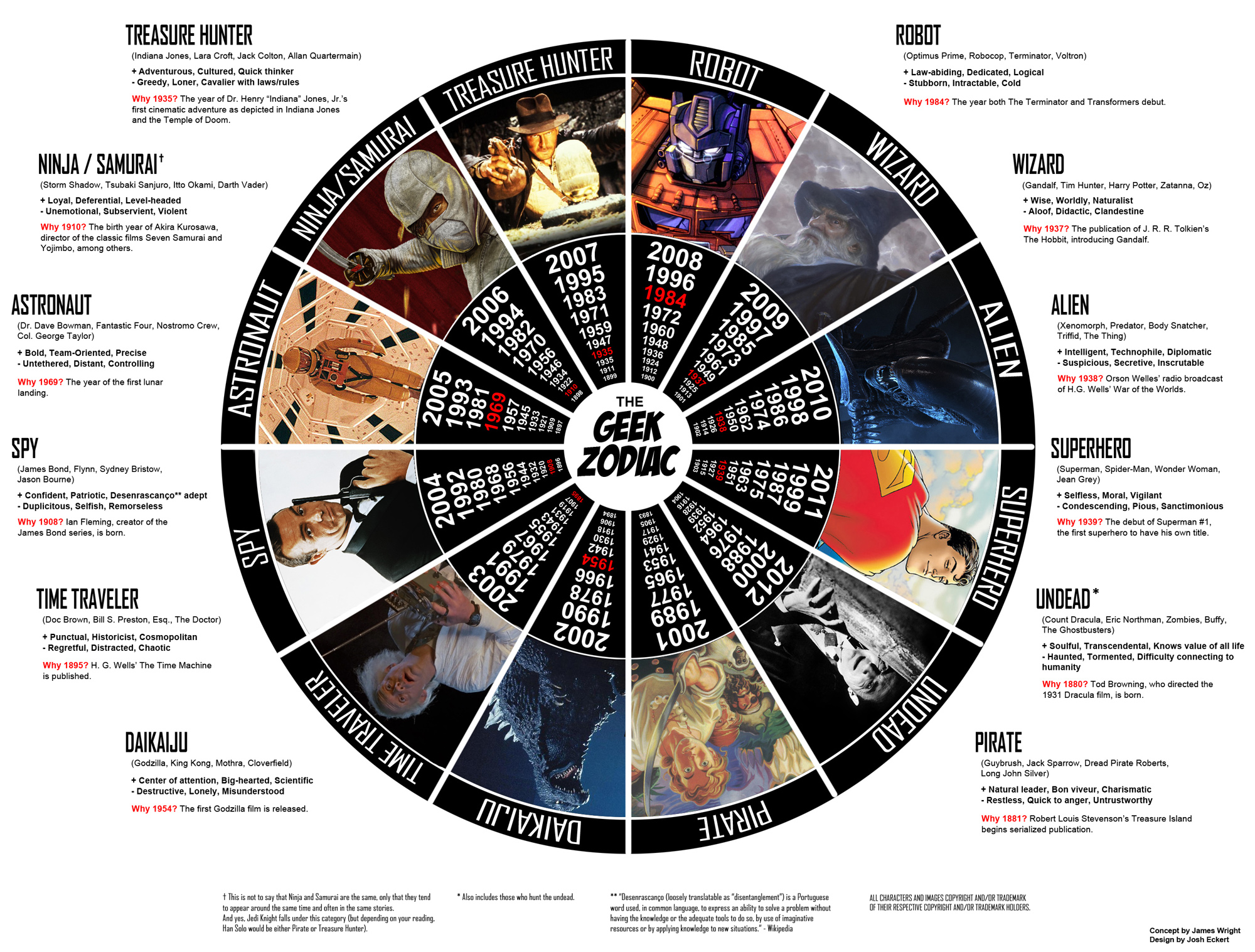
The Geek Zodiac: Concept by James Wright. Design by Josh Eckert.
Source: geekzodiac.jpg (2000×1517)
You might also like:
-The Geek hirarchy chart:
-The Geek Maslow Pyramid of Needs
-The Evolution of Geek
Subscribe to:
Posts (Atom)