Thursday, October 4, 2012

Deconstructing Disney Princesses

by Beat A Schwendimann

Even the Disney Coorporation realized that their pretty-damsel-in-distress-waiting-for-a-prince model of princesses became less and less appealing to current young girls. The latest Disney movie, Tangled, tries to update the image of the princess by making her a stronger self-confident character.
Image from Disney movie "Tangled"
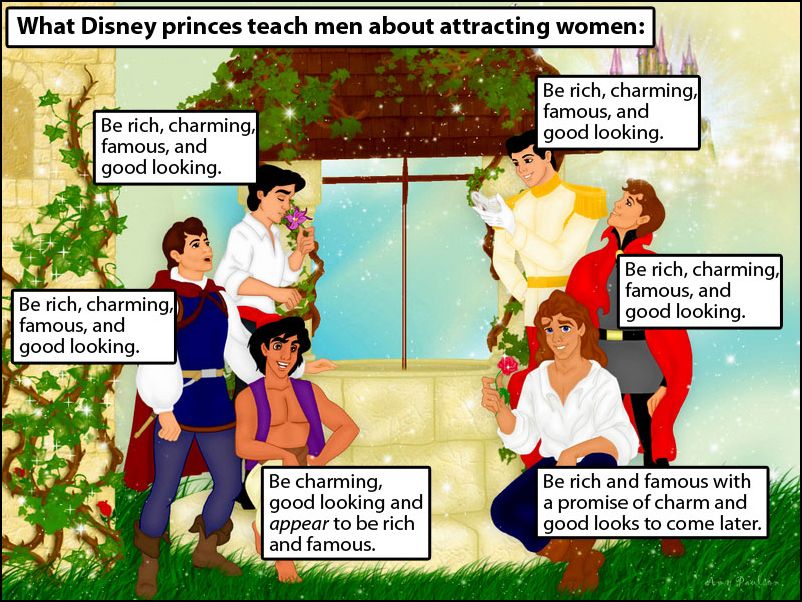
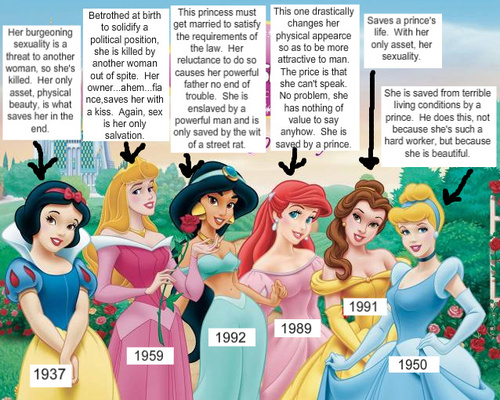
Disney princesses used to be (and maybe still are) role models for many young girls. However, the classic Disney princess presents an outdated stereotypical role model from the past (compare the two pictures below).


This youtube video discusses the gender stereotypes in Disney movies.


Among current girls, princesses and the romanticized ideal they represent — revolving around finding the man of your dreams — have a limited shelf life. With the advent of "tween" TV, the tiara-wearing ideal of femininity has been supplanted by new adolescent role models such as the Disney Channel's Selena Gomez and Nickelodeon's Miranda Cosgrove. "By the time they're 5 or 6, they're not interested in being princesses," said Dafna Lemish, chairwoman of the radio and TV department at Southern Illinois University and an expert in the role of media in children's lives. "They're interested in being hot, in being cool. Clearly, they see this is what society values." (Read full article in the L.A. Times on how Disney is closing the book on classic fairytale characters).

In Fallen Princesses, artist Dina Goldstein took a modern look at the life of a Disney princess by placing her in an environment that accentuates her conflict. The "Happily ever after" is replaced with a more realistic outcome and adresses current issues:

How about the life of a real princess? The life of a real princess does not seem to be much of a fairytale. This article by the Daily Beast: Kate's Royal Prison  describes the life that expects Kate Middleton as the wife of Prince William. Besides having no more private life or being able to say anything original, she is expected to be picture perfect for the rest of her life, every single minute will be monitored and discussed at large in the press. Each of her actions will constantly be compared to those of Queen Elisabeth and Princess Diana. I don't think many young girl would want to become a princess if they would know what it actually entails.

At least Disney princesses can have some fun (Prince Charming optional):

Or Disney princesses can be hipsters:
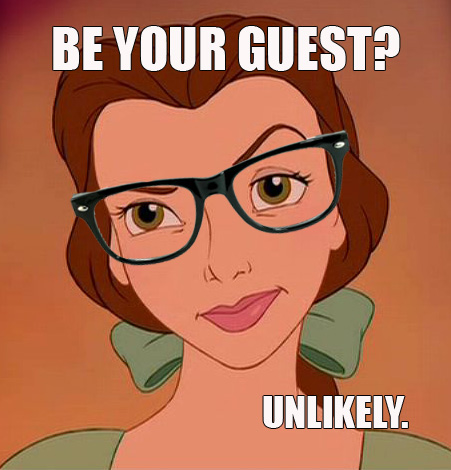
http://www.geekosystem.com/hipster-disney-princesses/
Click here to see the collection of hipster Disney princesses.

Honestly titled Disney movies might look like this:
Hamlet - With Animals
[Source: http://twentytwowords.com/2013/06/07/classic-disney-movies-honestly-retitled-5-pictures/]
See more honest Disney movie titles here.

Disney animators found a cheap way to create new princess characters: They just clone existing ones:

Thursday, September 13, 2012

Fujitsu is building a robot that can beat comprehensive university entrance exams

Todai Robot logo
(Source: http://spectrum.ieee.org/automaton/robotics/artificial-intelligence/fujitsu-trying-to-get-artificial-intelligence-into-university-of-tokyo)
After IBM's Watson computer sucessfully beat human competitors at "Jeoparday", Japanese researchers from Fujitsu are now working on a robot that can pass the comprensive entrance exam of Tokyo University (Todai). The full test involves language, science (physics, chemistry, biology, and geology), history, geography, English (plus some German, French, and Korean), civics (ethics, politics, and economics), and of mathematics. As a first step, the Fujitsu team focuses on solving the mathematical part of the test. This requires the Todai robot to translate natural language problem sets into mathematical formula (See picture below). The team hopes to succeed by 2016 and then extend to passing the full exam by 2024.

Todai robot's procedure to solve math problems
(Source: http://www.fujitsu.com/global/news/pr/archives/month/2012/20120910-01.html)
Source: http://spectrum.ieee.org/automaton/robotics/artificial-intelligence/fujitsu-trying-to-get-artificial-intelligence-into-university-of-tokyo

Microsoft is working on a holodeck for your living room

Microsoft Holodeck Room
[Image: Microsoft/USPTO]
Microsoft filed an US patent in early 2011 for an 'immersive display experience'. It consists of a standard video game system with a connected 'environmental display' capable of projecting a panoramic image that 'appears to surround the user.' Star Trek holodeck, finally!

[Source: http://presurfer.blogspot.com.au/2012/09/star-treks-holodeck-in-your-living-room.html?utm_source=feedburner&utm_medium=feed&utm_campaign=Feed:+presurfer+(The+Presurfer)]

A geographical map of physics from 1939

This map from 1939 depicts physics as a geographical map with different areas (e.g. astronomy, electricity, heat, magnetism, etc.) and scientists as towns (e.g. Galileo, Newton, Leibniz, etc.).

Map of Physics [Click to enlarge]
[Source: http://www.ritholtz.com/blog/2012/09/1939-map-of-physics/]

Friday, September 7, 2012

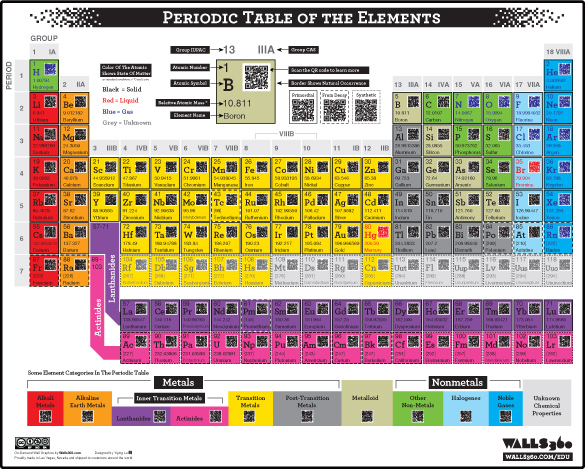
Interactive periodic table of elements with QR codes


Yinging Lu from Walls 360 developed an interactive periodic table of the elements by adding QR codes (linking to Wikipedia) to each element. Students can use their smartphones to quickly access more information about each element.

The periodic table of elements can be downloaded for free or ordered as a poster for pay: http://blog.walls360.com/periodic-table-wall-graphics-from-yiying-lu-plus-free-periodic-table-design-downloads/

Saturday, September 1, 2012

Envisioning Educational Technology of the Future

Educational Technology of the Future [Click to Enlarge]
(Source: http://www.teachthought.com/wp-content/uploads/2012/08/envisioning-the-future-of-education.png)

Michell Zappa and colleagues at Envisioningtech.com created a mindmap to visualize how educational technology might develop over the next 30+ years (See above).
In the visual there are three distinct domains/learning spaces: Classroom, Studio, and Virtual.
Within these domains are 6 sub-domains that represent both areas of growth and characteristics of how learning might change when fused with emerging technologies.
1. Digitized Classrooms: Rather than considering IT a standalone tool or skill, digitization tends to disperse throughout every facet of the classroom.
Examples: tablets, electronic screens, interactive whiteboards, data projectors, 
2. Tangible Computing: Embedding computation to the physical via intelligent objects, the internet of things, and connectivity with a profound impact on learning mechanisms.
Examples: reactive materials, reactive furniture, 3D printers, digitally intermediated field trips
3. Gamification: Billed as an evolution in grading mechanisms, gamification brings instant feedback to acquired knowledge through achievements and points systems.
Examples: student developed apps, educational games, educational programming tools, achievement badges, self-paced learning
4. Virtual/Physical Studios: Bridging the online–offline gap, these future technologies offer a potential future where embodiment is secondary to information access.
Examples: eyewear/HUDs, retinal screens, holography, neuroinfomatics, immersive virtual reality
5. Disintermediation: Undoing the traditional teacher-student model, these technologies offer a scenario where AI handles personalization while teachers focus on teaching
Examples: telepresence, algo-generated lessons, mobile learning platforms, task-assignment algorithms, S2S teaching platforms, assessment algorithms, student-designed learning mechanics
6. Opening of Information: Dissemination of information outside the physical silos of schools and classrooms, offering feedback and assessment to students anywhere.
[The text above is a reprint from: http://www.teachthought.com/technology/6-characteristics-of-tomorrows-classroom-technology/]