Walter Cronkite presents the "Home office of the Future" on March 12, 1967 in an episode of the CBS show "The 21st Century".
Thursday, February 7, 2013


Friday, January 25, 2013
A brief introduction to evolution
This youtube video by "Stated Clearly" introduces the basic mechanisms of evolution.
Tuesday, January 15, 2013
Gallup poll indicates students' loss of interest in school over time
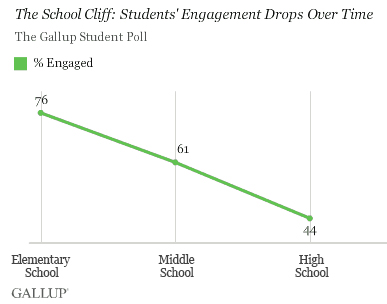
Albert Einstein said that "Education is what remains after one has forgotten what one has learned in school.“ Sadly, a recent Gallup survey of nearly 500,000 students from grades five through 12 from more than 1,700 public schools in 37 US states in 2012 suggests that students increasingly loose their interest in going to school in the first place. By the time students get to high school only about 4 in 10 qualify as engaged.
Larry Ferlazzo rightly points out that this is not a statistically valid survey as there was no random sampling involved; schools and students participated on a volunteer basis. However, the large sample size still provides an interesting dataset.
Another critique point is the measure for the construct "engagement". Here are some sample questions:
8. I have a best friend at school.
9. I feel safe in this school.
10. My teachers make me feel my schoolwork is important.
11. At this school, I have the opportunity to do what I do best every day.
12. In the last seven days, I have received recognition or praise for doing good schoolwork.
13. My school is committed to building the strengths of each student.
14. In the last month, I volunteered my time to help others.
The data however fits well with other surveys who indicated waining interest in STEM education (See http://proto-knowledge.blogspot.com.au/2012/05/usa-fails-to-make-progress-in-stem.html)
Mark Twain suggested: Don't let school interfere with your education.
Source: A Bad Start to Lifelong Learning? - Mission to Learn - Lifelong Learning Blog
Thursday, December 6, 2012
Test your web searching skills
 |
| Connected information [Picture source: http://www.scientificamerican.com/media/inline/semantics-searching-intuitive-internet_1.jpg] |
The internet offers vast amounts of information. The challenge is to find desired information quickly.
These two fun online applications will test your abilities to locate information fast:
"A google a day": Using the google search engine, how quickly do find the answer to question to a given question?
"The Wiki Game": This game asks you to locate information within Wikipedia. The answer can only be found by clicking through related information within Wikipedia pages. The fewer jumps the better.
Want to improve your search skills? Click on the infograph below for helpful Google search tips. [See original infograph here]

Wednesday, December 5, 2012
The future of digital [Slideshow]
This extensive slideshow presents an interesting overview of the history, present, and future of digital spaces. [Click on "Slide Deck" below]
Friday, November 30, 2012
Knowledge Integration Maps (KIM)
 |
| Knowledge Integration Map (KIM) |
Knowledge Integration Maps (KIMs) have been developed at the University of California, Berkeley by Beat A. Schwendimann in the research group of Marcia Linn.
You can learn more about Knowledge Integration Maps in this Wikipedia article.
More about the research on Knowledge Integration Maps in my dissertation (available for free here).
Wednesday, November 28, 2012
Causes for the persistent denial of evolution
 |
| Source: https://blogger.googleusercontent.com/img/b/R29vZ2xl/AVvXsEiWFZbj8Rb3st3cV-wf4VGimgU0IpBZJVnDng91tAoTsL33oegAdf9igjR9kFZn-pvgEqyn97NIT7QOPW_yZhfx98NMrkw4M68pkN1c7I5qiJeQNkXvts7_s6w4PMs6wvpScoZ4g1IHrcg/s1600/denialism.jpg |
Read more here: http://nothinginbiology.org/2012/11/27/science-denial-is-rationa/
Unfortunately, the article doesn't have any concrete suggestions how to better promote scientific understanding and acceptance among religious people.
Subscribe to:
Posts (Atom)