Thursday, February 21, 2013

Imagining the 3D digital bookshelf of the future

How can digital books be displayed more efficiently and aesthetically? Currently, most eBook programs use a 2D bookshelf or an iTunes-like cover flow display. 

2D digital bookshelf
[Source: http://www.authormedia.com/wp-content/uploads/2009/06/shelfari.jpg]

Digital media give us the freedom to explore new ways to display books. Google engineers created the 3D "Infinite Bookshelf". It is a compromise between a traditional bookshelf view while accommodating large amounts of books (One effect of switching from physical books to eBooks is that one can store a much larger collection of books  than one would ever own in physical form). The "Infinite Bookshelf" is an infinite 3D helix that you can spin side-to-side and up and down with your mouse. It holds 3D models of more than 10,000 titles from Google Books. 

Google 3D Infinite Bookshelf
[Source: http://farm7.static.flickr.com/6219/6258962915_b1b16ef550_b.jpg]
Each row represents books belonging to the same genre. The books are organized into 28 genres/subjects. To choose a subject, click the subject button near the top of your screen when viewing the bookcase. The camera then flies to that subject. Clicking on a book shows the cover and the first page with a link to google books and a QR code  that’s in the bottom left corner of the page, using a QR code app likeGoogle Goggles. Try the "Infinite Bookshelf" demo here.

This short video explains the functionality of the bookshelf.


Without physical bookshelves, there is no more shelf-snooping when you visit somebodies home or office. The books we have on display show our intellectual heritage and interests. Discovering that a new acquaintance read the same book is a great start for a conversation. But how can that happen if all our books are stored electronically? Do we give a new acquaintance acces to our shelfari,  goodreads, or calibre accounts? Will we have wall-sized touch-screens displaying our digital libraries?
Browsing Google's Infinite Bookshelf (at Google NY)
Will we have physical book-dummies on display? Once we are all wearing google glasses, will visitors be able to see my personal library displayed on a wall?

While Google's Infinite Bookshelf is an interesting concept, I wonder why a digital 3D library couldn't look more like this:
Clementinum National Library (Czech Republic) 
Jedi Temple Library (aka Trinity College Library, Ireland)
I imagine a 3D digital library that links to my eBook collection (e.g. on goodreads or calibre) and displays books from each genre on a different book shelf (and one shelf for to-be-read). I could give visitors full or partial access to the library and allow them to borrow books. I hope that somebody will take on the task of creating beautiful 3D digital libraries for personal use.

See more pictures of beautiful libraries here and here. 

Tuesday, February 12, 2013

Teaching machines in 1954

Harvard psychology professor B.F. Skinner presents the benefits of self-paced mastery learning using "teaching machines".

Thursday, February 7, 2013

Home office of the future in 1967

Walter Cronkite presents the "Home office of the Future" on March 12, 1967 in an episode of the CBS show "The 21st Century".

Friday, January 25, 2013

Tuesday, January 15, 2013

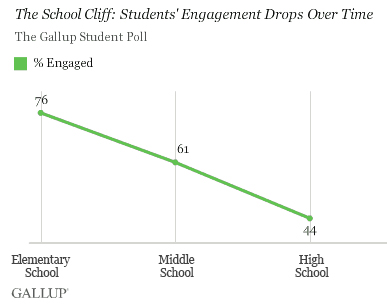
Gallup poll indicates students' loss of interest in school over time


Albert Einstein said that "Education is what remains after one has forgotten what one has learned in school.“ Sadly, a recent Gallup survey of nearly 500,000 students from grades five through 12 from more than 1,700 public schools in 37 US states in 2012 suggests that students increasingly loose their interest in going to school in the first place. By the time students get to high school only about 4 in 10 qualify as engaged.
Larry Ferlazzo rightly points out that this is not a statistically valid survey as there was no random sampling involved; schools and students participated on a volunteer basis. However, the large sample size still provides an interesting dataset.
Another critique point is the measure for the construct "engagement". Here are some sample questions:
8. I have a best friend at school.
9. I feel safe in this school.
10. My teachers make me feel my schoolwork is important.
11. At this school, I have the opportunity to do what I do best every day.
12. In the last seven days, I have received recognition or praise for doing good schoolwork.
13. My school is committed to building the strengths of each student.
14. In the last month, I volunteered my time to help others.
The data however fits well with other surveys who indicated waining interest in STEM education (See http://proto-knowledge.blogspot.com.au/2012/05/usa-fails-to-make-progress-in-stem.html)
Mark Twain suggested: Don't let school interfere with your education.

Source: A Bad Start to Lifelong Learning? - Mission to Learn - Lifelong Learning Blog

Thursday, December 6, 2012

Test your web searching skills

Connected information
[Picture source: http://www.scientificamerican.com/media/inline/semantics-searching-intuitive-internet_1.jpg]

The internet offers vast amounts of information. The challenge is to find desired information quickly.

These two fun online applications will test your abilities to locate information fast:

"A google a day": Using the google search engine, how quickly do find the answer to question to a given question?

"The Wiki Game": This game asks you to locate information within Wikipedia. The answer can only be found by clicking through related information within Wikipedia pages. The fewer jumps the better.

Want to improve your search skills? Click on the infograph below for helpful Google search tips. [See original infograph here]


Wednesday, December 5, 2012

The future of digital [Slideshow]

This extensive slideshow presents an interesting overview of the history, present, and future of digital spaces. [Click on "Slide Deck" below]